Avoiding Pitfalls When Recharging GPT Plus in China: Comparison of Three Methods and a Self-Service Subscription Tutorial
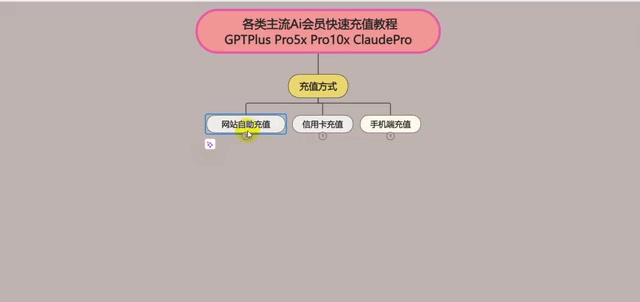
A Bilibili tutorial compares three ChatGPT Plus recharge methods, mainly promoting self-service website recharge while noting risks.
Based on a popular Bilibili tutorial, the article outlines three paths for users in China to subscribe to ChatGPT Plus: self-service website recharge, credit card recharge, and mobile app recharge. The video concludes self-service website recharge wins on price, speed, and privacy, with its core process being to log in to the official GPT website, obtain a Session code, and paste it into the recharge platform—no password needed. Credit card recharge is cited as costly and hard to set up, while mobile recharge is not recommended due to lack of local payment support and cumbersome operation. The article also notes promotional bias, Session credential permission risks, and insufficient stability/refund guarantees of third-party platforms, advising small test orders and keeping receipts.
As GPT-series models continue to iterate, demand among users in China for membership services like ChatGPT Plus shows no sign of slowing. But overseas credit cards present a high barrier, and the third-party recharge market is a mixed bag—so completing a subscription safely and hassle-free has become a pain point for many. A popular tutorial video on Bilibili compared the three mainstream recharge methods currently available in detail and demonstrated what it calls the "most hassle-free" self-service website recharge process. This article, based on that video, lays out a reference guide for avoiding pitfalls.
Side-by-Side Comparison of the Three Recharge Methods
The video categorizes recharge channels on the market into three types: self-service website recharge, credit card recharge, and mobile app recharge. The author's conclusion is clear—self-service website recharge has the overall edge in price, ease of use, and security, making it the most recommended method at present.
Specifically, the advantages of self-service website recharge are several: pricing is more competitive than third-party recharge, the process is short and funds arrive quickly; more importantly, there is no need to hand your account password to a stranger—only account ID-related information is needed to complete the operation, structurally eliminating the risk of privacy leaks and account theft.
Credit card recharge, on the other hand, is explicitly "not recommended" by the author. The reasons are high cost, the difficulty for ordinary people to obtain an overseas credit card, and hidden fees, with the overall rate described as "very high." The problems with mobile app recharge center on cumbersome operation and lack of support for local payment methods such as WeChat Pay and Alipay—novice users easily get stuck at the payment step, and when conditions are poor there is even a risk of losing money outright.
A note here: the video's assessment of the latter two methods carries an obvious promotional bias. Credit card recharge actually has its own advantages in compliance and billing transparency, and readers should judge based on their own circumstances.
The Barrier of Overseas Credit Cards and Virtual Cards
The judgment in the article that "credit card recharge is hard to set up" stems from the fact that OpenAI's payment channel is handled by overseas acquirers, which typically require cards bearing an international organization mark (Visa/Mastercard) and supporting USD settlement and 3D Secure verification. Most domestic dual-currency cards are easily rejected during risk control, which has given rise to virtual credit card solutions (such as Depay, WildCard, etc.): users first top up the virtual card and then bind it to the subscription. These services are not issued by banks and involve card-opening fees, top-up fees, and exchange-rate losses; some platforms also require real-name verification and a minimum deposit, which raises the overall cost. In addition, subscriptions are auto-renewing, so if the card balance is insufficient or the card is frozen, the charge will fail and the subscription will be interrupted—users must manage the renewal pace themselves. Only by understanding this chain can one judge where exactly the claim of "very high rates" comes from.
Step-by-Step Self-Service Website Recharge Process
The video uses a certain recharge website as an example to demonstrate the entire process from product selection to funds arriving, which can serve as a general operational reference for similar platforms.
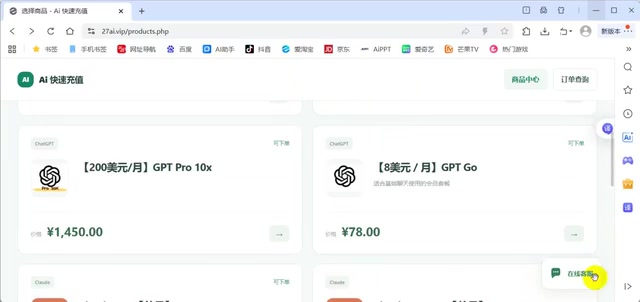
After opening the browser and entering the website, the page lists subscribable AI services, covering mainstream plans such as GPT Plus, GPT Pro 5x, GPT Pro 10x, GPT Go, and Claude Pro. First-time buyers can watch the built-in video tutorial, which is said to take just one minute to learn.
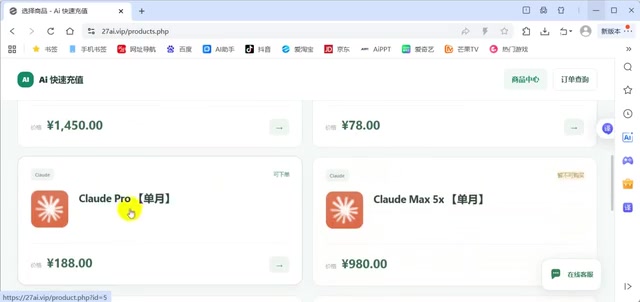
After selecting a plan, enter your email for order tracking, then obtain the account information that needs recharging. The key step is: first log in to the official GPT website in your browser and confirm that the free version is shown in the lower left corner, then return to the recharge website and click to obtain the Session link. If the copied code is relatively short, it means the account is not actually logged in and you need to try again. Copy the complete code (including brackets) from beginning to end and paste it back into the recharge website, confirm the account is correct, then choose a payment method and submit the order.
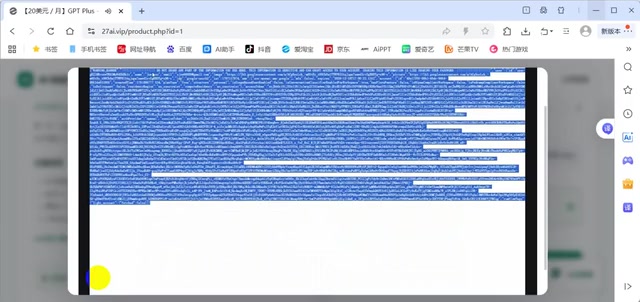
Once the order is processed, the page will show that the recharge was successful; return to the GPT website and refresh to see the Plus badge—if it doesn't appear, refresh a couple more times. The entire process requires no login to the account and no password, which is the security selling point the author repeatedly emphasizes.
The Relationship Between Session and Cookie
The "Session link" mentioned repeatedly in the article is essentially a string of credentials generated after the browser establishes a login state with the ChatGPT official website, usually existing in the form of a Cookie or token. The server relies on it to identify "which logged-in user the current request comes from," without needing a password each time. Therefore, obtaining the complete Session is equivalent to gaining operational permissions for that account during the validity period—able to read conversations, initiate subscriptions, and so on. It is not a one-time verification code; unless the user actively logs out or invalidates all sessions in settings, the credential may remain valid for a long time. This is why a platform's claim of "no password needed" does not equal "zero risk"—the credential itself is a key. When copying and pasting, users should confirm the page source is trustworthy and avoid operating on public computers or in environments with unknown browser extensions.
After-Sales and Risk Warnings
The video mentions that the website provides online customer service; if you encounter problems with recharging, need an invoice, or the recharge fails, you can click the lower right corner to contact customer service.
However, this type of third-party recharge service itself has aspects that warrant caution. Session information is essentially an account login credential, and handing it to a third-party platform likewise means ceding a certain degree of permissions—there is a gap with the claim of "no contact with the account at all." In addition, such platforms are mostly operated by individuals or small teams, with no guarantee of stability, refund policy, or long-term viability. The statement in the video that "funds will arrive 100% of the time" is marketing language; actual experience may fluctuate due to account status, platform risk control, and other factors.
Common Risk Control Types for Third-Party Recharge
Using non-official channels for subscriptions may trigger multiple types of platform-side risk control: first, abnormal payment methods—the same card paying for a large number of accounts in a short period is easily flagged by the acquirer; second, sudden changes in the login environment—subscription activity occurring from a different location or abnormal IP may trigger a secondary verification request or even a temporary restriction; third, subscription revocation—if the payment is deemed a fraudulent transaction (chargeback), Plus benefits may be revoked. These risks are not entirely related to whether the recharge website is "reliable," but are determined by the platform's payment security policies. Users should keep screenshots of orders and payment records; if the subscription drops, first check the account status and then contact customer service, avoiding repeated operations on the same account across multiple platforms, which would exacerbate risk control.
Final Thoughts
For users who genuinely lack overseas payment conditions but need to subscribe to GPT Plus, self-service website recharge offers a relatively low-barrier path, and its "no login, no password" design does reduce the risks of traditional third-party recharge. But when choosing a platform, prioritize services with a longer operating history and genuine user feedback, start with a small test order, keep payment receipts, and stay vigilant against any operation that requires providing a full password or verification code. Taking a rational view of the promotional elements in tutorials is the real way to avoid pitfalls.
One-line Summary
A Bilibili tutorial compares three ChatGPT Plus recharge methods, mainly promoting self-service website recharge while noting risks.
Paragraph Summary
Based on a popular Bilibili tutorial video, the article outlines three paths for users in China to subscribe to ChatGPT Plus: self-service website recharge, credit card recharge, and mobile app recharge. The video concludes that self-service website recharge has the overall edge in price, speed of funds arriving, and privacy security, with its core process being to log in to the official GPT website to obtain a Session code and paste it into the recharge platform, with no account password required throughout. Credit card recharge is cited as costly, hard to set up, and subject to hidden fees, while mobile app recharge is not recommended due to lack of support for local payments and cumbersome operation. The article also reminds readers that the video's assessment carries promotional bias, that ceding a Session credential still implies permission risk, and that third-party platforms lack sufficient stability and refund guarantees; users should start with small test orders, keep receipts, and take marketing language with a grain of salt.
Related articles

Claude May Apply Negative Weight to 'Overly Correct' Solutions
A Hacker News discussion suggests Claude may apply negative weight to 'overly correct' solutions. This article analyzes possible sources—conservative preferences from alignment training, simplicity signals under distribution shift, and implications for practical use and prompt debugging.

Nvidia CEO Jensen Huang to Testify Before US Congress This Week as Regulators Refocus on the Chip Giant
Nvidia CEO Jensen Huang testifies before Congress this week, facing three House committees including Intelligence and Foreign Affairs on Tuesday; General Counsel Tim Teter attends a closed-door session Wednesday.

AI Dating Recording Controversy: Don't Let Algorithms Steal Your Privacy
A hedge fund manager's secret date recording sparks privacy controversy. This article explores the ethical boundaries of AI in social interaction, analyzes the risks of secret recording, and offers advice on responsible AI-assisted socializing.