awesome-LLM-resources: A Comprehensive Analysis of the 8,200-Star LLM Learning Resource Repository on GitHub

A GitHub project with 8,200+ stars offering one-stop learning navigation across the full LLM technology stack.
awesome-LLM-resources is a Chinese-language LLM resource aggregation project on GitHub maintained by WangRongsheng, with over 8,200 stars. The project covers ten core modules including multimodal generation, AI Agents, AI-assisted programming, model training and inference optimization, MCP protocol, and small language models, forming a complete technology stack loop from data processing to model deployment. With strong systematization, good timeliness, and Chinese-language accessibility, it's suitable for AI beginners, engineers, and academic researchers alike.
Project Overview
The pace of Large Language Model (LLM) technology evolution is staggering, and systematically tracking and learning from the latest technical resources is a challenge every AI practitioner and researcher inevitably faces. The awesome-LLM-resources project on GitHub (maintained by WangRongsheng) has accumulated over 8,200 stars, making it one of the most popular LLM resource aggregation repositories in the Chinese-speaking community.
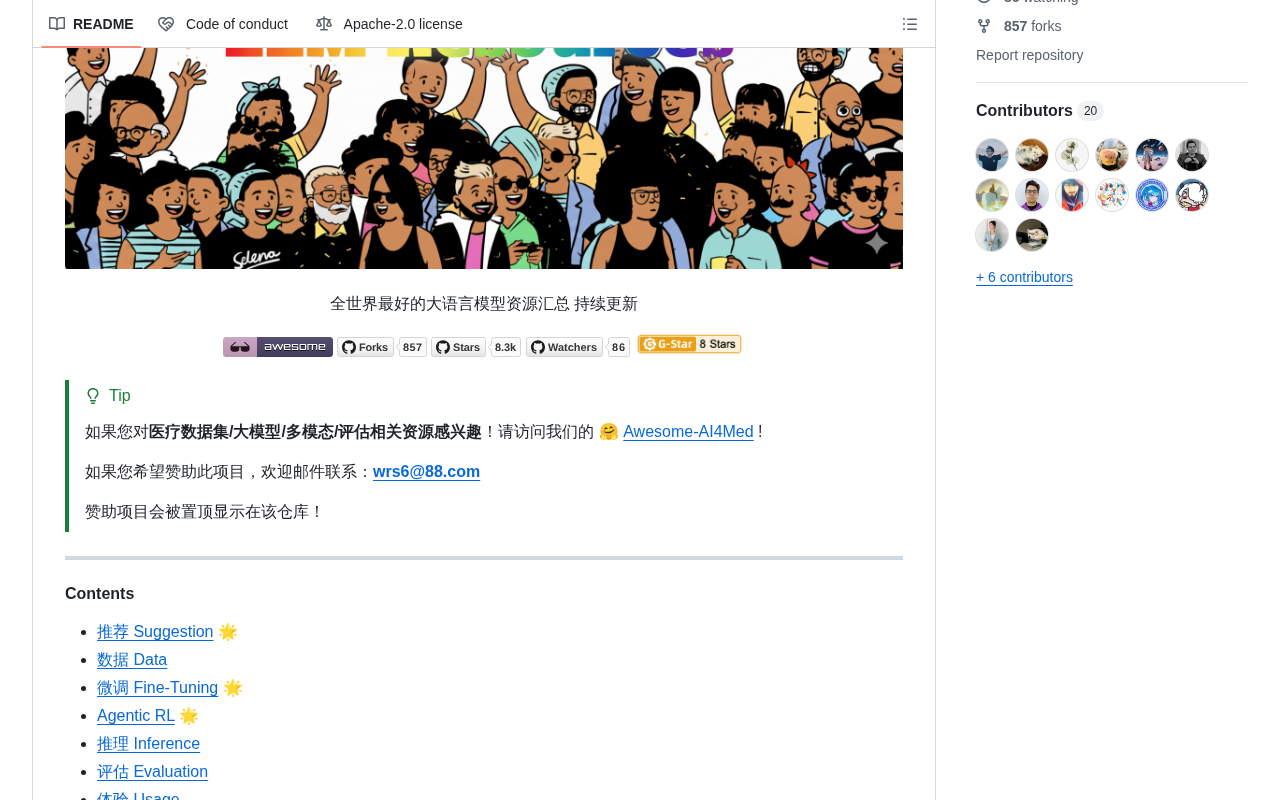
Positioned as "the world's best LLM resource compilation," the project covers the complete technology stack from model training to inference deployment, from multimodal generation to Agent construction — a true one-stop learning navigation for the LLM field.
Deep Dive into Ten Core Modules
1. Multimodal Generation
Multimodal generation is currently one of the hottest research directions in AI. This module brings together cutting-edge papers, open-source projects, and practical tutorials on cross-modal generation including text-to-image, video, and audio. From Stable Diffusion to Sora-like video generation models, the resource coverage is extremely broad, helping developers quickly grasp the latest developments in multimodal technology.
The core challenge of multimodal generation lies in enabling models to understand and generate semantic correspondences between different modalities (text, image, audio, video). Current mainstream technical approaches include: Diffusion Model-based image/video generation (e.g., Stable Diffusion, DALL-E 3), autoregressive multimodal generation based on Transformer architecture (e.g., GPT-4o), and the next-generation generation paradigm based on Flow Matching. Sora, released by OpenAI in 2024, pushed video generation to new heights — its core approach transforms video frames into spatiotemporal patch sequences and uses a Diffusion Transformer (DiT) architecture for denoising generation, demonstrating the enormous potential of scaling laws in the video generation domain. The rapid evolution of these technologies makes the systematic organization of multimodal generation resources particularly important.
2. Agent
In 2024-2025, AI Agents became the industry's biggest trend. This section organizes core resources on agent frameworks, tool calling, and multi-Agent collaboration. Whether it's classic projects like AutoGPT and MetaGPT, or the latest Agent design paradigms, you can find systematic reference materials here.
The core idea of AI Agents is to enable LLMs not only to generate text but also to perceive environments, formulate plans, invoke tools, and execute actions. Their technical architecture typically includes four key components: Planning, Memory, Tool Use, and Action. Planning capability relies on reasoning frameworks like Chain-of-Thought and ReAct; memory systems are divided into short-term memory (context window) and long-term memory (vector databases); tool calling is implemented through Function Calling mechanisms for interaction with external APIs. Multi-Agent collaboration systems like CrewAI and LangGraph further introduce role division, communication protocols, and task decomposition mechanisms, simulating human team collaboration patterns. Understanding these underlying mechanisms helps developers select learning resources more effectively within this module.
3. AI-Assisted Programming
AI-assisted programming is profoundly changing the way software development works. This module focuses on Copilot-type tools, code generation models, automated code review, and other directions, providing rich practical guides and tool recommendations for engineers looking to integrate LLMs into their development workflows.
4. AI Paper Review and Academic Assistance
This is a distinctive module. As the number of academic papers grows explosively, using LLMs to assist with paper review and literature surveys has become an essential need for researchers. This section collects relevant tools and methodologies, offering particularly valuable reference material for academic researchers.
5. Data Processing
"Data is the fuel of AI" — this module covers tools and best practices for the entire pipeline including data cleaning, annotation, augmentation, and synthesis. High-quality training data is the foundation of model performance, making these resources crucial for real-world project implementation.
6. Model Training and Inference Optimization
From pre-training and fine-tuning (SFT/RLHF/DPO) to efficient inference (quantization, distillation, vLLM, etc.), these two modules form the core of LLM engineering. Resources cover distributed training frameworks, parameter-efficient fine-tuning methods like LoRA/QLoRA, and various inference acceleration solutions.
The LLM training pipeline typically consists of three stages: pre-training (learning language knowledge from massive corpora), supervised fine-tuning SFT (aligning with human intent using high-quality instruction data), and alignment optimization (RLHF uses reinforcement learning from human feedback, while DPO directly optimizes preference data to avoid training a reward model). Parameter-efficient fine-tuning methods like LoRA update only a small number of parameters through low-rank decomposition, and QLoRA further combines 4-bit quantization to dramatically reduce memory requirements, making it possible to fine-tune 70B models on consumer-grade GPUs. On the inference optimization side, vLLM optimizes KV Cache memory management through the PagedAttention mechanism, achieving inference throughput near theoretical limits; Speculative Decoding accelerates autoregressive generation by using a small model to draft and a large model to verify. Mastering these technical details helps developers quickly locate solutions suitable for their scenarios within this module.
7. OpenAI o1 Reasoning Model
A dedicated section for the OpenAI o1 series reasoning models, reflecting the importance of the "slow thinking" (Chain-of-Thought reasoning enhancement) technology trend. The module collects in-depth analyses, reproduction attempts, and technical commentary articles related to o1.
The o1 model represents a new paradigm for improving LLM capabilities — Test-time Compute Scaling. Unlike traditional models that improve capability by increasing training data and parameter count, o1 invests more computational resources during inference for "deep thinking." Its core mechanism is that before generating the final answer, the model produces a lengthy internal reasoning chain (Chain-of-Thought), and through reinforcement learning, the model learns to self-reflect, backtrack, and self-correct. This "slow thinking" mode demonstrates significant advantages in mathematical reasoning, code generation, and scientific problems, but also introduces trade-offs of increased inference latency and computational cost. Open-source models like DeepSeekAd-R1 and Qwen-QwQ are also actively exploring this direction, making the resources in this module highly relevant for understanding the capability boundaries of next-generation LLMs.
8. MCP (Model Context Protocol)
MCP (Model Context Protocol) is a model context protocol proposed by Anthropic, aimed at standardizing how LLMs interact with external tools and data sources. The inclusion of this module reflects the project maintainer's keen judgment of cutting-edge technology trends.
MCP was open-sourced by Anthropic in late 2024, with its design inspired by how the USB protocol standardizes hardware devices — establishing a unified communication standard between LLMs and external data sources and tools. Before MCP, every LLM application needed custom integration code for different data sources (databases, APIs, file systems, etc.), resulting in massive duplication of effort. MCP defines three core primitives: Resources (contextual data), Tools (executable operations), and Prompts (templated interactions), implementing standardized connections between LLMs and the external world through a Client-Server architecture. This protocol is rapidly gaining industry adoption — mainstream AI products like Cursor and Claude Desktop have already integrated MCP support, and it is poised to become an infrastructure standard for AI application development.
9. Small Language Models and Vision Language Models
Small Language Models (SLMs) represent the "small but beautiful" technical approach, focusing on edge deployment and efficiency optimization; Vision Language Models (VLMs) focus on image-text understanding and reasoning capabilities. These two directions correspond to the two major trends of LLM technology: lightweight deployment and multimodal understanding.
The rise of Small Language Models (typically referring to models with 1B-7B parameters) is driven by two factors: first, the demand for local AI capabilities on edge devices (smartphones, IoT devices), and second, the finding that through high-quality data and refined training strategies, small models can approach or even surpass large models on specific tasks. Representative works include Microsoft's Phi series and Google's Gemma series. Vision Language Models (VLMs) convert images into token sequences through visual encoders (such as ViT, SigLIP), which are then input together with text tokens into a language model for joint reasoning. Open-source VLMs like LLaVA, Qwen-VL, and InternVL have demonstrated powerful capabilities in chart understanding, OCR, visual question answering, and other tasks, representing a key technical approach for achieving general multimodal understanding. Resources in these two directions are especially important for developers focused on model deployment and practical applications.
Project Value Analysis
Why Is This Project Worth Bookmarking?
Highly Systematic: Unlike scattered technical blogs or paper lists, this project is clearly organized in modular fashion following the logic of the LLM technology stack, forming a complete loop from data processing to model deployment.
Good Timeliness: The project is continuously updated, keeping pace with the latest technical hotspots like MCP and o1 reasoning models. The 841 forks also indicate high community engagement.
Chinese-Friendly: As a Chinese-language community resource aggregation project, it significantly lowers the learning barrier for domestic developers and researchers.
Who Is It For?
- AI Beginners: Quickly build a comprehensive understanding of the LLM technology landscape through the modular resource structure
- Backend/Algorithm Engineers: Find practical tools and solutions in modules on model training, inference optimization, and Agent development
- Academic Researchers: Track cutting-edge papers and technology trends, especially specialized topics like AI paper review and o1 models
- Product Managers: Understand the capability boundaries of LLM technology to provide technical reference for product design
Tips for Effective Use
Facing such a vast resource repository, a "goal-driven" learning strategy is recommended:
- Clarify Your Current Needs: First determine which stage of LLM learning or application you're at
- Focus on a Single Module: Avoid biting off more than you can chew — dive deep into one topic at a time
- Prioritize Practice: Prefer resources that come with code and tutorials — learning by doing is most effective
- Track Continuously: Star the project and check for updates regularly to maintain sensitivity to technology trends
Conclusion
With 8,200+ stars of community endorsement, awesome-LLM-resources has proven its core value as an LLM resource aggregation project. In an era where large model technology changes daily, having a well-structured, continuously updated resource navigation is an invaluable asset for anyone looking to dive deep into the LLM field. Whether you're a newcomer just getting started or an experienced practitioner, this project deserves a place in your bookmarks.
Project URL: https://github.com/WangRongsheng/awesome-LLM-resources
Related articles
 Product Reviews
The Programmer's Desk Setup Guide: Building a Workspace That Feels Like Home
Discover how programmers build productive, comfortable workspaces. From multi-monitor setups to ergonomic design, explore the desk philosophy that drives focus and flow.
 Product Reviews
Qoder vs Cursor Real-World Comparison: Which $20/Month AI IDE Is Better?
Hands-on comparison of Qoder vs Cursor AI IDEs: Agent autonomy, human interaction count, and architecture decisions. Qoder needed only 2 interactions vs Cursor's 8.
 Product Reviews
Cursor Cloud Agent Demo: Eliminating Bottlenecks Across the Entire Software Development Lifecycle
Deep analysis of Cursor's Cloud Agent demo showing how cloud VMs, automated test artifacts, and a full-chain control plane systematically eliminate human bottlenecks across the software development lifecycle.