awesome-LLM-resources: A Large Language Model Learning Resource Repository with 8000+ Stars

awesome-LLM-resources is the most comprehensive LLM learning resource collection on GitHub.
awesome-LLM-resources is a GitHub project with 8200+ Stars maintained by WangRongsheng, serving as a comprehensive resource collection for the LLM field. It systematically organizes high-quality resources across multimodal generation, AI Agents, model fine-tuning (LoRA/QLoRA), inference deployment (vLLM/TensorRT-LLM), o1 reasoning enhancement, MCP protocol, and small language models, covering a complete knowledge system from fundamental theory to cutting-edge applications, suitable for researchers, engineers, and students.
Project Overview
Large Language Model (LLM) technology iterates at breakneck speed, yet high-quality learning resources are scattered across paper repositories, blogs, code repositories, and other corners of the internet. For practitioners, systematically gathering and organizing these materials is a time-consuming and laborious task.
Large Language Models are deep learning models based on the Transformer architecture that acquire powerful language understanding and generation capabilities through self-supervised pre-training on massive text datasets. Since Google published the "Attention Is All You Need" paper proposing the Transformer architecture in 2017, model parameter scales have rapidly climbed from BERT's 340 million to GPT-3's 175 billion, and then to GPT-4's estimated trillion-plus parameters. The iteration cycle in this field has shortened from years to months or even weeks, with new model architectures, training methods, or application paradigms emerging every few weeks, creating serious information overload for practitioners.
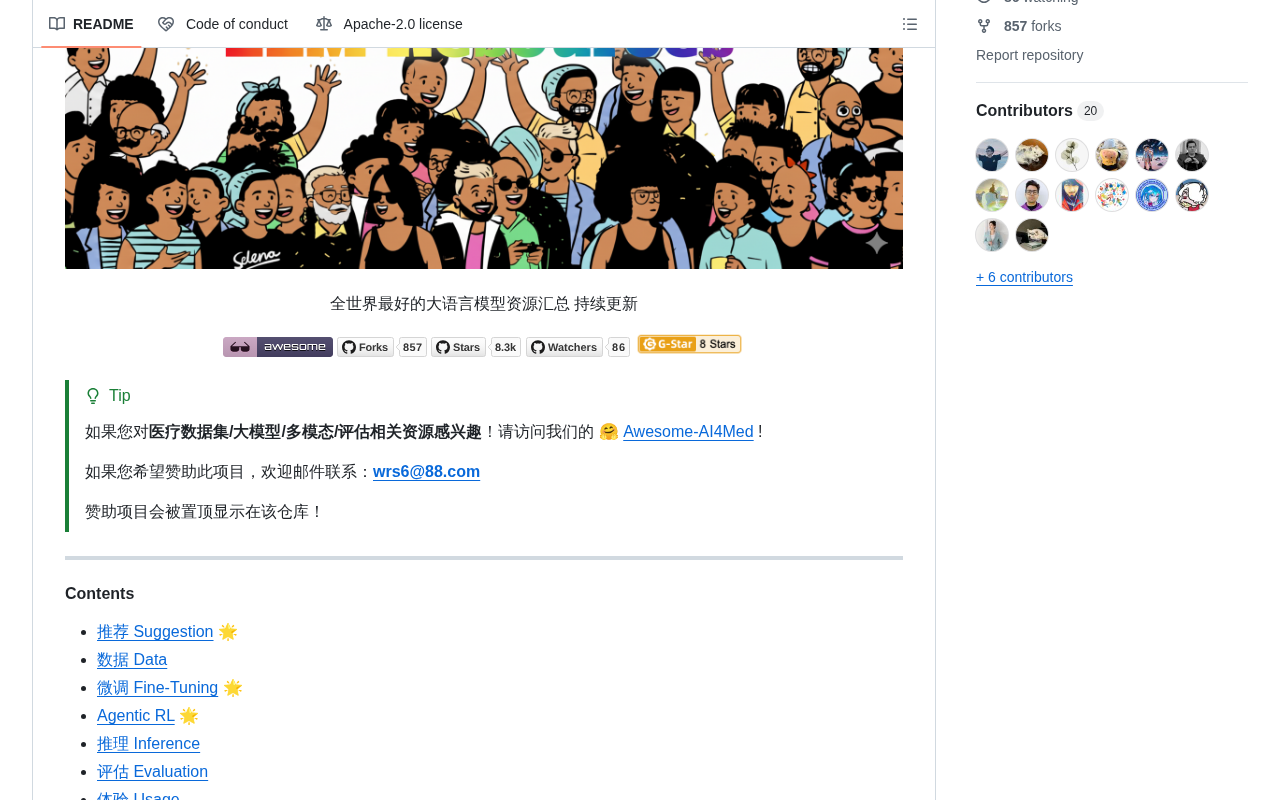
The awesome-LLM-resources project on GitHub was created to solve this problem — it aggregates the highest-quality LLM learning resources from around the world into one place. With over 8,200 Stars and 844 Forks, it's one of the most recognized resource collections in the LLM field.
Maintained by developer WangRongsheng, the project covers a complete knowledge system from fundamental theory to cutting-edge applications. Whether you're a newcomer just getting started or a seasoned researcher, you can find valuable reference materials here.
What Core Areas Does It Cover?
Multimodal Generation and Vision-Language Models
The project includes extensive resources related to multimodal generation, including cutting-edge directions like text-to-image and video generation. Vision-Language Models (VLMs) are a current research hotspot, and the project organizes a complete technical roadmap from GPT-4V to various open-source alternatives, helping developers quickly grasp the latest advances in multimodal AI.
Multimodal generation refers to an AI system's ability to understand and create across different information modalities such as text, images, audio, and video. The core idea behind Vision-Language Models (VLMs) is to connect a visual encoder (such as ViT) with a language model through alignment or projection layers, giving the model both "seeing" and "speaking" capabilities. GPT-4V (GPT-4 with Vision) is a landmark product in this direction, capable of accepting image inputs and performing reasoning analysis. The open-source community has also produced a series of alternatives including LLaVA, InternVL, and Qwen-VL, which use techniques like Visual Instruction Tuning to gradually approach or even surpass closed-source models on multiple benchmarks.
AI Agent and AI-Assisted Programming
AI Agent has been one of the hottest application directions since 2024. This resource repository systematically organizes core technical materials on Agent architecture design, tool calling, and memory mechanisms. The AI-assisted programming (AI Coding) section covers usage tips for tools like Cursor and GitHub Copilot, as well as hands-on experience building code generation systems from scratch.
An AI Agent refers to an AI system capable of autonomously perceiving its environment, making plans, calling tools, and executing tasks — going beyond the traditional "question-and-answer" dialogue mode. A typical Agent architecture contains four core modules: The Planning module is responsible for decomposing complex tasks into executable sub-steps, typically using reasoning strategies like ReAct (Reasoning + Acting) or Chain-of-Thought; the Tool Use module enables the Agent to access external tools like search engines, code interpreters, and APIs to extend its capabilities; the Memory mechanism is divided into short-term memory (conversation context) and long-term memory (historical experiences stored in vector databases), solving the problem of LLMs' limited context windows; and the Reflection module allows the Agent to evaluate its own output and perform self-correction. The emergence of frameworks like AutoGPT, LangChain Agent, and CrewAI has significantly lowered the barrier to Agent development.
Model Training and Inference Deployment
From data processing, pre-training, and fine-tuning to inference deployment, the project provides resources covering the complete model lifecycle:
- Data Processing: Practical tools and methodologies for data cleaning, annotation, and synthetic data generation
- Model Fine-tuning: Tutorials and best practices for parameter-efficient fine-tuning techniques like LoRA and QLoRA
- Inference Acceleration: Comparative evaluations and usage guides for mainstream inference frameworks like vLLM and TensorRT-LLM
LoRA (Low-Rank Adaptation) is a parameter-efficient fine-tuning method proposed by Microsoft in 2021. Its core insight is that the weight change matrix during downstream task adaptation has low-rank properties. Therefore, LoRA doesn't directly update all of the original model's parameters. Instead, it inserts two small low-rank matrices (a down-projection matrix A and an up-projection matrix B) alongside the attention weights in each Transformer layer, and only updates these two matrices during training. This way, a 7-billion-parameter model might only need to train a few million parameters to complete fine-tuning, dramatically reducing memory requirements. QLoRA goes a step further by quantizing the pre-trained model to 4-bit precision storage (using the NF4 data type), then applying LoRA fine-tuning on the quantized model. This makes it possible to fine-tune a 65-billion-parameter model on a single consumer-grade GPU (such as an RTX 4090 with 24GB VRAM). These two techniques have dramatically lowered the hardware barrier for LLM fine-tuning and are the most widely adopted fine-tuning approaches in industry today.
On the inference acceleration side, vLLM is a high-performance inference framework developed at UC Berkeley. Its core innovation is PagedAttention technology — borrowing the paged memory management concept from operating systems, it divides the KV Cache into fixed-size blocks for dynamic allocation, solving the memory waste caused by KV Cache fragmentation in traditional inference, achieving 2-24x throughput improvement over native HuggingFace inference. TensorRT-LLM is NVIDIA's inference optimization solution, deeply integrating NVIDIA GPU hardware features to achieve ultimate inference performance through operator fusion, quantization (INT8/FP8), In-flight Batching (dynamic batching), and other techniques. The choice between the two typically depends on hardware environment and deployment requirements: vLLM is more flexible with a more active community ecosystem, while TensorRT-LLM offers superior peak performance on NVIDIA GPUs.
o1 Model and Reasoning Enhancement Techniques
OpenAI's o1 model pioneered a new paradigm of "chain-of-thought reasoning." The project has a dedicated section tracking the latest research in this direction, including test-time compute scaling, chain-of-thought distillation, and other key techniques.
OpenAI's o1 model, released in September 2024, marks a new phase in LLM development — shifting from "fast thinking" (System 1) to "slow thinking" (System 2). Traditional LLMs have a fixed amount of computation per generated token, while the o1 model introduces the Test-time Compute Scaling paradigm: the model conducts extended internal "thinking" before answering a question, generating a detailed Chain-of-Thought, improving answer quality through repeated deliberation, verification, and self-correction. This means investing more computational resources during inference can continuously improve model performance, breaking the previous assumption that "model capability is primarily determined during pre-training." Chain-of-Thought Distillation (CoT Distillation) is a technique for "teaching" a large model's reasoning process to a smaller model — by having the small model learn from the thought chain data generated by the large model, it improves the small model's reasoning ability without increasing inference costs. Open-source models like DeepSeekAd-R1 and Qwen-QwQ have also made significant progress in this direction.
MCP Protocol (Model Context Protocol)
The MCP protocol proposed by Anthropic is becoming an important infrastructure for AI application development. The project includes MCP's technical specifications, implementation examples, and ecosystem tools, helping developers quickly understand and integrate this standardized protocol.
MCP (Model Context Protocol) is a standardized protocol open-sourced by Anthropic in November 2024, designed to solve the fragmented connectivity between AI applications and external data sources and tools. Before MCP, each AI application needed custom integration code to connect with different data sources (such as databases, file systems, SaaS tools), creating M×N integration complexity. MCP adopts a client-server architecture and defines a unified JSON-RPC communication protocol: MCP Servers encapsulate access capabilities for specific data sources or tools, while MCP Clients (typically embedded in AI applications) communicate with Servers through standardized interfaces. This way, any AI application supporting the MCP protocol can plug-and-play with any MCP Server, reducing integration complexity from M×N to M+N. Currently, mainstream AI products like Cursor, Claude Desktop, and Windsurf natively support the MCP protocol, and commonly used services like GitHub, Slack, and PostgreSQL already have community-maintained MCP Server implementations.
Small Language Models (SLM)
Driven by demands for edge deployment and cost control, small language models have become a research direction that cannot be ignored. The project organizes technical reports and practical application cases for model series like Phi, Gemma, and Qwen, which is especially useful for developers focused on lightweight deployment.
Small Language Models (SLMs) typically refer to language models with parameters ranging from hundreds of millions to several billion, complementing large models with hundreds of billions of parameters. The rise of SLMs stems from two core drivers: First, edge deployment needs — running AI capabilities in resource-constrained environments like smartphones, IoT devices, and edge servers requires sufficiently lightweight models; second, cost control — for many vertical scenarios, the API call cost of using hundred-billion-parameter large models is too high, while domain-fine-tuned small models can often achieve comparable results at one-tenth or even one-hundredth of the cost. Microsoft's Phi series (Phi-3's smallest is only 3.8B parameters) demonstrated through carefully designed "textbook-quality" training data that data quality matters more than data quantity; Google's Gemma series and Alibaba's Qwen series excel in multilingual capabilities and tool calling. Apple's on-device AI capabilities deployed on iPhones and Qualcomm Snapdragon processors with built-in NPU acceleration are both pushing SLMs from research toward large-scale commercialization.
What Makes This Project Stand Out?
Complete Classification System with Clear Knowledge Structure
Unlike scattered blog posts or paper lists, awesome-LLM-resources features carefully crafted categorization by technology stack and application scenarios, forming a complete LLM knowledge map. Regardless of which sub-direction you're focused on, you can find a learning path from beginner to advanced.
High Update Frequency, Keeping Up with the Cutting Edge
The project maintainer keeps a steady update cadence. From early ChatGPT-related resources to the latest MCP protocol, every important technical milestone gets timely resource additions, avoiding the frustrating "bookmarked but outdated" situation.
Practice-Oriented, Not Just a Paper List
Beyond academic papers, the project also includes extensive hands-on tutorials, open-source tools, and engineering best practices. Sections on AI paper review, data processing, and others directly address real needs in research and engineering scenarios — truly delivering knowledge you can apply immediately.
Who Should Use This?
- AI Researchers: Quickly track frontier papers and technical trends, saving literature search time
- Algorithm Engineers: Access practical guides and tool recommendations for model training, fine-tuning, and deployment
- Product Managers: Understand LLM capability boundaries and real-world application scenarios
- Students: Build a systematic knowledge framework of large language models, laying the foundation for job hunting and research
Summary
In today's rapidly evolving LLM landscape, the awesome-LLM-resources project serves as a continuously updated technical map, helping you quickly locate truly valuable learning resources amid the sea of information. The community recognition of 8,200+ Stars already speaks to its quality. If you're engaged in LLM-related learning or work, I recommend bookmarking this project and checking back regularly for new content.
Related articles
 Product Reviews
The Programmer's Desk Setup Guide: Building a Workspace That Feels Like Home
Discover how programmers build productive, comfortable workspaces. From multi-monitor setups to ergonomic design, explore the desk philosophy that drives focus and flow.
 Product Reviews
Qoder vs Cursor Real-World Comparison: Which $20/Month AI IDE Is Better?
Hands-on comparison of Qoder vs Cursor AI IDEs: Agent autonomy, human interaction count, and architecture decisions. Qoder needed only 2 interactions vs Cursor's 8.
 Product Reviews
Cursor Cloud Agent Demo: Eliminating Bottlenecks Across the Entire Software Development Lifecycle
Deep analysis of Cursor's Cloud Agent demo showing how cloud VMs, automated test artifacts, and a full-chain control plane systematically eliminate human bottlenecks across the software development lifecycle.