AWS MCP Server Expands to 6 New Regions: Infrastructure Acceleration for AI Coding Agents

AWS expands managed MCP servers to 6 new regions to reduce latency and meet global data compliance needs.
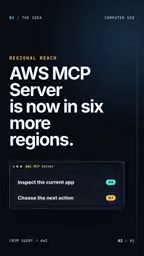
AWS has expanded its managed MCP (Model Context Protocol) server to six new regions: Singapore, Sydney, Tokyo, Ireland, London, and Oregon. MCP servers give AI coding agents a unified interface — eliminating the need to write separate integration logic for each AWS service — through a discover, call, and operate workflow for inspecting infrastructure, provisioning resources, and debugging issues. The expansion delivers two key benefits: lower latency through proximity, and local endpoints that help compliance-sensitive industries like finance and healthcare meet data residency requirements. This official AWS release, backed by production-grade support, signals that cloud providers are now treating AI agent infrastructure operations as a serious, globally distributed workload.
AWS recently expanded its managed MCP (Model Context Protocol) server to six additional regions — a move that has direct implications for the rapidly growing AI coding agent ecosystem. Rather than manually building integrations for each service one by one, MCP servers give agents a unified entry point to discover and invoke a wide range of AWS services.
What Problem Does the MCP Server Solve?
For developers building AI coding agents, the hardest part is often not the model itself — it's making the agent reliably operate external infrastructure. The traditional approach involves hand-writing integration logic for each AWS service, which means a lot of boilerplate code, authentication handling, and error management.
The core value of the AWS MCP server is consolidating all that fragmented work into a single interface. Instead of understanding the unique calling conventions of every service, agents access AWS capabilities through a standardized protocol layer. This aligns with the original design intent of the MCP protocol itself: to establish a universal connectivity standard between AI applications and external tools and data sources.
MCP (Model Context Protocol) is an open protocol standard proposed by Anthropic in late 2024, designed to address the fragmented, "everyone speaks a different language" problem between AI models and external tools and data sources. Before MCP, every AI application that wanted to call an external service had to implement its own custom bridging logic — an extremely high maintenance burden. By defining a unified client-server communication pattern, MCP lets AI models "speak MCP" to interact with any service that implements the protocol — similar to how HTTP works for web applications. The AWS-managed MCP server is an official implementation built on top of this standard. Developers don't need to deploy or maintain the protocol layer themselves; they simply configure a regional endpoint and their AI agents immediately gain the ability to operate AWS resources.
The Discover, Call, Operate Workflow
According to AWS, the MCP server workflow can be summarized in three actions: discover, call, and operate.
Agents can use regional endpoints to inspect existing infrastructure, provision new resources, and debug failures. These three steps cover a complete loop — from exploration to execution to troubleshooting — meaning agents aren't just passively reading information, but can actively participate in resource creation and problem diagnosis.

This design moves AI coding assistants one step closer from being "tools that write code" to being "collaborators that operate cloud environments." When an agent can directly inspect and debug live infrastructure, its practical usefulness in real engineering scenarios increases significantly.
What Do the Six New Regions Mean?
The six newly added regions are: Singapore, Sydney, Tokyo, Ireland, London, and Oregon. The distribution is deliberate — spanning Asia-Pacific, Europe, and North America, covering many of the world's major developer-dense areas.

The regional expansion brings two direct benefits. The first is latency: running services closer to developers geographically reduces round-trip time for agent calls, which matters especially for operations that require frequent interaction. The second is data residency: many enterprises and industries have compliance requirements about where data is stored geographically. Local regional endpoints allow these organizations to use MCP servers while satisfying regulatory constraints.
For teams in the Asia-Pacific region, the addition of Singapore, Sydney, and Tokyo nodes is particularly significant. Developers in these areas previously had to access services cross-region, but can now enjoy a much more localized experience.
Data residency is a core concept in enterprise compliance. It refers to the requirement that data must physically reside within a specific geographic region or legal jurisdiction during processing and storage. Regulations such as the EU's GDPR, Singapore's PDPA, and Japan's Act on the Protection of Personal Information all place explicit restrictions on cross-border data transfers. For financial, healthcare, or government customers, using cloud services without guaranteeing that data stays within the local regulatory region can create compliance barriers or even legal risk. AWS's nodes in Ireland and London cover both the EU and UK regulatory frameworks, while Singapore, Sydney, and Tokyo address localized compliance needs in Southeast Asia, Australia, and Japan respectively. This gives enterprises that were previously on the fence due to data compliance concerns a practical path to deploying MCP servers in production environments.
This Is an Official Release
To be clear, this is an official AWS release dated October 2, 2026 — not a third-party or experimental project. This means it comes with an official support and maintenance commitment, giving developers stronger assurance when adopting it in production environments.

If you're evaluating whether to integrate this into your workloads, it's worth reviewing the endpoint configuration details in the official announcement and confirming whether your target region is on the supported list. Different workloads have different requirements for latency and compliance, so selecting the most appropriate regional endpoint is a critical step before going live.
Summary
This regional expansion isn't a major technical breakthrough in itself, but it reflects a clear trend: cloud providers are treating AI agents' ability to operate infrastructure as a class of workload worthy of serious investment and global infrastructure buildout. As the MCP protocol gradually becomes the de facto standard for connecting AI to external systems, the breadth of coverage and availability of these managed services will directly shape how far AI coding agents can go.
Related articles

Amphibious Transforming Drone: Beyond 100x Power Savings, What Are the Real Needs?
Is the amphibious transforming drone just a gimmick? Starting from the 100x power difference of the M4 Morphobot, explore real application scenarios and thesis topic ideas, analyzing boundary conditions where pure drones and pure ground robots both fail.

Warhound Raises $200 Million: Genetically Engineered "War Dogs" Paired with Anduril Gear
Warhound raises $200M, backed by Ben Lamm and Palmer Luckey, to genetically engineer dogs for military and law enforcement use and equip them with Anduril gear. This article analyzes its technology direction, funding logic, and ethical controversy.

Claude API Comes to Google Cloud: IAM Integration and SDK Access Guide
Anthropic hosts the full Claude API on Google Cloud with IAM-controlled permissions and unified billing. This guide covers the Vertex AI and Anthropic-hosted entry points, IAM role configuration, and SDK access.