Backenly: The Autonomous Backend for AI Coding Agents

Backenly lets AI coding agents autonomously build and maintain a complete backend via MCP.
Backenly is a product that bills itself as "the autonomous backend for AI coding agents," designed to fill the gap where AI agents can only write frontend code while the backend must still be built manually. Agents can build a complete backend covering Postgres, authentication, file storage, cloud functions, and real-time communication directly through MCP. Its key differentiator is a self-healing loop that runs every minute to fix missing indexes, RLS policy gaps, and broken real-time triggers, verifying fixes in real time. As applications grow, the platform refactors the database schema after user approval, with all changes versioned and rollback-supported, keeping humans in control of high-risk changes. It received 81 votes on Product Hunt and ranked 5th, categorized as an open-source developer tool, representing a new infrastructure trend serving AI agents rather than humans.
AI coding agents are changing the way software is built, but most of them only handle writing frontend code. Once the backend comes into play—databases, authentication, storage, functions, and real-time communication—human developers still have to set it up and maintain it by hand. A new product on Product Hunt, Backenly, aims to fill that gap: it bills itself as "the autonomous backend for AI coding agents," letting agents build and maintain a complete backend infrastructure directly through the MCP protocol.
What Is Backenly
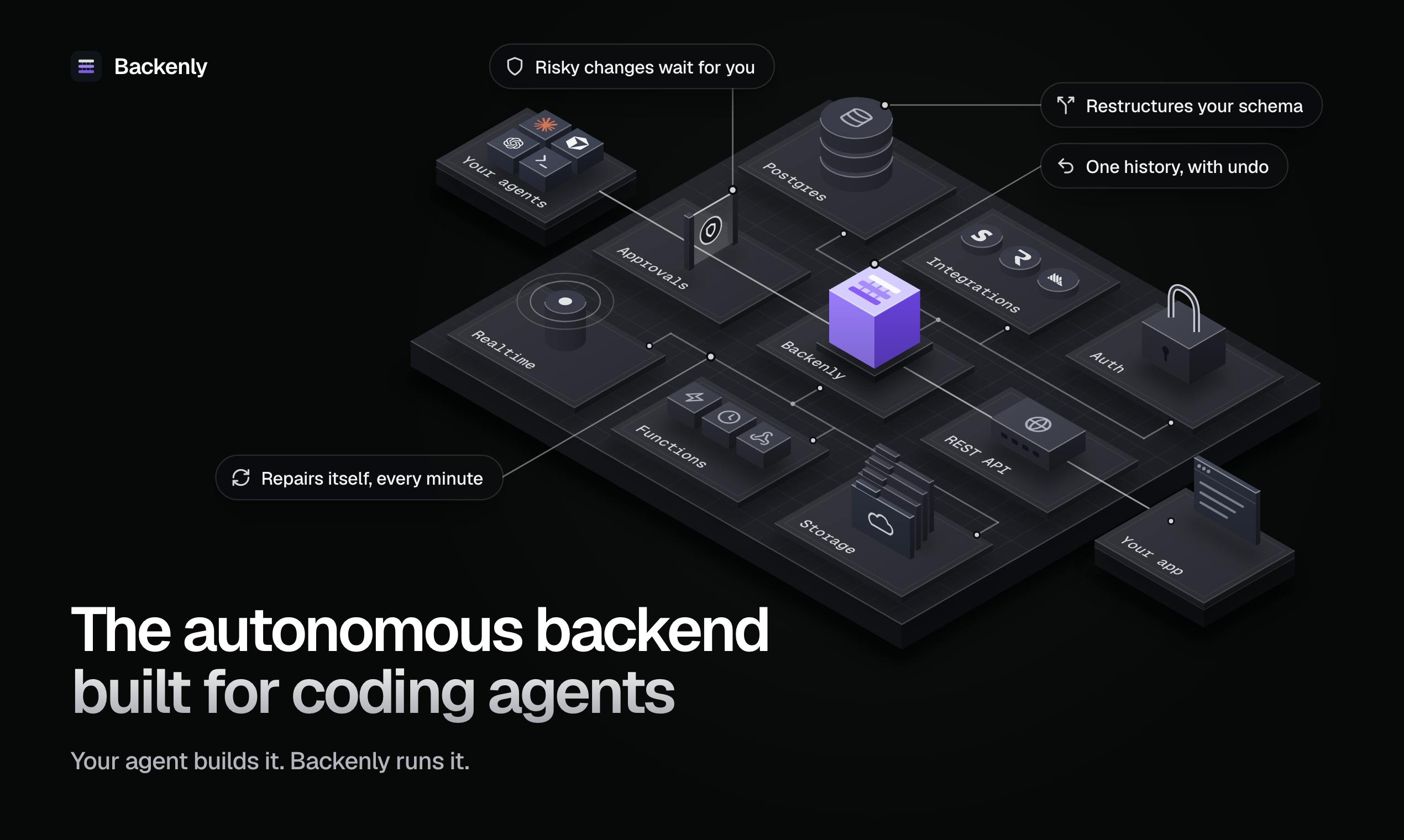
Backenly's positioning is clear: it is not another low-code backend platform, but an autonomous backend designed specifically for AI coding agents. According to its Product Hunt page, coding agents can build backends for applications through MCP (Model Context Protocol), covering the full range of capabilities from Postgres databases, login authentication, file storage, and cloud functions to real-time communication.
This means that when an AI agent is building an application, it no longer needs to stop and wait for a human to configure a database or write authentication logic. The agent can call Backenly directly through MCP and build the backend as part of the process. For workflows that rely on agents to handle end-to-end development, this is a critical piece of the puzzle.
MCP (Model Context Protocol) is an open protocol proposed by Anthropic in late 2024, designed to establish a standardized way for AI models to connect with external tools and data sources. Think of it as the "USB port" of the AI world: in the past, every AI application that needed to connect to a database, file system, or third-party API had to write its own adapter code; MCP defines a unified client-server interaction specification that lets models use external capabilities in a discoverable, callable way. For coding agents, the significance of MCP is this: the agent does not need to learn a proprietary SDK for every backend service—as long as the target platform exposes an MCP server, the agent can autonomously discover available tools and perform operations. Backenly packages itself as an MCP server precisely so that MCP-compatible agents such as Claude Code and Cursor can directly call its database, authentication, and function capabilities. This is the technical prerequisite that makes "agents building their own backends" possible.
Self-Healing: A Health Loop That Runs Every Minute
Backenly's most differentiated capability is "self-maintenance." The platform has a built-in self-healing loop that runs once a minute, automatically fixing missing indexes, row-level security (RLS) policy gaps, and broken real-time triggers, and verifying every change in real time after the fix.
This design targets the most tedious and error-prone parts of backend operations. Missing RLS policies can lead to data leaks, missing indexes slow down queries, and broken real-time triggers make features quietly fail—these problems often do not surface immediately, but they accumulate into hidden risks in production environments. By handing this work to an automated loop, Backenly essentially gives the backend a tireless on-call operator.
Row-Level Security (RLS) is a data access control mechanism natively provided by PostgreSQL. Traditional permission models control "who can access which table," whereas RLS refines the granularity to "who can see which row"—policies are bound to tables as SQL expressions, and the database automatically filters records for each user when executing queries. A typical usage is user_id = auth.uid(), ensuring that users can only read and write their own data. The advantage of RLS is that security logic is pushed down to the database layer, so even if application code has vulnerabilities or is bypassed, the data boundary remains effective. But its risks are also concentrated: once a table forgets to enable RLS or a policy is written incorrectly, the entire table may be fully open to all authenticated users, causing a silent data leak. This is exactly why Backenly includes RLS policy gaps in its minute-by-minute self-healing loop—such problems do not throw errors; they only quietly expand the exposure surface.
Schema Evolution and Risk Control
As an application grows, Backenly will refactor its own database schema after obtaining user approval. This "approve first, then execute" design is crucial: AI autonomously modifying database structures sounds aggressive, but Backenly leaves the decision-making power for high-risk changes in human hands.
At the same time, every change is versioned and supports rollback. For developers accustomed to managing code with Git, bringing database changes under version control is a natural extension, but it is uncommon in autonomous backend products. Combined with the approval mechanism, this design draws a clear line between "agent autonomy" and "human control."
Database schema refactoring has historically been a high-risk operation in production environments. A relational database schema defines table structures, field types, constraints, indexes, and foreign key relationships. Once an application has real data, modifying the schema may involve data migration, table locking, and downtime. For example, adding a non-null column to a large table, changing a field type, or renaming a column may require a full table rewrite, which can take minutes or longer when the data volume is large, during which writes are blocked. Many incidents stem from irreversible migration scripts failing during production execution. As a result, the industry has developed the practice of "migrations as code": recording every change in versioned migration files, validating them in a staging environment first, then applying them in order while preserving a rollback path. By bringing schema evolution into a framework of approval plus versioned rollback, Backenly is essentially transplanting this mature database operations discipline into scenarios where changes are initiated by AI agents.
An Openness Signal for Developer Tools
On Product Hunt, Backenly is categorized as an open-source, developer tools, GitHub, and database product. It received 81 votes and 7 comments, ranking 5th for the day. Although its absolute popularity is not explosive, its "open-source" label is worth noting—for developers who need to connect the backend to their own workflows, open source means auditability and room for customization.
From a broader trend perspective, Backenly represents a new class of infrastructure: not a visual tool serving human developers, but an API-first, protocol-first platform serving AI agents. As more and more code is written by agents, the "users" of backend platforms are themselves shifting from humans to agents, and the product's interaction model and trust model change accordingly—approval, versioning, and rollback are guardrails designed for agents to participate in production environments.
Whether Backenly can become the standard backend layer in the era of AI coding agents depends on whether it can continue to prove itself in terms of openness, reliability, and depth of agent integration. But at least in terms of product thinking, it has precisely hit a new demand that is taking shape.
One-line Summary
Backenly lets AI coding agents autonomously build and maintain a complete backend through MCP.
Paragraph Summary
Backenly is a product that bills itself as "the autonomous backend for AI coding agents," aiming to fill the gap where AI agents can only write frontend code while the backend still needs to be manually built by humans. Agents can directly build a complete backend covering Postgres databases, authentication, file storage, cloud functions, and real-time communication through the MCP protocol. Its differentiated capability is a self-healing loop that runs once a minute, automatically fixing missing indexes, RLS policy gaps, and broken real-time triggers, and verifying the fixes in real time. As an application grows, the platform refactors the database schema after user approval, with all changes versioned and rollback-supported, preserving human decision-making power over high-risk changes. The product received 81 votes on Product Hunt, ranking 5th, and is categorized as an open-source developer tool, representing a new infrastructure trend that serves AI agents rather than humans.
Related articles

DeepSeek Harness in Detail: DIY Your Own Software Like Building with LEGO
What is DeepSeek Harness? Using the metaphor of a car assembly platform, this article explains this equipment system of freely combinable functional modules, analyzes its spatiotemporal composability technical foundation, and shows how ordinary users can DIY exclusive software that does not exist on the market at extremely low cost.

DeepSeek Harness Step-by-Step Tutorial: Master DSH and Its Plugin Ecosystem in 50 Minutes
DeepSeek Harness step-by-step install tutorial: from Node.js environment setup to client installation, covering three plugin install methods — chat, marketplace, and command line — plus practical uses of local file access and plugin extensions.

DeepSeek Open-Sources Super-agent Architecture: A Turning Point for Proactive AI
DeepSeek's open-source Super-agent architecture proposes a new proactive AI paradigm: a central Agent dispatches tasks, sub-Agents execute autonomously, and humans only decide and accept. This article analyzes the watershed between passive and proactive AI, and the implementation logic of proactive Agents in scenarios like short-video lead generation.