BadGCL: A New Threat of Persistent Backdoor Attacks in Graph Continual Learning

Research finds that GCL's knowledge retention mechanisms solidify early backdoors and proposes the BadGCL persistent attack framework.
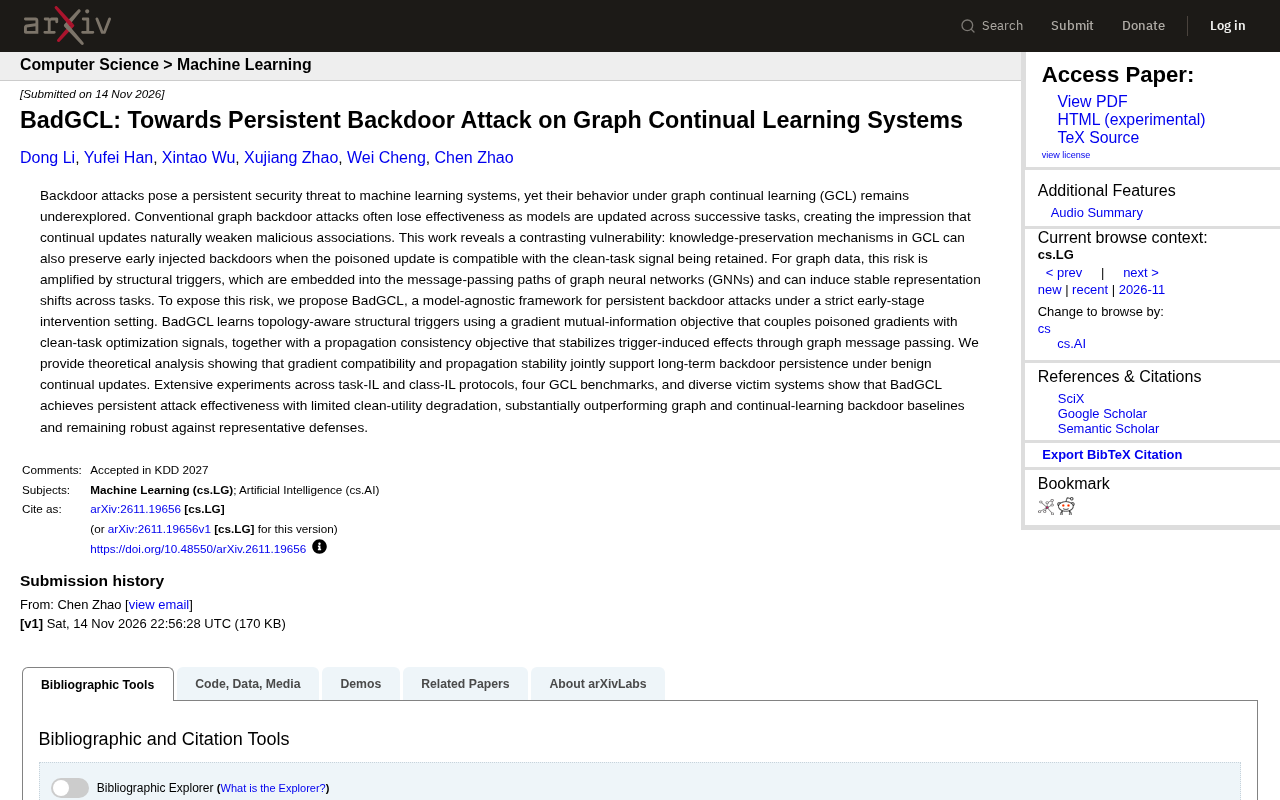
The article introduces a study on Graph Continual Learning (GCL) security risks. Contrary to the conventional view that continual updates dilute graph backdoor attacks, the study shows that when poisoning updates are gradient-compatible with clean tasks, GCL's retention mechanisms protect the backdoor instead. Researchers propose BadGCL, a model-agnostic persistent backdoor framework for strict early-injection settings, using gradient mutual information to align poisoning gradients with normal learning and propagation consistency to stabilize structural triggers. Experiments on task-IL and class-IL protocols across four benchmarks show persistent attacks, limited utility loss, and robustness to defenses.
When Continual Learning Meets Backdoors: An Overlooked Security Blind Spot
Graph Continual Learning (GCL) is widely regarded as a key technique for enabling Graph Neural Networks (GNNs) to continuously absorb new knowledge from dynamic data streams while avoiding catastrophic forgetting. However, a recent study reveals a counterintuitive security risk: the very mechanisms in GCL used to retain old knowledge may also preserve backdoors injected early on. This means that the "stability" a model exhibits during continual updates may be exactly what an attacker hopes for—malicious associations are not diluted but instead solidified.
The conventional view holds that graph backdoor attacks gradually lose effectiveness as the model updates on subsequent tasks, creating the illusion that continual updates naturally weaken malicious associations. But the study points out that when a poisoned update is gradient-compatible with the clean task signals that need to be retained, GCL's knowledge retention mechanism becomes a "protective umbrella" for the backdoor. For graph data, this risk is further amplified by structural triggers—triggers embedded in the GNN's message-passing paths can induce stable representation shifts across tasks.
Graph Continual Learning (GCL) and Catastrophic Forgetting: When a graph neural network sequentially learns multiple tasks on a dynamic data stream, fine-tuning directly on new task data causes a sharp drop in performance on old tasks—a phenomenon known as catastrophic forgetting. Typical GCL countermeasures include regularization (e.g., constraining the update magnitude of important parameters), experience replay (storing and replaying some old samples), and parameter isolation (allocating sub-networks to different tasks). What these mechanisms share is that they explicitly protect "parameters or representations important to old tasks," and this is precisely where the risk revealed by BadGCL originates: if the traces left by early poisoning in the parameter space happen to be judged as "important to old tasks," then the retention mechanism will protect the backdoor along with them.
Graph Backdoor Attacks and Structural Triggers: A backdoor attack refers to an attacker injecting samples with a specific trigger pattern into training data and assigning them a target label, causing the model to output the attacker-specified result when it encounters the trigger while behaving normally on clean data. Triggers on graph data can be either node feature patterns or subgraph structural patterns (e.g., specific node connection patterns). Structural triggers are especially stealthy because they are embedded in the graph topology and diffuse across multiple nodes through GNN message passing, thereby affecting a wider range and being harder to detect by feature-based detection methods.
The BadGCL Framework: Keeping Backdoors "Alive" in Continual Learning
To systematically expose this risk, the researchers propose BadGCL—a model-agnostic persistent backdoor attack framework suitable for a strict early-intervention setting. "Early intervention" means the attacker can inject a trigger only once in the early stage of the learning process, with no further intervention opportunities afterward. This is closer to real threat scenarios than the traditional setting that allows attackers to repeatedly poison data, and it places higher demands on attack persistence.
The core of BadGCL lies in learning topology-aware structural triggers. Unlike traditional methods that rely on fixed subgraph patterns, BadGCL couples the poisoning gradient with the optimization signal of the clean task through a gradient mutual-information objective, making the backdoor update "go in the same direction" as the normal learning process in terms of gradient direction. At the same time, the researchers introduce a propagation consistency objective, which leverages the graph message-passing mechanism to stabilize the effects induced by the trigger, making them less likely to be washed out in subsequent tasks.
Theoretical Support: Gradient Compatibility and Propagation Stability
The work provides a theoretical analysis explaining how gradient compatibility and propagation stability jointly support the long-term survival of the backdoor under benign continual updates. Simply put, gradient compatibility ensures that the poisoning update is not rejected by the optimization process of the clean task, while propagation stability gives the trigger's influence "inertia" on the graph structure. Together, they enable the backdoor to remain active while the model continually learns new tasks.
Experimental Validation: Persistence Across Protocols and Benchmarks
The researchers conducted extensive experiments under two protocols—task-incremental learning (task-IL) and class-incremental learning (class-IL)—based on four GCL benchmarks and multiple victim systems. Results show that BadGCL maintains persistent attack effectiveness while having limited negative impact on clean task utility, significantly outperforming baselines of graph backdoors and continual learning backdoors, and remains robust against representative defenses. These experiments cover different protocols and system configurations, providing strong external validity for the conclusions.
Gradient Mutual Information: Mutual information measures the amount of information shared between two random variables. In BadGCL, the researchers treat the gradients produced by poisoned samples and those produced by clean task samples as two variables and maximize the mutual information between them, which is equivalent to keeping their gradient distributions statistically correlated in the high-dimensional parameter space—that is, making the parameter adjustment direction indicated by the poisoning update as consistent as possible with the direction indicated by normal learning. In this way, when subsequent tasks optimize their own losses, they will not erase the parameter shifts left by poisoning as "noise" but will instead continue to reinforce them along a compatible direction.
Task-Incremental Learning (task-IL) and Class-Incremental Learning (class-IL): These are two classic evaluation protocols in continual learning. In task-IL, the model is told the task ID to which a test sample belongs, and it only needs to discriminate within that task's label set, which is less difficult; in class-IL, no task ID is provided at test time, and the model must distinguish among all learned classes uniformly, making cross-task confusion more likely and the model more sensitive to forgetting. BadGCL verifies backdoor persistence under both protocols, indicating that its attack effectiveness does not depend on explicit information about task boundaries.
Implications for Security Research in Graph Learning
The significance of this study goes beyond proposing a new attack method. Its more important contribution lies in correcting a security assumption: knowledge retention in continual learning does not equate to improved security. For applications built on GCL, such as recommender systems, fraud detection, and knowledge graph updates, the risk of early data poisoning may have been underestimated for a long time. Defense strategies need to be adjusted accordingly—relying solely on model updates to "forget" malicious behavior is unreliable, and backdoor persistence must be considered simultaneously at the levels of data admission, trigger detection, and continual learning mechanism design.
Interestingly, the model-agnostic nature of BadGCL means its ideas may transfer to broader continual learning scenarios, not limited to graph data. This raises new questions for subsequent security evaluation and defense research.
One-line Summary
Research finds that knowledge retention mechanisms in graph continual learning solidify early backdoors, and proposes the BadGCL persistent attack framework.
Paragraph Summary
The article introduces a study on the security risks of Graph Continual Learning (GCL). The conventional view holds that continual model updates dilute the malicious associations of graph backdoor attacks, but the study points out that when poisoned updates are gradient-compatible with clean tasks, GCL's mechanisms for retaining old knowledge instead protect the backdoor. To this end, the researchers propose BadGCL—a model-agnostic persistent backdoor attack framework suitable for a strict setting where the trigger can be injected only once early on. It uses a gradient mutual-information objective to align poisoning gradients with normal learning and a propagation consistency objective to stabilize the effects of structural triggers in message passing. Theoretical analysis shows that gradient compatibility and propagation stability jointly support long-term backdoor survival; experiments under both task-IL and class-IL protocols on four benchmarks show that the attack is persistent, causes limited utility loss, and is robust to defenses. The article concludes that knowledge retention in continual learning does not equal improved security, and defenses must address multiple levels including data admission, trigger detection, and mechanism design.
Related articles

ChatGPT Plus Subscription Pitfall Guide: Go/Plus/Pro Tier Comparison and Quick Activation
A complete ChatGPT Plus subscription guide based on a Bilibili tutorial: from registering an account, comparing Go/Plus/Pro tiers, to the practical steps for quickly completing your subscription.

GPT-6.2 Sol/Astra Released! A Step-by-Step ChatGPT Plus Subscription Guide and Tier Comparison
GPT-6.2 Sol/Astra is out—here's a ChatGPT Plus subscription guide: register an account, compare Go/Plus/Pro tiers, and subscribe in a minute.

Comparing Three Channels for Subscribing to GPT Plus in China: Is Website Top-Up the Easiest?
How to subscribe to GPT Plus in China? This article compares website top-up, credit card, and mobile top-up channels—process, cost, and risk—with steps and tips to help you choose wisely.