agent-usage-guard: An Open-Source Tool to Protect Claude Code Usage Windows

Open-source mod agent-usage-guard monitors Claude Code usage windows and intervenes early near thresholds to prevent long-task interruptions.
agent-usage-guard is an open-source project on Hacker News that addresses AI coding agents like Claude Code exhausting API quotas during long tasks. It monitors token consumption rates within time windows and proactively intervenes near thresholds—pausing requests, prompting users, or guiding agents into low-consumption modes—so agents can save progress, adjust strategy, or wait for window resets. The article notes such tools form the agent runtime governance layer, managing resource boundaries rather than model capabilities, turning post-hoc errors into pre-emptive prevention. However, limited information and lack of documentation or benchmarks mean compatibility and effectiveness remain unverified, making it suitable for small-scale developer experimentation.
agent-usage-guard: An Open-Source Tool to Protect Claude Code Usage Windows
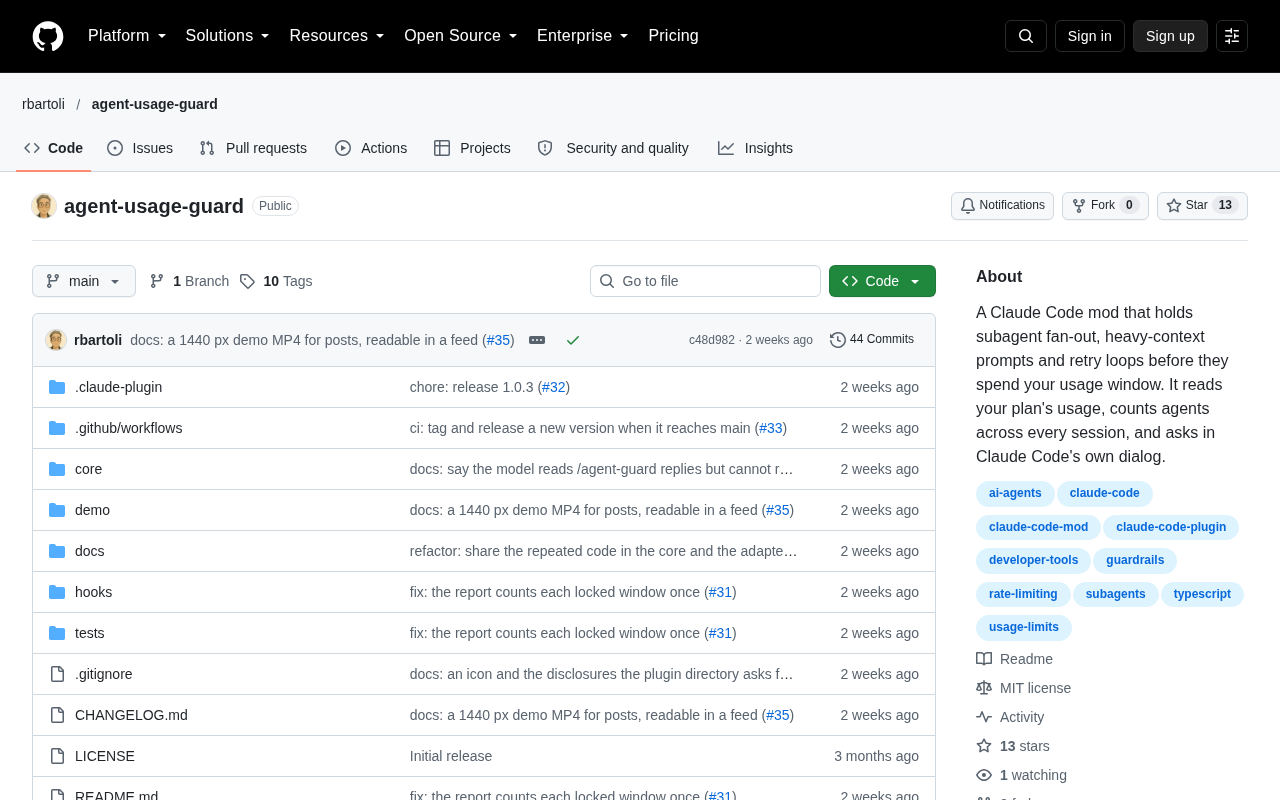
AI coding agents like Claude Code can easily exhaust their API usage quotas during long-running tasks, causing interruptions. The open-source project agent-usage-guard, which appeared on Hacker News, attempts to solve this problem—it monitors usage windows and intervenes proactively when approaching the threshold, preventing the agent from "running out of fuel" at critical moments.
Why Usage Window Protection Is Needed
Claude Code's billing model is typically based on token consumption within a time window. When an agent performs long tasks such as refactoring, batch testing, or multi-file modifications, usage can climb rapidly. Once the limit is hit, subsequent requests are rejected, and the agent stalls or returns errors.
Such interruptions not only waste already-consumed quota but also force users to re-plan their tasks. The idea behind agent-usage-guard is to intervene early when the window is nearly exhausted, giving the agent a chance to save progress, adjust strategy, or wait for the window to reset.
Claude Code's usage windows and billing model: Claude Code typically tracks token consumption over sliding or fixed time windows (e.g., 5 hours, daily, or monthly), with different plans corresponding to different quota limits. When consumption within a window reaches the threshold, subsequent API requests are rate-limited or return errors directly. Understanding this is key: usage limits are not a hard cap on individual requests but a cumulative constraint over the time dimension, which is why agents running continuously for long periods are more likely to hit the ceiling mid-window. For this very reason, agents can recover execution by "waiting for the window to reset," and the core job of a protection tool is to let the agent proactively enter a waiting or throttled state before being rate-limited.
How the Tool Works
According to the Hacker News post, agent-usage-guard operates on Claude Code as a "mod," monitoring the consumption rate of the current usage window. When usage is detected approaching a set threshold, it triggers a protection mechanism—possibly pausing new requests, prompting the user, or guiding the agent into a low-consumption mode.
The specific implementation details are not fully elaborated in the post, but based on its positioning, it belongs to the agent runtime governance layer: it does not change model capabilities but manages resource boundaries. The value of such tools lies in turning "post-hoc errors" into "pre-emptive prevention."
"Mods" and agent runtime governance: Here, "mod" refers to changing Claude Code's runtime behavior through wrapping, hooks, or an intermediate layer without modifying its core code. Typical implementations include intercepting requests sent to the API, reading usage response headers or local logs to estimate remaining quota, and inserting delays, rejecting requests, or rewriting prompts when thresholds are triggered. The advantage of such "peripheral governance" approaches is lower upgrade compatibility costs and the ability to enable or disable them at any time, but the trade-off is reliance on assumptions about upstream interfaces and log formats—once Claude Code adjusts its billing or telemetry methods, the monitor logic may need to be adapted accordingly.
Implications for Agent Engineering
agent-usage-guard reflects a broader trend: as AI coding agents take on increasingly long tasks, resource management is becoming an independent engineering problem. Relying solely on models and prompts is no longer enough—runtime monitoring, quota scheduling, and failure recovery mechanisms are also needed.
Although the discussion on Hacker News (6 comments, 9 upvotes) is small in scale, it touches on real pain points in practical use. For teams that rely on Claude Code for daily development, such lightweight mods offer a low-cost means of risk control.
Resource boundaries and failure recovery for agents: Long tasks for AI coding agents typically consist of multiple rounds of tool calls (reading files, running tests, modifying code), each consuming tokens, and failures often occur in the middle-to-late stages of a task, when consumed quota cannot be recovered. Runtime governance layers therefore need three types of capabilities: usage observability (real-time estimation of window consumption), policy control (rate limiting, pausing, switching to low-consumption modes), and state persistence (saving progress before interruption for resumption). agent-usage-guard's positioning corresponds to the first two, while the third requires the agent framework itself to support checkpoint mechanisms—a dimension worth noting when evaluating the practical value of such tools.
Limitations and Open Questions
Information in the post is limited, and no detailed documentation or benchmarks are yet available. The tool's actual impact on agent workflows, compatibility with different versions of Claude Code, and whether threshold policies are configurable all require further verification. As an early-stage project, it is better suited for developers willing to experiment on a small scale.
One-line Summary
Open-source mod agent-usage-guard monitors Claude Code usage windows and intervenes early when approaching thresholds to prevent long-task interruptions.
Paragraph Summary
agent-usage-guard is an open-source project that appeared on Hacker News, aimed at solving the problem of AI coding agents like Claude Code exhausting API usage quotas during long tasks and causing interruptions. Its approach is to monitor the token consumption rate within a time window and proactively intervene when approaching thresholds—possibly by pausing new requests, prompting the user, or guiding the agent into a low-consumption mode—giving the agent a chance to save progress, adjust strategy, or wait for the window to reset. The article notes that such tools belong to the agent runtime governance layer, managing resource boundaries rather than changing model capabilities, turning "post-hoc errors" into "pre-emptive prevention." It reflects that as AI coding agents take on long tasks, resource management is becoming an independent engineering problem. However, due to limited information in the post and the lack of documentation and benchmarks, compatibility and actual effectiveness remain to be verified, making it currently more suitable for small-scale experimentation by developers.
Related articles

Uber Deploys ChatGPT Work Company-Wide: AI in the Workplace Enters the Scaled Implementation Phase
Uber deploys ChatGPT Work to 30,000+ employees, extending it from engineering to all roles. We analyze its expert-engineer pairing, end-to-end automation, and questions of AI control and power concentration—insights for scaling AI in the workplace.

Shift at Midnight Hands-On: When "ID Verification" Becomes Alien Hunting
Shift at Midnight blends ID verification with horror survival in a four-player co-op game. We break down its inspection mechanics and chaotic humor.

Zelensky Recounts the Outbreak of War: I Need Ammunition, Not a Ride
Zelensky recalls the first day of war in a YouTube interview: farewell to family, rejecting Biden's evacuation offer with "I need ammunition, not a ride," and how Bucha shaped his stance on compromise and peace talks.