Banned by Anthropic, Then Went Viral: How OpenCode Surged to 13 Million Monthly Active Users
Banned by Anthropic, OpenCode's open-source coding agent exploded to 13M MAU and ~$40M ARR in 8 months.
OpenCode, an open-source alternative to Claude Code, has reached 13 million monthly active users and processes 7 trillion tokens per day — surpassing OpenRouter's entire platform. Its breakout moment came when Anthropic tried to block users from routing Claude Code subscriptions through OpenCode, inadvertently turning it into a viral sensation. The team redefines free-tier token spend as CAC, captures bulk model discounts at scale, and counts dozens of Fortune 500 companies as customers — all built on 16 years of persistence and 9 YC applications.
Open-source coding agent OpenCode is rewriting the competitive landscape for coding tools at a breathtaking pace. In a Y Combinator interview, OpenCode founder and CEO (referred to here as JB) revealed a stunning set of numbers: approximately 13 million monthly active users — a 20x increase from the start of the year — and roughly 7 trillion tokens processed per day. For context, the aggregator platform OpenRouter handles around 6 trillion tokens per day across its entire platform. This team, which applied to YC nine times over 16 years, interviewed four times, and only got in back in 2021, has now achieved genuine product-market fit with an open-source alternative to Claude Code.
The Numbers Behind the Explosive Growth
OpenCode's business model has two components: inference services and a subscription product. The token-based inference business, extrapolated from recent data, is on track for roughly $38–40 million in annualized revenue — reached in approximately eight months since launching in late September to early October of last year.
The subscription product is equally impressive. Launched in early March, it has grown to approximately 160,000 paying subscribers per month, representing about $18 million in annualized revenue. For ten dollars a month, users get access to any open-source model on the platform.
Also noteworthy is a shift in how competitors are responding. According to the interview, a lead engineer at Codex tweeted that roughly 5% of Codex subscribers use OpenCode as their primary tool, accessing the underlying API directly. In other words, Codex officially supports OpenCode — users can plug their Codex subscription directly into OpenCode.
OpenRouter is a middleware platform that aggregates APIs from multiple AI model providers, allowing developers to call models from OpenAI, Anthropic, Google, and dozens of other vendors through a single unified interface, without managing multiple accounts and API keys. OpenRouter doesn't train models itself — it acts as a traffic relay, which means its daily token volume serves as a useful benchmark for multi-model usage across the broader developer ecosystem. The fact that OpenCode alone processes more tokens per day than OpenRouter's entire platform signals that OpenCode is no longer just one of many coding tools — it has become one of the single largest entry points driving open-source model consumption, and this comparison directly illustrates the unusual scale it has reached.
How Getting Banned Became the Growth Inflection Point
OpenCode's explosive growth is closely tied to a head-on confrontation with Anthropic. At the start of the year, OpenCode had around 650,000 monthly active users. In the first week of January, the team began hearing rumors that Anthropic was attempting to prevent users from routing through OpenCode while using a Claude Code subscription. The mechanism: any request whose system prompt explicitly contained the word "OpenCode" would be rejected.
From Anthropic's perspective, the logic was understandable — they were effectively subsidizing Claude Code subscriptions. But the move inadvertently elevated OpenCode to the same tier as Claude Code, sending a market-wide signal that OpenCode wasn't just another one of the dozen-odd coding agents out there, but a competitor serious enough to warrant a dedicated countermeasure from Claude Code.
JB drew a classic analogy: when Amazon acquired Whole Foods, the market briefly assumed it spelled doom for Instacart — but the "death knell" narrative actually introduced Instacart to every grocery store in America, ultimately driving explosive growth. The ban brought a flood of users who had never heard of OpenCode to discover it for the first time.
Claude Code is Anthropic's official command-line coding agent. Subscribers pay a fee to use it for code generation, debugging, refactoring, and related tasks via Claude. The subscription pricing includes a token quota that Anthropic subsidizes below market cost, so Anthropic carries real marginal cost exposure on subscription usage. OpenCode, as an open-source alternative, allows users to plug the same Claude Code subscription API credentials into its own platform, effectively bypassing the official client. This "pass-through" usage touches Anthropic's commercial interests, which explains why Anthropic specifically targeted requests containing "OpenCode" in the system prompt — essentially an attempt to confine subscription entitlements to the official toolchain.
An Unprecedented Global Usage Map
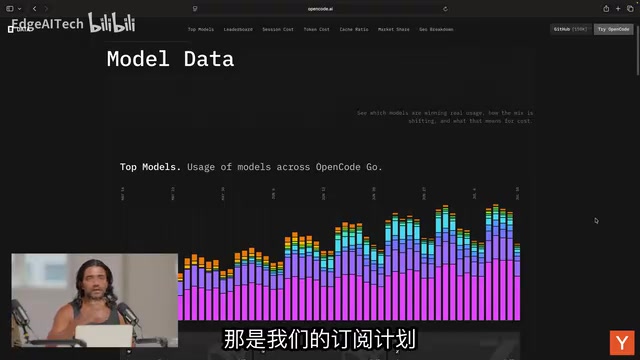
OpenCode may hold the best data in the world on how engineers globally use large language models — and it has made a significant portion of that data public (viewable on its website's data page). What that data reveals is a picture starkly different from the Silicon Valley narrative.
By region, China leads with roughly 17% of the user base — JB joked that OpenCode is probably the only YC company with a large user base in China, partly because many popular open-source models originate there. Developing countries represent a substantial share as well: Indonesia accounts for about 4% of traffic, Brazil about 5%. In places like Vietnam, a $200/month Claude Code subscription is prohibitively expensive, making cheap open-source alternatives especially attractive.
The data also debunks some social media hype. Despite Twitter being full of posts claiming GLM has displaced DeepSeekAd, the token-volume market share chart shows the actual top three are two DeepSeek models plus GLM. DeepSeek Flash is used heavily due to its extremely low cost — when users approach their daily or weekly limits, they switch to these ultra-cheap models to finish remaining work. This stands in sharp contrast to the Western tendency to maximize budgets and burn through compute.
A Distinctive Unit Economics Model
The interview referenced analyst Dylan Patel's claim that Anthropic could hit roughly $50 billion in annualized revenue with approximately 70% margins in a given quarter. OpenCode is moving toward profitability, but via a different path.

The key is a "new form of CAC." Traditional SaaS acquires customers through advertising; OpenCode's acquisition cost is spent on tokens — using the free tier to deliver the "aha moment" of a coding agent to new users. Thanks to its massive processing volume, OpenCode can negotiate bulk discounts from model providers, and when users pay per token, that discount margin converts into profit.
The influx of enterprise customers further validates the product. JB disclosed that over a dozen Fortune 500 companies are using OpenCode at meaningful scale. Their core reason for choosing it isn't cheaper tokens — it's avoiding vendor lock-in to a specific model or toolchain, and preserving the flexibility to switch in the future. When enterprises are proactively pushing you to sign their security agreements, you know you've truly found product-market fit.
Customer Acquisition Cost (CAC) is a core efficiency metric for SaaS companies, traditionally encompassing direct marketing spend like advertising and sales headcount. OpenCode's innovation is redefining the "token compute consumed during the free tier" as acquisition cost: the compute resources used during free trials are, in accounting terms, equivalent to ad spend. This model works under two conditions: first, sufficient scale to secure bulk purchasing discounts from upstream model providers; second, a high enough free-to-paid conversion rate so that lifetime value (LTV) per user covers the upfront token investment. When both conditions hold simultaneously, "burning tokens" stops being pure cost and becomes a customer acquisition channel with a quantifiable ROI.
The Hidden Advantage of Global Distribution

A globally distributed user base also delivers an unexpected competitive advantage. OpenCode has noticed that the gap between peak and trough GPU utilization throughout the day is relatively small — when the East is working, the West is sleeping, and vice versa, creating a remarkably stable 24-hour GPU utilization cycle. This high utilization allows the unit economics of running models to be further optimized in ways that competitors serving only a single region simply cannot replicate.
JB frames OpenCode as a marketplace: users can freely pick from models with different cost and performance profiles, creating a competitive environment among labs that ultimately benefits consumers. He emphasizes that the team doesn't bet on a single winner but instead "bets on the entire open-source ecosystem." In his view, models are commoditizing into utilities — but the market is large enough that each lab will capture its own segment. DeepSeek, for instance, has explicitly chosen to push cost as its defining dimension to the extreme.
16 Years of Running, 8 Months of Explosion

OpenCode may look like an overnight success, but it's built on more than a decade of persistence. The legal entity was founded in 2010 — about 16 years old today. JB started wanting to build a company after reading Paul Graham's essays in college, first encountered YC in 2007, applied nine times and interviewed four times between 2016 and 2021, tried a wide range of ideas, and was finally admitted in 2021 with a Heroku-like serverless platform.
Those detours into dead ends weren't wasted. Running consumer products gave the team deep expertise in user acquisition and data tracking; building terminal UI experience — including one particularly quirky project: a terminal interface for buying coffee — gave them distinctive taste in terminal UX. When OpenCode launched, it deliberately supported multiple models: 70+ models and providers at the time, for which the team created a standalone open-source project, models.dev, to build out the entire database.
The name OpenCode itself was carefully chosen: when there's a dominant player in a market, the rest of the ecosystem tends to coalesce around a single open alternative. Claiming that position is extraordinarily hard to displace once established, and open-source products in particular need to become the default choice as quickly as possible.
JB's closing thought is worth noting: "To catch lightning, you have to have the bottle in the right place first." Spend years developing taste, keep building in public, and when the opportunity arrives, you'll actually be in position to seize it. From zero to tens of millions — ten years of groundwork, eight months of explosion.
Paul Graham is a co-founder of Y Combinator, whose series of startup essays are considered essential reading by founders in Silicon Valley and around the world, covering topics from startup growth logic and founder mindset to product philosophy. YC (Y Combinator) is the world's most influential early-stage startup accelerator, selecting roughly 200 teams per batch from tens of thousands of applications, providing seed funding, mentorship, and alumni networks. Its graduates include Airbnb, Stripe, and Dropbox. Applying repeatedly after multiple rejections is exceedingly rare in YC history — and it reinforces the credibility of this team's story. They weren't accidental participants who rode the AI wave; they are long-term believers who have been thoroughly tested by the market.
Related articles

5 Practical Ways Real Estate Agents Can Use AI to Boost Efficiency (2026 Edition)
How can real estate agents use AI to boost efficiency? Based on a YouTube walkthrough, this breaks down five methods — ChatGPT for listing descriptions, Canva for marketing materials, forms for open house leads, Zapier for automated follow-up, and seller meeting prep — and flags risk boundaries like fair housing laws, photo authenticity, and price verification.

Grok Bot vs ChatGPT Agent: Which AI Agent Is More Powerful?
How does Grok Bot differ from ChatGPT Agent? This comparison examines how they work: Grok Bot has a cloud computer and runs persistently inside tools to execute multi-step tasks automatically; ChatGPT Agent operates web pages in a browser and is more mature at general tasks. Includes selection advice.

Walmart Agent Gateway: AI Shops for You Automatically—Why Is Amazon Going the Opposite Way?
Walmart's Agent Gateway lets ChatGPT, Gemini and other AI assistants access its product catalog to search, compare and add to cart, with spending limits and per-purchase approval. Amazon blocks external AI agents—two retail giants, opposite paths. Currently US-only, India may follow.