Baseten Releases Bison-1 and Groundhog-1, Topping the Decision Model Leaderboard

Baseten releases open-weight decision models bison-1 and groundhog-1 built on Gemma 4, topping the AA Decision Index.
Baseten launches two open-weight decision models, bison-1 and groundhog-1, both built on Gemma 4, with bison-1 scoring 76 on the AA Decision Index v2.1 and ranking first. Both models support a 128k context window and image input, shifting from general conversation to structured judgment—digesting long documents in one pass and combining screenshots and charts as multimodal evidence. The open-weight strategy enables private deployment and domain fine-tuning for compliance-sensitive sectors like finance and risk control. The article cautions that a single benchmark score isn't real business performance and recommends comparative testing on your own data, plus watching toolchain adaptation and the community fine-tuning ecosystem.

Baseten has launched two open-weight decision models, bison-1 and groundhog-1, both built on Gemma 4 and scoring 76 on the AA Decision Index v2.1, taking the top spot on that leaderboard. For developers focused on deploying decision intelligence, this move signals that open-weight models are closing the gap with closed-source solutions on specialized decision tasks.
The shift toward specialized decision models
Traditional language models excel at generation and understanding, but in scenarios that require multi-step reasoning and a clear decision output, their performance often depends on prompt engineering or external orchestration. Baseten's two new models are positioned directly as "decision models," indicating that their training objective has shifted from general conversation to structured judgment.
bison-1 and groundhog-1 share the Gemma 4 foundation, meaning they inherit the architecture's baseline reasoning efficiency while targeted optimization improves decision accuracy. The open-weight strategy lets enterprises deploy in their own environments and avoid data leakage—critical for compliance-sensitive sectors such as finance, risk control, and operations.
Open Weights refers to making a model's trained parameters publicly available so users can download and run, modify, or even retrain it locally or in a private cloud. It is not entirely equivalent to "open source": open source typically also requires publishing training code, data, and a license, whereas open weights only guarantee that the parameters are accessible. For enterprises, the core value of open weights is that data stays in-house, domain fine-tuning is possible, and you are not affected by an API vendor shutting down service or raising prices; the trade-off is that you must bear the inference compute, deployment operations, and safety alignment responsibilities yourself. By releasing decision models as open weights, Baseten is essentially turning "decision capability" from a hosted service into a component that can be embedded in customer infrastructure.
The capability combination of 128k context and image input
Both models support a 128k context window and image input. Long context allows the model to digest a complete contract, log, or report in a single inference without splitting it up and losing cross-section associations; image input extends the basis for decisions from plain text to charts, screenshots, and scanned documents.
The practical value of this combination lies in reducing preprocessing steps. In a ticket-routing scenario, for example, the model can read the text description and an attached interface screenshot at the same time, directly producing priority and routing recommendations. Extending the capability boundary from "text classification" to "multimodal judgment" is an important characteristic that distinguishes decision models from general-purpose models.
A 128k context window refers to the upper limit on the total number of tokens a model can hold in a single inference, roughly equivalent to tens of thousands of Chinese characters or over a hundred pages of a document. It solves the "cross-section association" problem in long documents: references between contract clauses, causal links between events far apart in a log, and consistency of metric definitions before and after in a report no longer need to be stitched together via chunked retrieval. But long context does not equal effective long context—models often utilize information in the middle of very long inputs less effectively, the so-called "lost in the middle" phenomenon. Therefore, when evaluating such models, beyond looking at the window size, you should also test the stability of judgments when key information is placed in different positions within the document.
What the 76 score means on the benchmark
The AA Decision Index v2.1 is a specialized benchmark for measuring decision capability, and bison-1's score of 76 places it at the top. It is important to view this objectively: a single benchmark score cannot fully represent real-world business performance, and leaderboard rankings mainly reflect a model's relative advantage under a particular evaluation distribution.
Nevertheless, an open-weight model topping a specialized leaderboard is itself a signal: it shows that high-quality decision capability is no longer exclusive to closed-source APIs. When selecting models, teams can include open-weight options in their comparisons—especially when fine-tuning or private deployment is required, where the modifiability of the foundation model often has more long-term value than leaderboard rank.
The AA Decision Index is a specialized index within the evaluation system maintained by Artificial Analysis, used to measure model performance on tasks that require a clear judgment output, such as classification, routing, prioritization, and option trade-offs. Such benchmarks typically consist of a set of standardized decision questions, converted into a 0-100 score based on metrics such as accuracy; v2.1 represents the version of the evaluation set or scoring method. The difference between specialized leaderboards and general-capability leaderboards is that they are closer to the scenario of "making a choice given information" rather than open-ended generation. Understanding this helps correctly interpret the 76 score—it reflects a relative level under a specific question distribution, which does not match the category distribution or the proportion of edge cases in real business.
Practical implications for developers
From an engineering perspective, the differentiated positioning of bison-1 and groundhog-1 is worth noting. Deriving two variants from the same foundation usually means offering different trade-offs between accuracy and cost, allowing teams to match according to scenario latency requirements and compute budgets. The 128k context also reduces the engineering complexity of chunking in long-document processing.
Another factor that cannot be ignored is ecosystem maturity. The value of open-weight models depends on toolchain support, including inference framework compatibility, quantization options, and deployment documentation. Baseten, as a model hosting platform launching its own models, has inherent integration advantages in the deployment pipeline, but community adaptation still needs time to be validated.
Selection advice and what to watch
For teams evaluating the deployment of decision models, we recommend running small-scale comparative tests of bison-1 against existing solutions on your own datasets, focusing on judgment consistency under long context and the stability of multimodal input, rather than relying solely on public leaderboard scores.
Going forward, it is worth tracking the reproduction results of the two models on real business benchmarks, as well as the speed at which community fine-tuned versions emerge. The significance of open weights ultimately lies in the efficiency of ecosystem iteration; leaderboard rank is only the starting point.
One-line Summary
Baseten releases open-weight decision models bison-1 and groundhog-1 built on Gemma 4, topping the AA Decision Index.
Paragraph Summary
Baseten launches two open-weight decision models, bison-1 and groundhog-1, both built on Gemma 4, with bison-1 scoring 76 on the AA Decision Index v2.1 and ranking first. Both models support a 128k context window and image input, shifting their positioning from general conversation to structured judgment; they can digest long documents in a single pass and combine screenshots, charts, and other multimodal evidence to produce decision recommendations. The open-weight strategy facilitates enterprise deployment and domain fine-tuning in their own environments, and is especially attractive for compliance-sensitive scenarios such as finance and risk control. The article also cautions that a single benchmark score does not represent real business performance, and recommends that teams run comparative tests on their own data while watching toolchain adaptation and the pace at which the community fine-tuning ecosystem matures.
Related articles
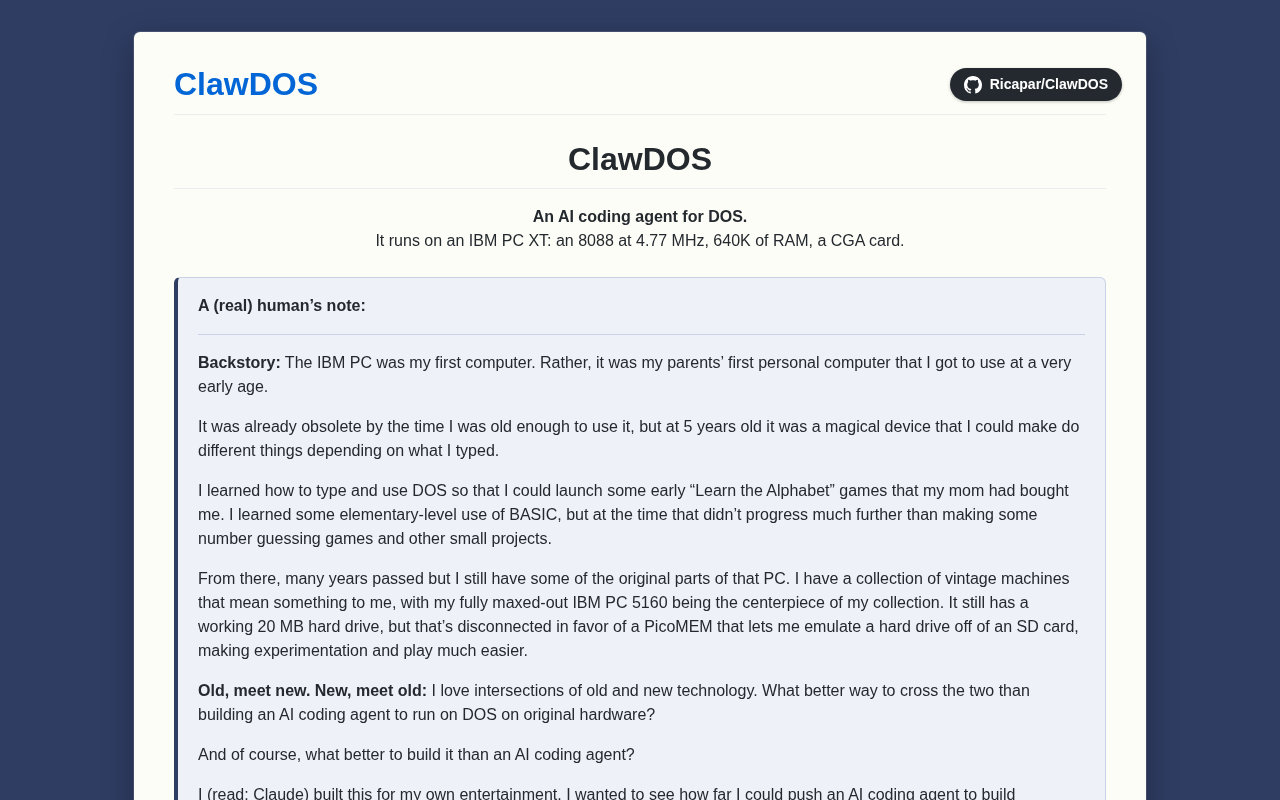
ClawDOS: Bringing AI Coding Capabilities to DOS
ClawDOS is an AI coding agent project for DOS, exploring the possibility of bringing AI coding assistance into resource-constrained retro computing environments. This article analyzes its positioning, use cases, and community response.

Cline CLI v3.0.75 Released: Yolo Mode Now Default for One-Shot Runs
Cline CLI v3.0.75: one-shot runs now default to yolo mode, --timeout and Ctrl+C can interrupt the first round, read_files is no longer truncated to 8k chars, plus reasoning parameter fixes and 94 new providers.

Cline Desktop v0.0.50 Update: Model Catalog Overhaul and Reasoning Control Fixes
Cline Desktop v0.0.50 fixes Reflection Beam 400 errors, misdelivered reasoning parameters, and stuck compaction; read_files no longer truncates to 8k characters; adds 94 providers and changes 67 default models.