ClawDOS: Bringing AI Coding Capabilities to DOS
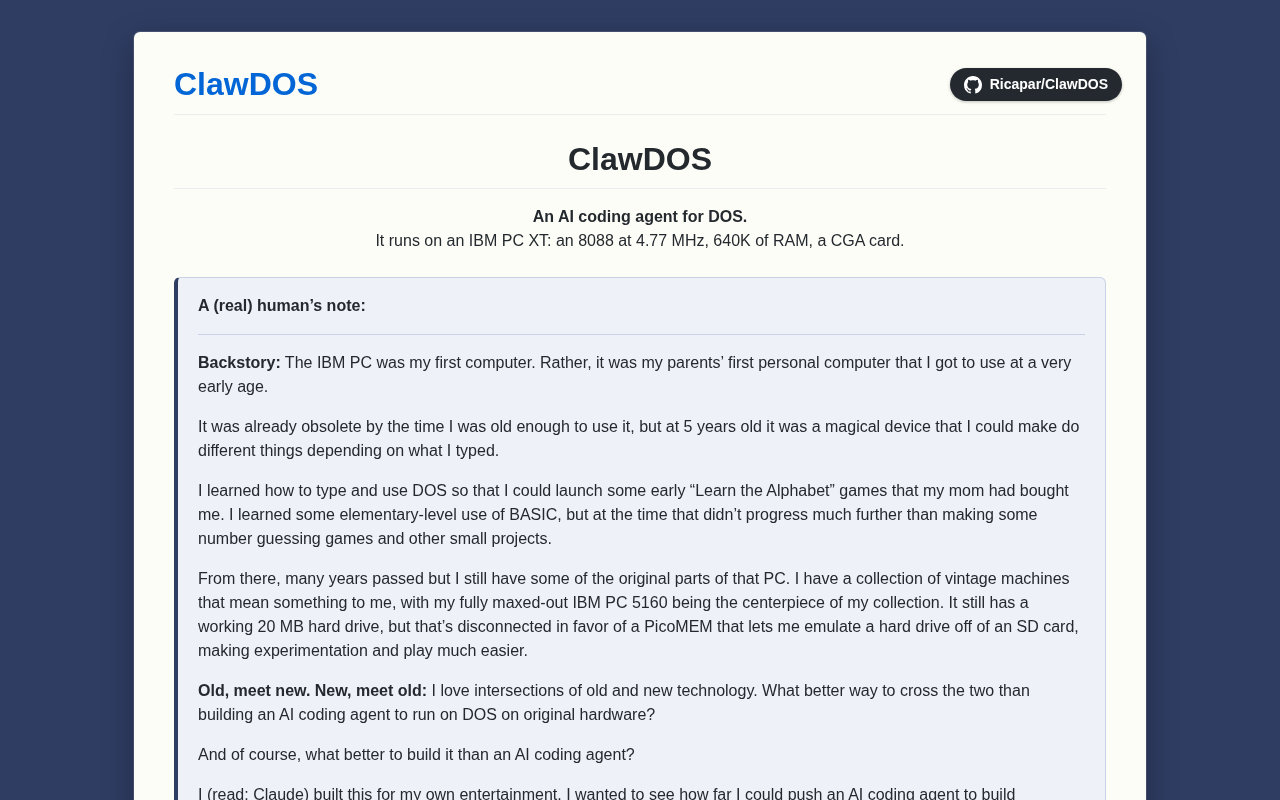
ClawDOS brings AI coding agents into the DOS environment, exploring dimensionality-reduction adaptation in resource-constrained scenarios.
ClawDOS is a project that introduces AI coding agents into the DOS environment, positioned as "An AI coding agent for DOS." Against the backdrop of AI coding assistants generally targeting modern operating systems and cloud IDEs, it goes the opposite direction, rooting itself in the DOS platform that has exited the mainstream yet remains active in special domains such as industrial control, retro computing, and education. Since DOS's memory and compute power cannot run large models locally, its inference most likely relies on external services or network bridging; the interaction interface needs to adapt to a plain text terminal, and the file system needs to be compatible with the FAT system. The project has low traction on Hacker News, with only 14 points and 2 comments, and is still in an early stage, with usability and stability lacking public verification. Its value lies more in demonstrating a "dimensionality-reduction adaptation" approach that breaks down, trims, and embeds modern AI capabilities into edge runtime environments, expanding the imagination of where AI agents can exist.
When AI Coding Assistants Meet DOS
At a time when AI coding assistants almost all target modern operating systems and cloud IDEs, a project called ClawDOS goes the opposite direction—it brings a coding agent to the DOS environment. This project, discussed on Hacker News, isn't particularly hot (14 points, 2 comments), but its direction itself is interesting enough: it tries to answer a question—when the development environment is compressed down to the most primitive command line and text interface, what can an AI agent still do?
ClawDOS positions itself as "An AI coding agent for DOS," an AI coding agent for the DOS system. It doesn't choose Linux, macOS, or Windows as its host, but instead roots itself in a platform that long ago exited the mainstream view yet is still used by retro computing enthusiasts and embedded developers.
Why Build an AI Agent on DOS
The answer to this question lies in the use cases. DOS remains active in several special domains to this day: control terminals for old industrial equipment, preservation-oriented development of retro games and software, demonstrations of "bare metal" concepts in educational settings, and a community of enthusiasts who love tinkering on real hardware. What these scenarios share is limited resources, limited network capabilities, and a runtime environment disconnected from modern toolchains.
The emergence of ClawDOS means that even in these "edge" environments, developers can leverage AI agents to assist with code generation, modification, and debugging. It doesn't aim to replace modern IDEs, but rather to provide a layer of intelligent assistance where modern tools cannot reach.
DOS (Disk Operating System) usually refers to MS-DOS and its compatible systems, the mainstream operating system for personal computers from the 1980s to the mid-1990s. It is characterized by single-tasking, 16-bit real mode, and a command-line interface, with memory addressing limited to 640KB of conventional memory (the so-called "640K barrier"), and a file system based mainly on FAT12/FAT16. Compared with modern operating systems, DOS has no built-in multitasking scheduler, memory protection, or network protocol stack, and drivers often need to directly manipulate hardware ports. For this reason, the DOS environment is extremely unfriendly to modern software stacks, but precisely because it is simple, predictable, and has extremely low startup overhead, it is still used today in embedded industrial control, old POS terminals, hardware diagnostic tools, and the retro computing community. Running any modern AI agent on DOS is essentially redesigning the data pathways and interaction methods on top of this extremely constrained abstraction layer.
Design Orientation and Possible Implementation Approaches
The original information does not disclose the specific technical details of ClawDOS, but from the positioning of "AI coding agent for DOS" it can be inferred that its design must revolve around several constraints: the memory and processing power of the DOS environment are limited and cannot run large models locally, so the agent most likely completes inference through some kind of network bridge or external service; the interaction interface needs to adapt to a plain text terminal; and file system and command compatibility also need special handling for the DOS FAT system.
The value of such projects lies not only in the functionality itself, but also in the way it demonstrates a "dimensionality-reduction adaptation" approach—breaking down and trimming modern AI capabilities, then embedding them into runtime environments that seem impossible.
When implementing AI agents in the DOS environment, an unavoidable constraint is inference compute. Even the smallest quantized language models require hundreds of MB of memory and billions of floating-point operations, far exceeding the addressing and computing capabilities of 16-bit real-mode DOS. Therefore, such projects usually adopt a "thin client" architecture: the DOS side is only responsible for capturing user input, constructing requests, serializing context, and sending requests to an external inference service via a serial port, a network card Packet Driver, or a TCP/IP stack (such as mTCP or WATTCP); the returned text results are then parsed by the DOS side and written to files or displayed on the terminal. This bridging mode is not uncommon in retro computing projects; for example, IRC clients and Telnet tools all adopt similar approaches. The real engineering difficulty lies in: how to manage the conversation context buffer under conditions of no protected mode and no virtual memory, and how to make the agent's file editing operations compatible with FAT's 8.3 filename and line-ending conventions.
Community Response and Points to Watch
The discussion on Hacker News is very small, and the only 2 comments are not enough to form a systematic evaluation. This means ClawDOS is still at an early stage, and its usability, stability, and actual development efficiency all lack public verification. For readers interested in exploring the boundaries of AI tools, this project is worth observing as a sample; but if you expect to put it into production use immediately, you need to evaluate it carefully.
From a broader perspective, ClawDOS represents a niche but persistent type of attempt: bringing AI coding capabilities down to lower layers of the computing stack. Such projects may not become mainstream, but they expand the imagination of "where AI agents can exist."
One-line Summary
ClawDOS brings AI coding agents into the DOS environment, exploring dimensionality-reduction adaptation in resource-constrained scenarios.
Paragraph Summary
ClawDOS is a project that introduces AI coding agents into the DOS environment, positioned as "An AI coding agent for DOS." Against the backdrop of AI coding assistants generally targeting modern operating systems and cloud IDEs, it goes the opposite direction, rooting itself in the DOS platform that has exited the mainstream yet remains active in special domains such as industrial control, retro computing, and education. Since DOS's memory and compute power cannot run large models locally, its inference most likely relies on external services or network bridging; the interaction interface needs to adapt to a plain text terminal, and the file system needs to be compatible with the FAT system. The project has low traction on Hacker News, with only 14 points and 2 comments, and is still in an early stage, with usability and stability lacking public verification. Its value lies more in demonstrating a "dimensionality-reduction adaptation" approach that breaks down, trims, and embeds modern AI capabilities into edge runtime environments, expanding the imagination of where AI agents can exist.
Related articles

Baseten Releases Bison-1 and Groundhog-1, Topping the Decision Model Leaderboard
Baseten releases open-weight decision models bison-1 and groundhog-1 built on Gemma 4; bison-1 scores 76 on the AA Decision Index v2.1 to top the leaderboard. Both support 128k context and image input—here we analyze their capability combination, benchmark significance, and selection advice for developers.

Cline CLI v3.0.75 Released: Yolo Mode Now Default for One-Shot Runs
Cline CLI v3.0.75: one-shot runs now default to yolo mode, --timeout and Ctrl+C can interrupt the first round, read_files is no longer truncated to 8k chars, plus reasoning parameter fixes and 94 new providers.

Cline Desktop v0.0.50 Update: Model Catalog Overhaul and Reasoning Control Fixes
Cline Desktop v0.0.50 fixes Reflection Beam 400 errors, misdelivered reasoning parameters, and stuck compaction; read_files no longer truncates to 8k characters; adds 94 providers and changes 67 default models.