Batch Release of Uncensored Qwen3 Models: Native MTP Preserved with Full GGUF Format Support
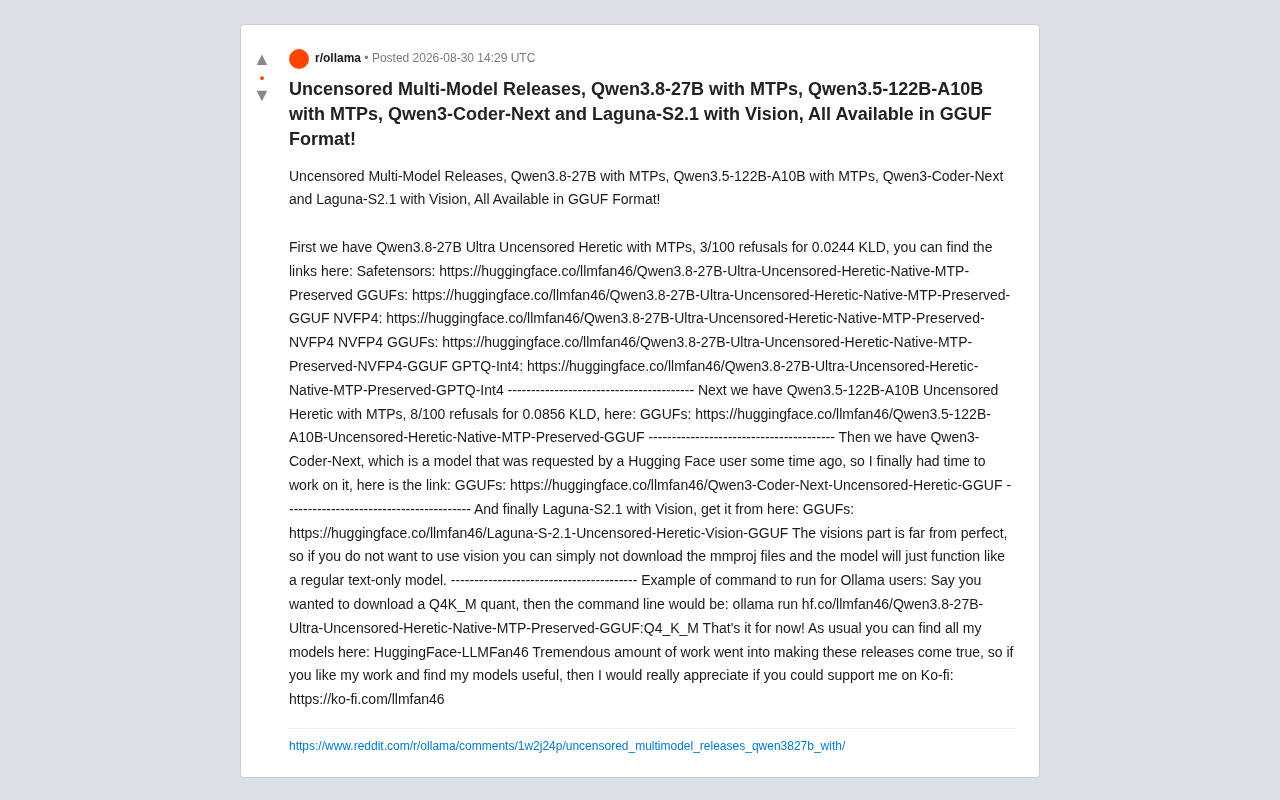
Multiple uncensored Qwen3 models released with preserved MTP capability and full GGUF format support.
Developer llmfan46 has batch-released multiple uncensored Qwen3 series models on Hugging Face, including Qwen3.8-27B, Qwen3.5-122B-A10B, Qwen3-Coder-Next, and the multimodal Laguna-S2.1. All models preserve native MTP (Multi-Token Prediction) capability and offer comprehensive GGUF quantization support for local deployment. The flagship Qwen3.8-27B Heretic version achieves just 3/100 refusals with a remarkably low KLD of 0.0244, demonstrating surgical precision in uncensoring.
A Batch Release of Multiple Uncensored Models
Recently, Hugging Face community developer llmfan46 released a batch of uncensored fine-tuned models based on the Qwen3 series, spanning from medium to very large parameter counts, all with GGUF format support for convenient local deployment. This release includes Qwen3.8-27B, Qwen3.5-122B-A10B, Qwen3-Coder-Next, and the vision-capable Laguna-S2.1, covering text reasoning, code generation, and multimodal use cases.
So-called "uncensored" models are versions where safety alignment restrictions injected during training have been removed or weakened through fine-tuning. Mainstream LLMs typically undergo alignment training such as RLHF (Reinforcement Learning from Human Feedback) or DPO (Direct Preference Optimization) before release, causing the model to refuse requests involving violence, illegal activities, sensitive topics, and more. The core challenge of uncensored fine-tuning lies in precisely removing these refusal behaviors without degrading the model's general reasoning capabilities and knowledge base.
For local LLM enthusiasts and developers, the value of such uncensored models lies in providing a less restricted experimental environment. The developer specifically emphasized in the release notes that these models preserve native MTP (Multi-Token Prediction) capability — a notable technical challenge in uncensored fine-tuning, as many fine-tuning processes break the original architectural features. MTP is an inference acceleration technique: traditional autoregressive language models predict only the next token per forward pass, while MTP architecture allows the model to predict multiple subsequent tokens in a single forward pass. This design achieves parallel output through additional prediction heads, and during inference can be combined with Speculative Decoding strategies to significantly boost generation speed. If the training pipeline doesn't correctly handle the parameters of these additional prediction heads, the MTP module's weights get corrupted or reset, causing the acceleration capability to be lost. Preserving MTP therefore requires careful tuning of the training configuration.
Core Model Breakdown: Qwen3.8-27B and Qwen3.5-122B
Qwen3.8-27B Ultra Uncensored Heretic
As one of the flagships of this release, the Qwen3.8-27B Ultra Uncensored Heretic version employs the "Heretic" uncensoring method while preserving native MTP capability. Heretic is a relatively novel uncensoring methodology in the open-source community, with a core approach that differs from traditional large-scale instruction dataset retraining. Conventional uncensoring methods typically require full fine-tuning or LoRA fine-tuning with large volumes of refusal-free conversational data — a process often accompanied by degradation of the model's general capabilities (known as catastrophic forgetting). The Heretic method reportedly uses a more targeted intervention strategy, potentially involving surgical modifications to specific neurons or attention patterns associated with refusal behaviors, thereby lifting safety restrictions while minimizing perturbation to the model's overall weight space.
According to the developer's data, this model produced only 3 refusals out of 100 tests (3/100 refusals), with a KLD (KL Divergence) of just 0.0244.
KL Divergence (Kullback-Leibler Divergence) is a classic information-theoretic metric for measuring the difference between two probability distributions. In the context of LLM fine-tuning evaluation, KLD compares the output probability distribution of the fine-tuned model against the original model given the same inputs. A KLD of zero means the two distributions are identical; larger values indicate greater deviation. For uncensored fine-tuning, the ideal outcome is to change only the model's refusal behavior on sensitive requests without affecting its performance on general tasks — which is exactly what a low KLD reflects. A KLD of 0.0244 means the fine-tuning barely altered the model's overall behavioral distribution, making only precise adjustments to the target behavior (removing refusals). This is known as a "surgical" modification in fine-tuning and is an important marker of high-quality fine-tuning. The extremely low KLD data from this release demonstrates that the Heretic method indeed excels at preserving the model's original distribution, reflecting a broader trend in uncensoring technology evolving from brute-force retraining toward precision adjustment.
This model offers an exceptionally rich selection of formats, including Safetensors original weights, GGUF, NVFP4, NVFP4 GGUF variants, and GPTQ-Int4 quantized versions — covering virtually every need from high-precision inference to low-VRAM deployment.
Qwen3.5-122B-A10B: Large-Parameter MoE Architecture Uncensored
Qwen3.5-122B-A10B is the largest model in this batch. As the name suggests, it's a MoE (Mixture of Experts) architecture model with approximately 122B total parameters and about 10B active parameters.
MoE (Mixture of Experts) is a neural network architecture that achieves efficient scaling through conditional computation. In a MoE Transformer, the traditional feed-forward network (FFN) layers are replaced with multiple parallel "expert" networks, each being an independent FFN module. A trainable Router/Gate network dynamically selects the most relevant handful of experts for each input token (typically via Top-K selection), while the remaining experts don't participate in processing that token. Taking Qwen3.5-122B-A10B as an example, its total parameter count reaches 122 billion, but only about 10 billion parameters are activated per inference step. This gives it far greater knowledge capacity than a dense model of equivalent active parameters, while maintaining inference speed and VRAM requirements comparable to a 10B-class model. Google's Switch Transformer and Mixtral are early landmark works of MoE architecture in the LLM domain, and this architecture has since become the mainstream choice for training ultra-large-scale models. This design allows models to possess vast knowledge capacity while keeping actual computational costs manageable during inference.
This model also preserves MTP capability, with uncensoring test data showing 8 refusals out of 100 (8/100) and a KLD of 0.0856. Compared to the 27B version, its KLD is slightly higher and its refusal rate somewhat elevated — a reasonable outcome for uncensoring larger models, as safety alignment behaviors become more dispersed across the weight space with increasing parameter count, making precise removal correspondingly more difficult. This version is currently available only in GGUF format.
Code and Multimodal Uncensored Models
Qwen3-Coder-Next Uncensored
Qwen3-Coder-Next is a code-specific uncensored model created in response to Hugging Face community user requests. The Qwen Coder series already enjoys a solid reputation in open-source code generation, and this uncensored version offers a new option for developers who need a less restricted code generation environment. In code generation scenarios, safety alignment restrictions sometimes over-reject legitimate security research, penetration testing scripts, or system-level programming requests — the uncensored version reduces unnecessary blocking in these use cases. This model is currently available in GGUF format.
Laguna-S2.1 Vision Model
Finally, there's the vision-capable Laguna-S2.1 model. The developer candidly noted that the vision component is "far from perfect" and offered practical advice: if you don't need vision capabilities, you can simply skip downloading the mmproj file, and the model will function normally as a text-only model. The mmproj file here refers to the Multimodal Projector weight file, which maps image features extracted by the vision encoder into the language model's embedding space — serving as the bridge component connecting visual understanding with text generation.
This honest attitude is commendable and reminds users to maintain reasonable expectations regarding multimodal capabilities. Vision understanding fine-tuning is inherently challenging, requiring simultaneous handling of complex interactions between the vision encoder, projection layer, and language model. That a community developer can offer an optional vision module is already a significant achievement.
Local Deployment Methods and Quantization Version Selection Guide
All models are available in GGUF format, meaning they can run directly in mainstream local inference frameworks like Ollama and llama.cpp. GGUF (GPT-Generated Unified Format) is a model storage format created by the llama.cpp project, designed specifically for local CPU/GPU hybrid inference. It packages model weights, tokenizer configuration, and metadata into a single file with native support for multiple quantization precisions. The widespread adoption of this format has dramatically lowered the technical barrier for local LLM deployment and has become the de facto standard for distributing quantized models in the open-source community.
The developer provided example Ollama commands, such as downloading the Q4_K_M quantized version:
For most users, Q4_K_M offers a good balance between VRAM usage and quality. Q4_K_M uses llama.cpp's k-quants grouped quantization strategy, adaptively applying different quantization precisions to different layers based on their importance, maintaining model quality as much as possible at the 4-bit compression level. If VRAM is limited, consider more aggressive quantization options like NVFP4 or GPTQ-Int4 — NVFP4 is NVIDIA's 4-bit floating-point quantization format for their next-generation GPU architectures, leveraging hardware-level FP4 support for higher inference throughput; GPTQ-Int4 is a post-training quantization method based on second-order information that preserves accuracy by minimizing quantization error, and is widely supported by serving frameworks like vLLM and TGI. If you're pursuing maximum quality and have sufficient hardware, you can use the Safetensors original weights for FP16/BF16 precision inference.
The Continued Flourishing of the Open-Source Community Ecosystem
This batch of releases once again demonstrates the vitality and creativity of the open-source LLM community. From the Heretic uncensoring method to MTP capability preservation to full-format quantization support, individual developers can now independently accomplish complex work that previously required entire teams. This capability improvement is driven by the maturation of the entire open-source toolchain — from the standardized model interfaces provided by the Hugging Face Transformers library, to the lowered training barriers offered by parameter-efficient fine-tuning frameworks like PEFT/LoRA, to the comprehensive quantization and deployment toolchain provided by the llama.cpp ecosystem. Every link in the chain empowers individual creators.
The developer noted that producing this batch of models involved "a massive amount of work" and expressed hope that users would show support via Ko-fi. This also reflects a reality the open-source community faces: producing quality models requires substantial investment (including GPU compute costs, data preparation, and time spent on testing and validation), and sustainable contributions often depend on positive community incentives.
For developers and researchers looking to explore unrestricted LLM capabilities, this batch of models provides a complete range of options — from 27B to 122B, from text-only to multimodal, from code to general reasoning. However, it's important to note that when using uncensored models, users should comply with applicable laws and regulations and take responsibility for generated content.
Key Takeaways
Related articles
Deep Dive into Multi-Agent System Design Patterns and Common Pitfalls
In-depth analysis of multi-agent system design patterns—Orchestrator-Worker, Debate & Review, Hierarchical Delegation—and key pitfalls like error accumulation, communication costs, and state management.

Kira Community: How an AI Creation Tool Is Transforming Into a Creator Community
Kira Community pivots from an AI image/video generation tool to a creator community, using hashtags to organize content and help creators build portfolios and find peers.
DeepSeek V4 Pro Real-World Test: 7 Projects Reveal Its True Coding Ability and Value
Real-world test of DeepSeek V4 Pro across 7 projects covering frontend, backend, 3D games, and long tasks. Frontend lags behind Claude, but at 1/180th the cost.