Cloudflare Open-Sources AI Code Security Audit Tool, Hits 60K Stars

Cloudflare open-sources Security Audit, giving coding agents three-step automated security auditing.
AI generates code far faster than humans can review it, and the Cursor platform extension backdoor incident highlights the security gap. Cloudflare has launched the open-source Security Audit project, which embeds free security auditing into coding agents and has already gained nearly 60,000 stars. Its workflow has three steps: first map all input points and attack surfaces of the application, then dispatch multiple independent agents to hunt for vulnerabilities and cross-validate to filter false positives, and finally output a three-tier classified report of confirmed, needs checking, and rejected findings. Born from Cloudflare's internal vulnerability hunting system, the tool emphasizes shifting security left rather than replacing humans; installation takes one command and running it takes one sentence to audit a codebase, but its actual effectiveness still needs real-world project verification.
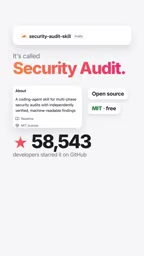
AI writes code faster and faster, but manual review simply can't keep up. Last week, the official Clawed Code extension on the Cursor Marketplace was found to contain a hidden backdoor, sounding the alarm once again. Cloudflare's answer: give every coding agent its own free security team — Security Audit. It's an open-source project that nearly 60,000 developers have already starred.
Why AI Code Needs Dedicated Security Audits
The efficiency gains from AI-generated code have left traditional security review processes struggling to keep pace. Developers can hardly inspect every line of logic AI produces, while the attack surface expands along with the volume of code. Security Audit isn't meant to replace manual review — it shifts security auditing left, embedding it into the coding agent's workflow. It's open-source and free to use, lowering the barrier for teams to adopt automated security scanning.
Nearly 60,000 stars show that demand for this kind of tool genuinely exists in the community.
"Shift Left Security" is a core practice in DevSecOps: moving security detection from pre-launch penetration testing earlier to the coding and commit stages, thereby reducing remediation costs. Traditional shift-left relies on IDE plugins or static scanning in CI pipelines, but when faced with massive amounts of AI-generated code, rule libraries often fall short in coverage. Security Audit embeds auditing into the coding agent's conversation flow — essentially a more thorough form of shift-left: completing preliminary security validation at the same stage the code is written, rather than waiting for human intervention at the merge request stage.
Three-Step Workflow: Mapping, Hunting, Adjudication
Security Audit's core mechanism can be broken into three stages.
Step 1: Application Mapping
The tool first scans your application, cataloging every input point, every boundary, and every location an attacker might enter. This amounts to drawing a security map of the codebase, and all subsequent hunting is based on this map.
Step 2: Multi-Agent Adversarial Bug Hunting
Once mapping is complete, Security Audit dispatches multiple independent agents to hunt for vulnerabilities separately. Crucially, each vulnerability is challenged by a different agent attempting to disprove it — this adversarial design filters out a large number of false positives.
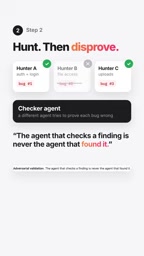
The "adversarial validation" here borrows from the Red Team / Blue Team approach in software security: one agent plays the attacker and proposes a vulnerability hypothesis, while another independent agent plays the reviewer and tries to refute it. Only when the vulnerability hypothesis still holds after multiple disproof attempts does it make it into the report. This mechanism differs from rule-matching approaches used by static analysis tools (such as SAST) — it relies on the LLM's semantic understanding to find flaws at the logic level, while using multi-agent cross-validation to suppress the "hallucinated false positives" common in large models. The trade-off is higher computational cost, requiring multiple model calls.
Step 3: Three-Tier Classification Report
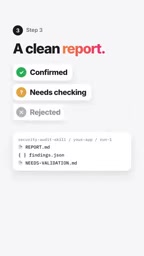
The final output is a clean report that categorizes findings into three types: confirmed, needs checking, and rejected. This tiering lets developers prioritize real risks instead of being drowned in noise.
Not a Toy: Born from Cloudflare's Internal Vulnerability Hunting System
Security Audit is no lab demo. According to the video, it is the starting point of Cloudflare's own vulnerability hunting system. That means the tool has been honed through real business scenarios, not merely a proof of concept. For teams looking to improve the security of AI-generated code, this is an open-source option worth watching.
Installation takes just one command, and running it takes just one sentence: tell the coding agent "Security Audit, this code base."
Cloudflare is a globally known CDN and network security company whose business is naturally exposed to massive volumes of real attack traffic. Its internal security team has long needed to do vulnerability hunting — proactively, non-rule-driven searching for unknown vulnerabilities. Such systems typically combine threat intelligence, attack surface mapping, and hands-on penetration experience. Security Audit being born from this internal practice means its methodology has been tested in real offense-defense scenarios; however, the open-source version may differ from the internal system in model capability, data integration, and configuration depth, and its actual effectiveness needs to be evaluated against your own codebase.
Editor's Observations
The proliferation of AI coding agents is reshaping the form of security auditing. Security Audit's approach — first mapping, then adversarial validation, and finally tiered output — compresses the working model of a security team into the agent workflow. Being open-source and having nearly 60,000 stars are early signals of community recognition, but actual effectiveness still needs to be verified in real projects. For teams that rely on AI-generated code, this kind of tool is worth adding to your toolchain evaluation.
Related articles

DSH + Ollama Local LLM Deployment in Practice: Free Chat with Da Fei Yu
Bilibili creator tests DSH + Ollama local LLM deployment end to end: Ollama install, Xunlei-accelerated downloads, ModelScope GGUF model import, DSH custom API address setup, and a comparison of Qwen 3.5 4B, 8B, Gemma, and other models on 8GB VRAM, with advice on choosing local deployment vs. API calls.

Tested: A $899 Mac Mini vs. a $200/Month AI Subscription
Real-world test of whether an M4 Mac mini can replace a $200 AI subscription: 16GB can't fit large models, and both speed and quality fall short—but privacy, no caps, and near-zero running costs make it an ideal host for an always-on agent. Includes buying advice per configuration and money-saving strategies.

RSTGameTranslation: Real-Time OCR Localization + Offline Translation with Local LLMs
RSTGameTranslation is an open-source real-time Windows game translation tool: OCR for English, Japanese, and Korean with Chinese overlays in place, plus Ollama or LM Studio local LLM offline translation and Whisper speech transcription for games, manga, and visual novels.