bawkterm: An Open-Source Remote Management Client Combining SSH, SFTP, and Docker
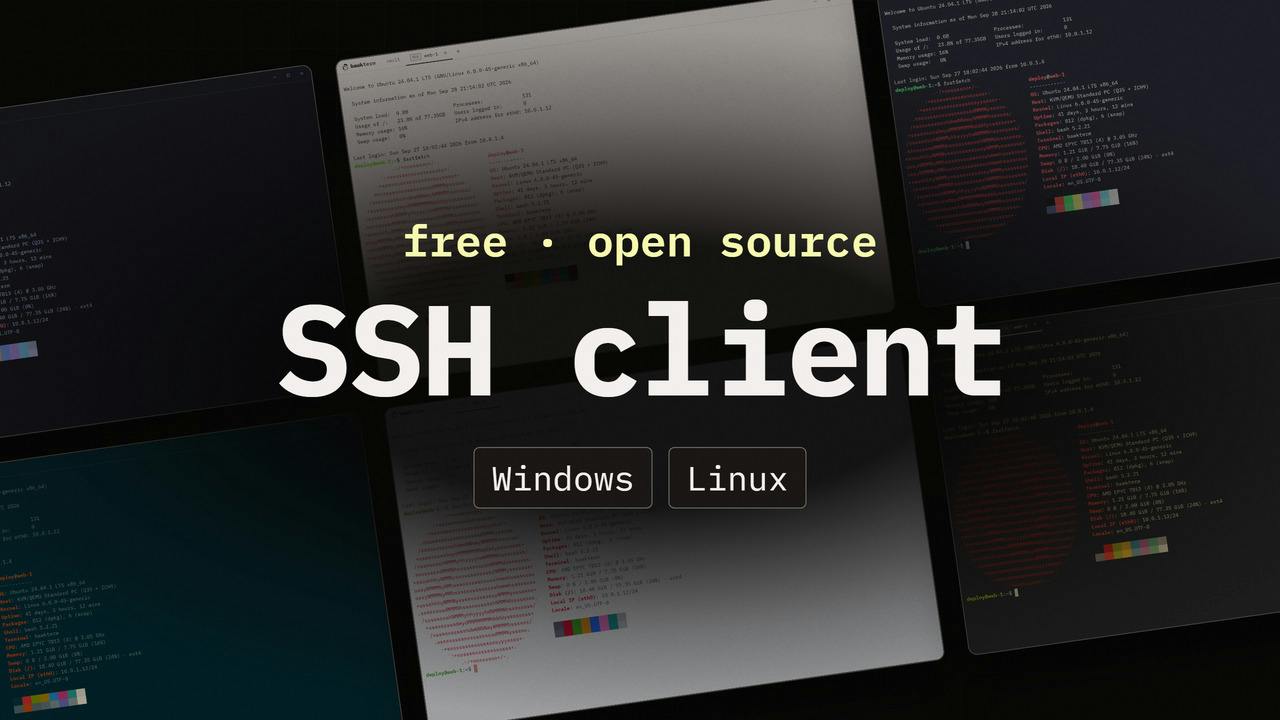
bawkterm is an open-source desktop client unifying SSH, SFTP, Docker management, and Remote Desktop for Windows and Linux.
bawkterm is an open-source remote management desktop client by developer Chris Judd that consolidates SSH terminal access, SFTP file transfer, Docker over SSH container management, and Remote Desktop into a single interface on Windows and Linux. Its core value lies in reducing context-switching for developers and ops engineers — particularly the ability to manage remote Docker containers directly through an existing SSH connection. Compared to commercial tools like Termius and MobaXterm, bawkterm differentiates itself with full protocol integration plus open-source transparency, making it more suitable for users who prioritize credential security. The project is still in early stages, with community activity and feature maturity yet to be proven, and macOS is not currently supported.
Developers spend a significant chunk of their day managing remote servers: logging in via SSH to debug, transferring files over SFTP, accessing graphical interfaces through remote desktop, and wrangling Docker containers scattered across multiple machines. Traditionally, each of these tasks required a separate tool, and the constant context-switching added up fast. The open-source project bawkterm aims to consolidate all of these functions into a single desktop client.
The project was posted to Product Hunt by developer Chris Judd, categorized under Open Source, Developer Tools, and GitHub. It received 66 upvotes and ranked 20th on its launch day.
One Tool, Multiple Remote Protocols
bawkterm positions itself as a "cross-protocol remote management desktop client." According to its official description, it supports SSH, SFTP, Docker management over SSH, and Remote Desktop — running on both Windows and Linux.
This all-in-one approach targets a core pain point for developers and ops engineers. In a typical workflow, you'd open a terminal tool to connect to a server, switch to something like FileZilla for file transfers, manually type docker commands on the server to manage containers, and pull up a separate RDP client for machines with a graphical interface. bawkterm puts all of this in a single interface, eliminating the friction of jumping between tools.
The "Docker over SSH" feature is particularly clever — it doesn't require a local Docker environment to be set up separately. Instead, it leverages an existing SSH connection to manage containers on remote hosts directly. This is especially handy for anyone overseeing multiple servers running containerized services.
SFTP (SSH File Transfer Protocol) is a secure file transfer protocol built on top of SSH. Unlike legacy FTP, all data is encrypted in transit, so file contents and authentication credentials are never exposed in plaintext. RDP (Remote Desktop Protocol) is Microsoft's protocol for accessing the full graphical interface of a remote machine over a network — commonly used to connect to Windows servers or remote environments requiring GUI interaction. Although SSH, SFTP, and RDP all serve the broad goal of "remote access," they operate at different protocol layers and serve distinct use cases, which is precisely why multiple specialized tools have historically been necessary.
Why Open Source Matters Here
bawkterm is published on GitHub as an open-source project, which carries real weight for its target audience. Remote connection tools handle sensitive data — server credentials, SSH keys, and the like. Being open source means the code is auditable: users can verify for themselves how credentials are stored and handled, rather than placing blind trust in a closed-source commercial product.
The market already has plenty of competitors — commercial terminal tools like Termius and MobaXterm, as well as various open-source tools that focus on a single protocol. bawkterm differentiates itself with the combination of "full protocol integration + open-source and free" — covering most remote access scenarios while retaining the transparency and customizability of an open-source project.
Termius is one of the most popular cross-platform SSH clients available, offering cloud sync and team sharing features — but its core functionality requires a paid subscription. MobaXterm is a comprehensive remote tool for Windows that bundles SSH, X11 forwarding, SFTP, and more; it has a free tier but with limited features, and the commercial version requires a license. The common concern with closed-source commercial tools is that users have no way to inspect how credentials are stored or transmitted — and if the tool has a security vulnerability or engages in data collection, it's nearly impossible to detect. This is the fundamental reason open-source alternatives continue to find a market in security-sensitive scenarios.
Use Cases and a Realistic Assessment
Based on its feature set, bawkterm seems well-suited for the following users:
- Full-stack developers: Those who frequently connect to dev and production servers locally while managing containerized applications;
- Ops and DevOps engineers: Those who switch between multiple hosts daily, handling file transfers and container orchestration;
- Security-conscious individual users: Those who prefer open-source, auditable tools to manage private servers.
That said, some perspective is warranted. As of now, the project has relatively limited traction on Product Hunt (66 votes, 4 comments), placing it firmly in early-stage territory. It currently supports Windows and Linux, with no mention of macOS support — a potential dealbreaker for some developers. Feature maturity, stability, and community activity all remain to be seen. Users who are curious are advised to test it in non-critical environments first.
Conclusion
bawkterm reflects a broader trend in remote management tooling toward consolidation: bringing SSH terminals, SFTP file transfer, Docker management, and remote desktop into a single open-source client, aiming to be the "one-stop" remote access hub on a developer's desktop. For developers who are tired of switching between multiple tools and value transparency in their toolchain, it's an open-source option worth keeping an eye on. Whether it can carve out a lasting place in a competitive terminal tool market will depend on continued feature development and community growth.
Related articles

Amphibious Transforming Drone: Beyond 100x Power Savings, What Are the Real Needs?
Is the amphibious transforming drone just a gimmick? Starting from the 100x power difference of the M4 Morphobot, explore real application scenarios and thesis topic ideas, analyzing boundary conditions where pure drones and pure ground robots both fail.

Warhound Raises $200 Million: Genetically Engineered "War Dogs" Paired with Anduril Gear
Warhound raises $200M, backed by Ben Lamm and Palmer Luckey, to genetically engineer dogs for military and law enforcement use and equip them with Anduril gear. This article analyzes its technology direction, funding logic, and ethical controversy.

Claude API Comes to Google Cloud: IAM Integration and SDK Access Guide
Anthropic hosts the full Claude API on Google Cloud with IAM-controlled permissions and unified billing. This guide covers the Vertex AI and Anthropic-hosted entry points, IAM role configuration, and SDK access.