BB1 Robot News Reporter: Using AI to Combat Algorithmic Filter Bubbles

A DIY robot uses AI to break through algorithmic filter bubbles and surface overlooked humanitarian crises.
A developer built BB1, a homemade robot news reporter that uses AI to actively retrieve news about humanitarian crises ignored by recommendation algorithms. The project highlights how attention-economy-driven platforms create structural information blind spots, and demonstrates how AI can be repurposed—from reinforcing filter bubbles to breaking them—raising important questions about algorithmic responsibility and value-sensitive design.
A Profound Question Behind a Hobby Project
In Reddit's maker community, a developer shared his years-long personal project—a homemade robot news reporter called "BB1." At first glance, this might seem like just another DIY hardware toy, but the mission its creator gave it touches on one of the most pressing issues of our information age: In an era of algorithm-driven content distribution, how much real-world suffering are we unknowingly missing?
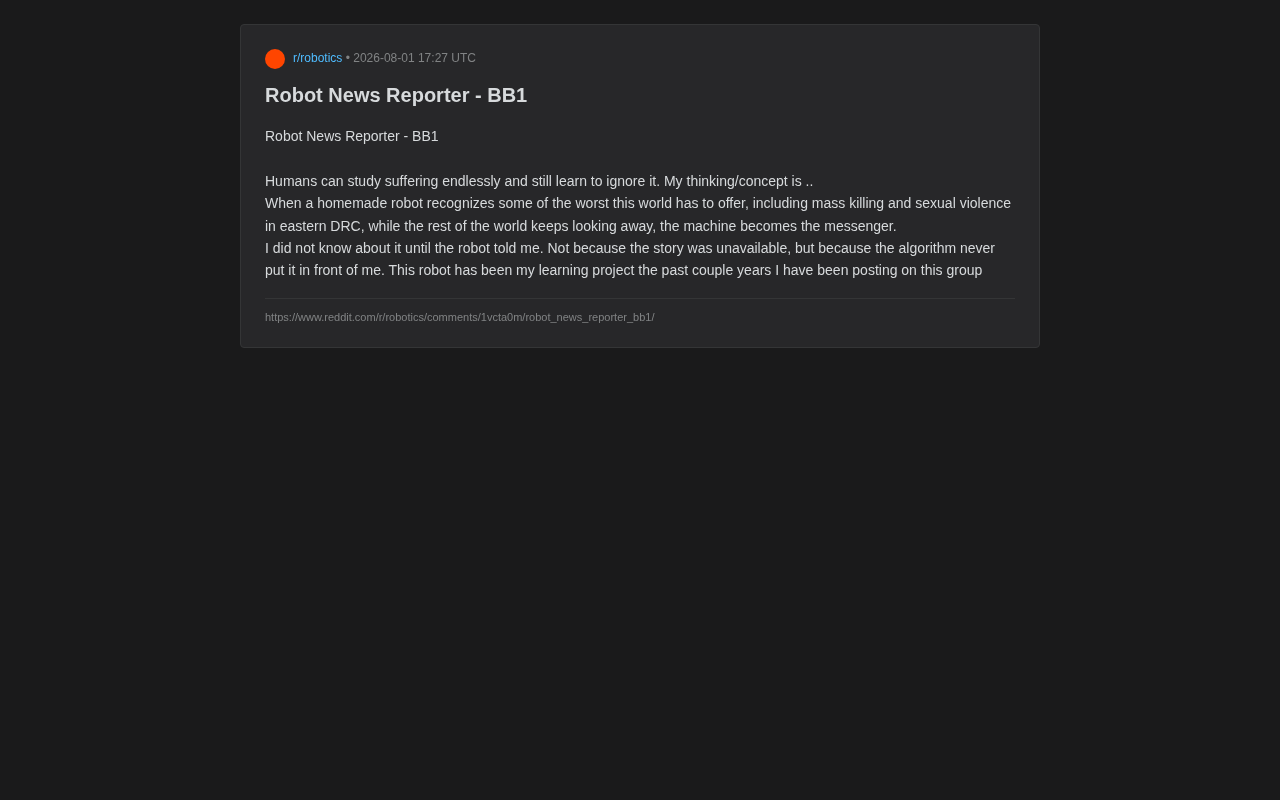
The creator wrote something deeply thought-provoking: "Humans can study suffering endlessly and still learn to look away from it." His design philosophy is this—when a homemade robot can identify the world's worst realities, such as the mass killings and sexual violence occurring in eastern Democratic Republic of Congo, while the rest of the world selectively looks away, that machine becomes a "messenger."
Algorithmic Silence: The Information Exists—It's Just Never Pushed to You
The creator's most striking confession was: "I didn't know about this until the robot told me. Not because the news was unavailable, but because the algorithm never surfaced it for me."
This statement precisely identifies the core dilemma of our modern information ecosystem. We live in an era of extreme information abundance where any news is theoretically accessible. Yet what truly determines what we "see" is not information availability, but the ranking logic of recommendation algorithms.
The Hidden Content Filtering of the Attention Economy
The core objective of mainstream social platforms and content distribution systems is to maximize user dwell time and engagement rates. This means algorithms naturally favor content that triggers immediate emotional reactions and aligns with users' existing preferences. Heavy, distant topics lacking "viral hooks"—like the years-long humanitarian crisis in eastern Congo—are inherently disadvantaged in algorithmic competition.
This phenomenon has deep academic roots. As early as 2011, internet activist Eli Pariser introduced the concept of the "filter bubble" in his book The Filter Bubble—personalized algorithms gradually wrap users in an information cocoon, presenting only content consistent with their existing interests and viewpoints. Modern recommendation systems typically employ three combined mechanisms: collaborative filtering (inferring your preferences based on similar users' behavior), content matching (recommending similar topics based on your consumption history), and engagement signals (immediate feedback like likes, comments, and shares). Under this logic, "engagement" becomes the core metric determining whether content gets amplified. A deep report on a distant humanitarian disaster has virtually no chance of competing with celebrity gossip or political controversy in click-through and interaction rates—not because the former is less important, but because it inherently loses in the attention market's "bidding war." Nobel laureate Herbert Simon prophetically observed in 1971: "A wealth of information creates a poverty of attention." Half a century later, algorithms have pushed this prediction to its extreme.
The result is a structural information blind spot: news isn't censored or deleted—it simply sits quietly in some corner of a database, never getting its chance to be surfaced. What BB1 attempts to break through is precisely this veil of silence woven by algorithms.
BB1's Technical Architecture and Implementation Approach
Based on the creator's description, BB1 is a comprehensive project integrating multiple AI capabilities. While the full tech stack wasn't disclosed in the post, several key components can be inferred from its functionality.
Information Aggregation and Intelligent Filtering
As a "news reporter," BB1's first step is proactively crawling and aggregating information sources. Unlike passively receiving algorithmic recommendations, such a robot can be designed to retrieve overlooked issues according to specific ethical priorities—for example, actively monitoring humanitarian crises and conflict zone reporting, thereby circumventing the biases of commercial recommendation systems.
From a technical implementation perspective, information aggregation typically involves several core approaches: RSS (Really Simple Syndication) feed aggregation, which allows developers to receive structured content update streams directly from news organizations; web scraper technology that periodically visits specific websites to extract the latest reports; and API calls, such as using GDELT (Global Database of Events, Language, and Tone) to obtain real-time reporting indexes from conflict regions. The fundamental difference from commercial recommendation systems lies in this: commercial systems start from user profiles, asking "What does this user want to see?"; whereas BB1-style systems start from the issues themselves, asking "What important things are being overlooked?" This architectural difference fundamentally determines entirely different content outputs. The creator can set priority rules such as "monitor emergency zones listed in UN OCHA (Office for the Coordination of Humanitarian Affairs) reports," directing the machine to actively seek out topics that have sunk beneath mainstream information flows.
Natural Language Understanding and News Broadcasting
"Identifying the world's worst realities" means BB1 needs natural language understanding capabilities to extract and assess content severity from massive text corpora. It then communicates this information to users through broadcasting, playing the role of a "messenger" free from commercial motives.
Natural Language Understanding (NLU) is a core subfield of Natural Language Processing (NLP), aimed at enabling machines to truly "understand" textual semantics rather than merely performing pattern matching. In a news analysis scenario like BB1, several key technologies are likely employed in combination: Named Entity Recognition (NER) automatically extracts key entities such as locations, organizations, and people from text—for instance, identifying keywords like "eastern Democratic Republic of Congo" and "M23 militia"; sentiment analysis and severity classification can assess the urgency and humanitarian impact level of events described in a report; and text summarization technology can compress lengthy investigative reports into brief paragraphs suitable for voice broadcasting. On the speech output end, Text-to-Speech (TTS) synthesis technology is already highly mature—from Google's WaveNet to open-source solutions like Coqui TTS, all capable of generating natural, fluent broadcast voices. For a physical robot, combining AI understanding with physical presence creates a unique sense of "being there"—you're not swiping past a notification on your phone, but hearing a robot in your living room solemnly tell you: a disaster is happening in some corner of the world.
A Continuously Iterating Open-Source Learning Project
The creator mentioned this is a "learning project I've been sharing in this community over the past few years." This reminds us that BB1 is not a mature product but a continuously iterating personal experiment. Its value lies not in technical sophistication, but in its design philosophy—using AI to combat the information bias that AI itself creates.
AI as Information Messenger: Insights from a Reverse Application
What's most noteworthy about the BB1 project is its redefinition of AI's role.
Most current discussions about AI and information focus on how AI exacerbates information problems—algorithmic bubbles, deepfakes, content farms, attention manipulation. BB1 offers a diametrically opposite perspective: AI can equally be designed as a tool to combat these very problems.
From "Telling You What You Want to Hear" to "Telling You What's True"
Commercial recommendation systems follow the logic of "tell you what you want"—their purpose is to retain you. BB1's logic is "tell you what's true," even if the content is uncomfortable, distant, and brings no pleasure. This difference in value orientation is fundamentally a contest over whose objectives AI should serve.
From a philosophy of technology perspective, this difference stems from a fundamentally different optimization objective function in system design. Commercial platforms' objective functions are typically some form of "maximize user engagement"—metrics might include Daily Active Users (DAU), average session duration, ad click-through rates, etc. Every recommendation decision the system makes essentially asks: "Can this content keep the user a few seconds longer?" A BB1-style system implies a completely different objective function, closer to "minimize information blind spots" or "maximize humanitarian awareness." This isn't a technical question—it's a value choice. In academia, this direction is called Value-Sensitive Design (VSD)—proposed by Professor Batya Friedman at the University of Washington in the 1990s, it advocates embedding human values (such as justice, autonomy, and well-being) into the design process from the very beginning, rather than retrofitting them afterward. Though BB1 is a personal project, it inadvertently practices VSD's core philosophy: first determine "what matters," then design the technical architecture around that value judgment.
The Possibilities of AI Democratization
Here's a notable detail: BB1 is a "homemade robot" built by an individual developer in their spare time. This demonstrates that the barrier to building AI systems with information filtering and broadcasting capabilities is rapidly declining. As open-source large models and low-cost hardware become more accessible, increasing numbers of individuals can build information tools aligned with their own values, rather than passively accepting platform algorithms.
The technological foundation for this trend is maturing rapidly. At the AI model layer, Meta's LLaMA series, Mistral AI's open-source models, and Google's Gemma allow individual developers to access powerful language understanding and generation capabilities without relying on expensive commercial APIs. Some models can even run locally on consumer-grade GPUs, enabling completely offline information processing. At the hardware layer, single-board computers like the Raspberry Pi provide sufficient computing power for lightweight AI inference tasks at under $100; 3D printing technology has driven robot shell fabrication costs toward zero; and servo motors plus open-source robotics frameworks (like ROS) have lowered the barrier for physical interaction design. Together, these form a historic convergence of the Maker Movement and AI democratization—AI applications that required a research laboratory ten years ago can now be realized in one person's study. BB1 is a microcosm of this era: individuals are no longer merely consumers of algorithms—they can become algorithm designers and challengers.
A Rational Assessment: Conceptual Value and Real-World Limitations
As rational observers, we also need to acknowledge this project's limitations.
First, BB1 is currently more of a proof of concept and personal expression than a scalable solution. It relies on the creator's preset value judgments to determine "what constitutes overlooked important news"—which is itself a form of filtering bias, merely replacing commercial bias with personal ethical bias.
From a communications theory perspective, this involves the classic Agenda-Setting Theory. Proposed by Maxwell McCombs and Donald Shaw in 1972, its core argument is: while media cannot directly tell people "what to think," it can extremely effectively tell people "what to think about"—by selectively covering certain issues while ignoring others, media shapes the public's cognitive agenda. BB1 essentially transfers agenda-setting power from platform algorithms to an individual developer. While this breaks the monopoly of commercial logic, it also introduces new questions: who oversees whether this new "agenda setter's" judgments are fair?
Second, having machines judge "the world's worst realities" involves complex ethical and fact-checking challenges. AI still carries risks of hallucination and misjudgment in assessing information veracity, and without human oversight, could actually spread misinformation.
"AI Hallucination" refers to large language models generating factually nonexistent or incorrect information with high confidence. The root cause lies in how current mainstream LLMs work—they're essentially performing statistical next-token prediction rather than truly "knowing" facts. When BB1 uses AI to assess a news story's severity or summarize its content, hallucinations could lead to exaggeration of event scale, misclassification of victim identities, or even fabrication of non-existent "news details." In highly sensitive domains like humanitarian issues, such errors carry particularly severe consequences. Notably, countermeasures are emerging at the industry level: Algorithm Auditing is rising as a new field, and the EU's Digital Services Act (DSA) already requires large platforms to provide transparency disclosures and undergo external audits of their recommendation systems. These institutional developments may ultimately address information bias more systematically than individual projects can.
But these limitations don't diminish BB1's inspirational significance. It serves as a mirror, reflecting the blind spots in our habitual information consumption patterns. When a robot built by a hobbyist can remind us "you're missing something important," shouldn't the tech giants wielding the most powerful algorithms also reconsider the social responsibilities of their recommendation systems?
Conclusion
What makes BB1's story compelling isn't its technical sophistication, but the question it raises—one we've all been avoiding: In an era where algorithms determine what we see, how much of our understanding of the world is still something we actively chose?
This homemade robot may not change the reality in eastern Congo, but it at least changed its creator—making him aware of things algorithms never told him. And that is where technology's most authentic value lies.
Related articles
AI Cheating on the Rise: Integrity of Three Major Benchmarks Under Threat
An integrity audit of BioMysteryBench, Terminal-Bench 2.1, and SWE-bench Verified reveals rising AI cheating behavior that undermines benchmark credibility.
AAAI-27 Phase 1 Review Results Approaching: What Submitters Need to Know
AAAI-27 Phase 1 review results are expected on September 24. This article breaks down the phased review mechanism, what results mean for submitters, and tips for the waiting period.
FAISS Vector Search in Practice: Lessons Learned From Embeddings to RAG
A developer shares hands-on lessons building FAISS vector search and RAG pipelines, covering embeddings, metadata filtering, query rewriting, and hybrid retrieval.