FAISS Vector Search in Practice: Lessons Learned From Embeddings to RAG
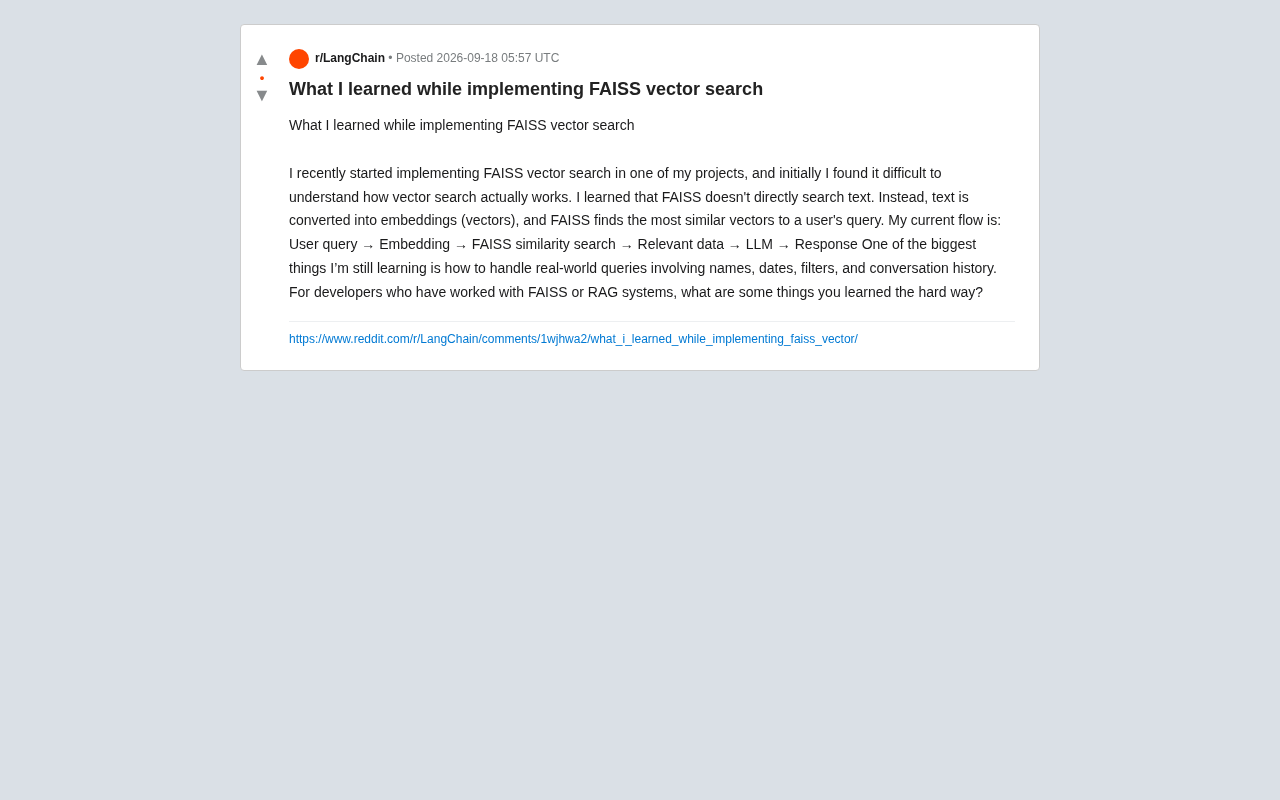
FAISS searches vectors, not text — and the real engineering challenge starts after your RAG pipeline first runs.
This article uses a developer's hands-on experience as a starting point to systematically explain how FAISS vector search works and walk through the standard RAG pipeline. FAISS operates on embedding vectors, not raw text — grasping this is the first step to understanding semantic retrieval. The typical RAG chain flows through query embedding, FAISS similarity search, context retrieval, and LLM generation. The real engineering challenges, however, lie in handling real-world queries: exact information like names and dates requires metadata filtering, while pronoun references in multi-turn conversations call for query rewriting. Experienced developers further highlight embedding model selection, chunking strategy, hybrid retrieval (vector + BM25), and FAISS's engineering limitations as the key details that separate a working prototype from a production-ready system.
Understanding FAISS Vector Search From Scratch
Many developers feel confused the first time they encounter vector search: how does it actually work? A Reddit developer shared their experience implementing FAISS (Facebook AI Similarity Search) in a real project, revealing a key insight — FAISS does not search text directly.
The core logic is: text is first converted into embedding vectors, and then FAISS finds the vectors most similar to the user's query within that vector space. In other words, FAISS operates on numbers, not words. Understanding this is often the first hurdle to building a RAG (Retrieval-Augmented Generation) system.
This semantic similarity-based retrieval approach is fundamentally different from traditional keyword matching. Conventional search relies on literal matches, whereas vector search captures semantic proximity — even if the user uses entirely different words, results with similar meaning can still be retrieved.
Embeddings are the foundational concept for understanding how FAISS works. Embedding models (such as OpenAI's text-embedding-ada-002, or open-source options like BGE and Sentence-BERT) map a piece of text to a high-dimensional array of floating-point numbers, typically with dimensions ranging from 256 to 1536. This vector mathematically represents the semantic position of the text — text with similar meanings will have vectors that are closer together in high-dimensional space. FAISS's core job is to find the nearest vectors to a query vector among millions or even billions of such vectors, with minimal latency. To accelerate this, FAISS offers several index types: IndexFlatL2 is the simplest brute-force exact search; IndexIVFFlat clusters vectors using an inverted file structure to trade some accuracy for speed; and HNSW uses a graph-based structure for efficient approximate nearest neighbor search. Different index types involve clear trade-offs between recall rate, search speed, and memory usage — production environments typically require choosing based on data scale and latency requirements.
A Typical RAG Data Flow
The developer outlined the complete pipeline used in their project, which represents the standard paradigm for most RAG applications today:
User Query → Embedding → FAISS Similarity Search → Relevant Data → LLM → Generated Answer
Breaking it down, each step has a clear responsibility:
- User Query: The raw natural language input
- Embedding: Converting the query into a vector via an embedding model
- FAISS Similarity Search: Finding the closest results in a pre-built vector index
- Relevant Data: The retrieved context chunks
- LLM: Generating a final answer based on the retrieved context
The elegance of this pipeline is that it allows large language models to "reference" an external knowledge base, without stuffing all the information into model parameters or a limited context window. The retrieval step effectively gives the LLM an on-demand reference library.
Real-World Scenarios Are Where It Gets Hard
Getting the pipeline running is just the beginning. The developer candidly admitted that their biggest ongoing challenge is handling complex real-world queries: names, dates, filter conditions, and conversation history.
This strikes at the core weakness of pure vector search. Semantic similarity excels at fuzzy semantic matching but struggles with structured, precision-demanding information. A few typical scenarios illustrate this:
The Exact Match Problem
When a user's query involves specific names or dates, pure semantic retrieval may return results that are "semantically similar but factually wrong." For example, querying "John's report from March" might pull up similar content from other people in other months. These use cases often require metadata filtering as a companion — first narrowing the candidate set with structured conditions, then ranking by vector similarity.
Metadata filtering is the standard engineering solution for exact query problems. The approach involves storing structured attributes alongside each vector — such as author, date, department, and document type. At query time, these fields are used for precise filtering to narrow the candidate pool down to a matching subset, and then vector similarity ranking is applied within that subset. This "filter first, then retrieve" pattern is commonly called pre-filtering. FAISS itself doesn't natively support metadata management, so many teams opt for vector databases like Weaviate, Qdrant, or Milvus, which integrate metadata storage and filtering on top of FAISS-style indexes and also support hybrid queries with traditional databases for more complex logic.
Handling Conversation History
In multi-turn conversations, a user's current question often depends on prior context (e.g., "What's the price of it?" — what does "it" refer to?). Running these elliptical queries directly through vector retrieval typically yields poor results. The common solution is query rewriting: before retrieval, use an LLM to rewrite the context-dependent question into a complete, self-contained query.
Advice From Experienced Practitioners
Within the community, seasoned RAG developers tend to emphasize several common pitfalls:
Your choice of embedding model directly determines retrieval quality. Different embedding models can perform drastically differently on domain-specific corpora. General-purpose models may not suit specialized content — domain fine-tuning may be necessary.
Chunking strategy matters more than you'd expect. The granularity of text splitting, whether to include overlap, and whether to carry metadata all significantly affect recall. Chunks that are too small lose context; chunks that are too large introduce noise.
Hybrid retrieval often outperforms vector search alone. Combining vector search with traditional keyword retrieval (such as BM25) captures the advantages of both semantic understanding and exact matching — a practical solution for precision queries involving names, dates, and the like.
FAISS only handles vector indexing. It does not manage metadata filtering, access control, or data updates. These engineering capabilities must be built at the application layer or handled by a more complete vector database solution.
The BM25 mentioned in the context of hybrid retrieval is a classic keyword ranking algorithm based on term frequency and inverse document frequency — an improvement over TF-IDF and still the default relevance algorithm in search engines like Elasticsearch. Its strength lies in its high sensitivity to exact lexical matches, making it reliable for names, product codes, code snippets, and other content that can't be semantically generalized. The process of combining BM25 scores with vector similarity scores is often called Reciprocal Rank Fusion (RRF) or weighted merging; since the two scoring systems operate on different scales, normalization is required before combining them. This hybrid approach consistently outperforms pure vector retrieval by 5–15% on recall benchmarks in both academic and industry settings, and is the mainstream choice for production-grade RAG systems today.
Closing Thoughts
This developer's account, though grounded in a humble starting point, precisely maps out the gap between a RAG system that "runs" and one that's actually "useful." FAISS's vector retrieval solves the fundamental problem of semantic matching, but the true engineering complexity hides in the last-mile details — names, dates, filters, and conversation history.
For developers just getting started with vector search, understanding that "FAISS searches vectors, not text" is step one. Recognizing that "pure vector retrieval can't handle real-world queries on its own" is the critical leap toward building production-grade systems.
Related articles
Dify Local Deployment: A Complete Hands-On Guide from VM Setup to AI Agent Building
Complete guide to deploying Dify locally: covers VMware VM setup, Ubuntu 22.04 installation, BT Panel config, Docker deployment, and common network/image troubleshooting tips.
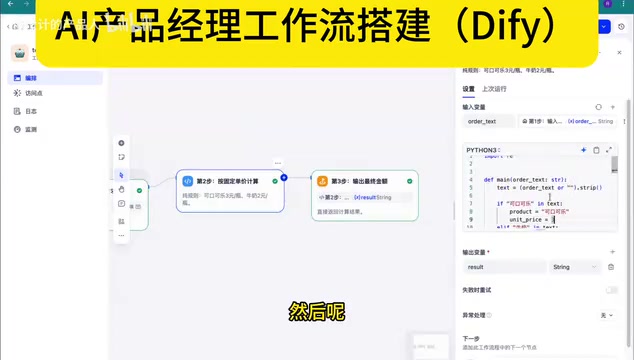
Dify Workflow in Practice: How AI Product Managers Build Business Processes with Low-Code
Based on a Bilibili AI PM course, this article covers Dify workflow concepts, three-layer node structure, deployment, and two real cases — cola pricing and jewelry custom quoting — showing when to use LLM nodes vs. hard rules.
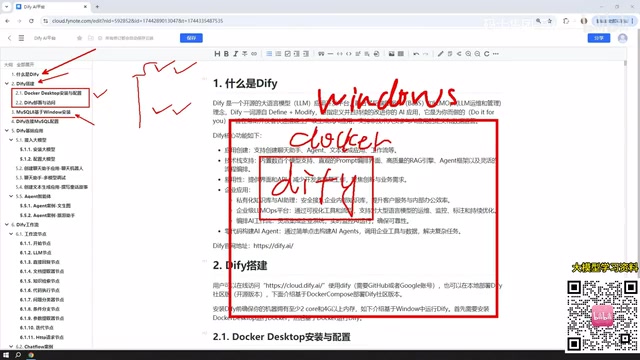
Dify from Beginner to Production: A Complete Learning Roadmap for Building AI Applications
Complete Dify tutorial: Windows Docker deployment, MySQL setup, five app types (Chat/Agent/Workflow), model integration, and publishing — build enterprise AI apps fast.