Beam Model Technical Report Explained: How a 501B-Parameter MoE Revolutionizes Coding and Reasoning
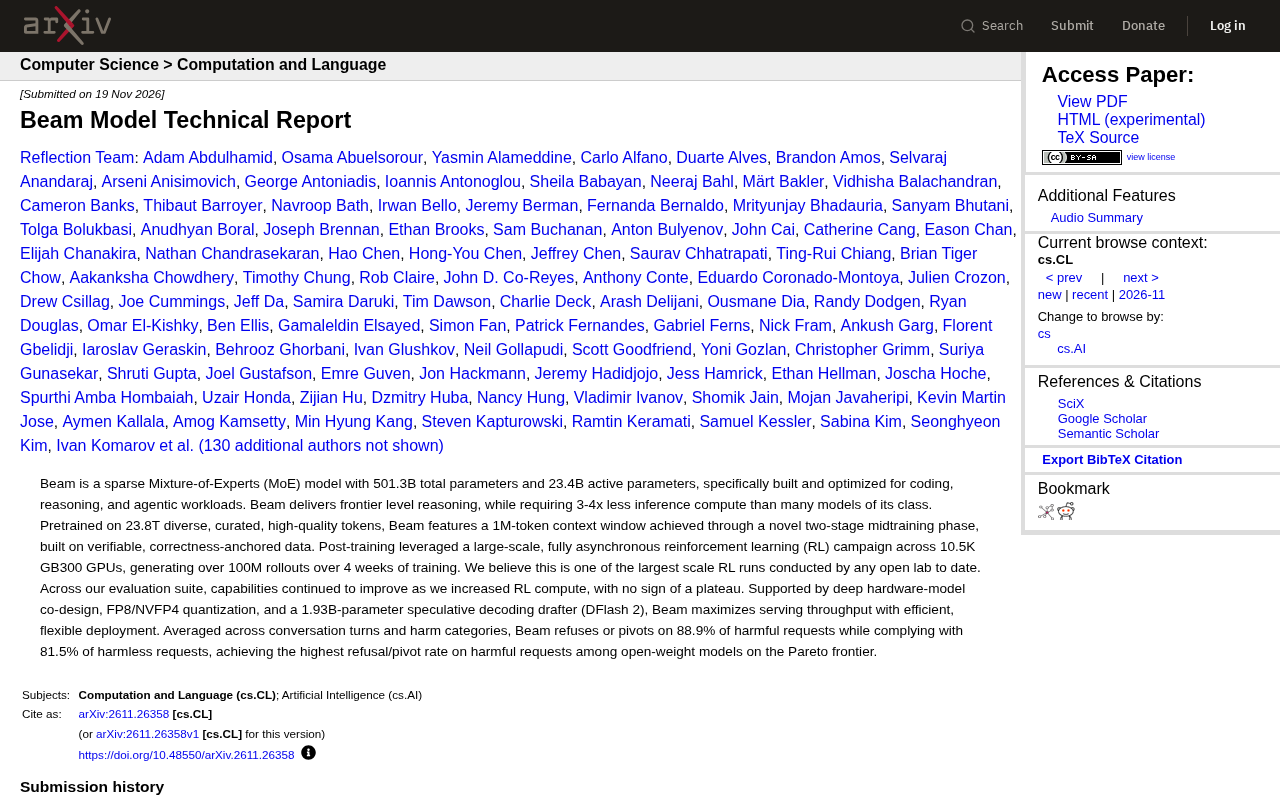
Beam uses sparse MoE and ultra-large-scale async RL to claim frontier coding and reasoning with 3-4x less inference compute.
Beam is a sparse MoE model with 501.3B total and 23.4B active parameters, targeting coding, reasoning, and agentic workloads, claiming frontier-level performance with 3-4x less inference compute than peers. It is pre-trained on 23.8T high-quality tokens and achieves a 1M-token context via two-stage midtraining. Post-training used 4 weeks of fully asynchronous RL on 10.5K GB300 GPUs, generating over 100M rollouts, with no observed plateau as RL compute scaled. Deployment combines FP8/NVFP4 quantization and the 1.93B draft model DFlash 2 for speculative decoding. Safety evaluations show 88.9% refusal/diversion of harmful requests and 81.5% compliance with harmless ones. The report offers a reference engineering recipe, but its claims still need independent replication.
The open-source community has welcomed a heavyweight contender. Beam is a sparse mixture-of-experts (MoE) model with 501.3B total parameters and 23.4B active parameters, explicitly built for coding, reasoning, and agentic workloads. The most striking aspect of the technical report is not the parameter scale, but its efficiency claim in inference compute: it achieves frontier-level reasoning capability with 3 to 4 times less inference compute than models of the same tier.

1. Architectural Choice: The Efficiency Logic of Sparse MoE
Beam adopts a sparse MoE architecture, which is the starting point for understanding its efficiency claims. The large gap between 501.3B total parameters and 23.4B active parameters means only a small subset of expert networks is activated in each forward pass. This design allows the model to maintain a vast knowledge capacity while keeping actual computational overhead close to that of small and medium-sized models.
This trade-off is especially critical for coding and agentic scenarios. Such workloads often require long-chain reasoning and multi-turn tool calls, and inference costs accumulate with interaction depth. If Beam's claimed 3 to 4 times inference compute savings hold in real deployments, they will directly affect the per-task cost of agentic applications.
Basic Mechanism of Mixture-of-Experts (MoE) Architecture
The core idea of MoE is to replace the single feed-forward network (FFN) in a traditional Transformer with multiple parallel "expert" sub-networks, and to equip each token with a lightweight router that decides which few experts process that token. The key to sparse MoE is "sparse activation": each token is routed to only a few experts (typically top-1 or top-2), rather than all experts. As a result, the model's total parameter count can grow linearly with the number of experts, but the actual computation per token depends only on the number of activated experts.
This contrasts sharply with dense models: every token in a dense model must pass through all parameters, so total parameters equal computation. Sparse MoE decouples "knowledge capacity" from "computational overhead," enabling the model to run at a computational cost far below its total parameter scale. Beam's 501.3B/23.4B ratio is approximately 21:1, meaning only about 4.7% of parameters are used in a single forward pass. This mechanism also introduces training challenges such as load balancing and expert collapse, which typically require auxiliary loss functions to constrain the routing distribution.
2. Training Data and Million-Token Context
Beam's pre-training corpus consists of 23.8T filtered high-quality tokens. More noteworthy is its 1M token context window, which the report says is achieved through a novel two-stage midtraining phase built on verifiable, correctness-anchored data.
The practical significance of million-token context for coding tasks is that entire code repositories, long technical documents, or multi-turn agent session histories can be included in the context at once, reducing information loss caused by truncation. The "correctness-anchored" data construction approach suggests stronger filtering standards for data quality rather than mere scale during training.
Technical Background of Midtraining and Million-Token Context
Midtraining is a stage between pre-training and post-training, typically using more curated, higher-quality data than pre-training and targeting specific capabilities (such as long context and instruction following). Compared with pre-training, midtraining uses much less data but applies stricter filtering and more explicit objectives. Beam reports that its 1M token context window is achieved through "two-stage midtraining," meaning long-context capability does not emerge naturally during pre-training but is gradually extended through dedicated midtraining stages.
The technical challenge of million-token context lies in the quadratic complexity of attention mechanisms: standard self-attention has O(n²) compute and memory overhead with respect to sequence length n, and the attention matrix for a 1M token sequence is extremely large. The industry typically mitigates this with sparse attention, linear attention approximations, block-wise computation, or positional encoding extrapolation (such as RoPE interpolation). In addition, long-context training requires large amounts of long-document corpora, and models are prone to "losing" information in the middle of long sequences, making correctness-anchored data construction particularly critical for maintaining long-range consistency.
3. Large-Scale Asynchronous Reinforcement Learning: RL Experiments at the Tens-of-Thousands-of-GPUs Scale
The core of Beam's post-training phase is a large-scale, fully asynchronous reinforcement learning training run: conducted on 10.5K GB300 GPUs over a 4-week training cycle, generating over 100M rollouts. The report states outright that this may be one of the largest RL training runs in any open lab to date.
One noteworthy observation is that as RL compute increased, the model's capabilities on evaluation suites continued to improve without signs of a plateau. This phenomenon is directly relevant to the long-standing community question of whether "RL scaling will hit a ceiling." Beam's report provides evidence from an ultra-large-scale experiment that "continuing to increase RL compute still yields gains," but note that this is a self-report from a single source and awaits independent replication.
Implications of Asynchronous Reinforcement Learning and RL Scaling
In LLM post-training, reinforcement learning typically follows a "generate—evaluate—update" loop: the model generates multiple responses to prompts (rollouts), a reward model or verifiable rules score them, and policy gradients (such as PPO or GRPO) update the parameters. Synchronous RL requires strict alternation between generation and training, resulting in low GPU utilization; asynchronous RL decouples rollout generation from parameter updates, allowing inference clusters and training clusters to operate in parallel, greatly improving hardware utilization—this is precisely the engineering basis that enabled Beam to run on 10.5K GPUs for 4 weeks and generate over 100M rollouts.
"RL scaling" refers to whether model capabilities continue to improve as more compute is invested in the RL stage. Because RL training is unstable and reward signals may saturate, the community has long worried that its gains would quickly plateau. Beam reports no observed plateau; if true, this means that with sufficiently large asynchronous RL infrastructure, post-training compute remains an effective scaling dimension. However, the causal chain between rollout count and capability improvement still requires independent verification, and the stale policy problem introduced by asynchrony may also affect the generality of the conclusions.
4. Deployment Optimization: Quantization and Speculative Decoding
Beam's high-throughput serving capability relies on multiple engineering optimizations. The report mentions deep hardware-model co-design, FP8/NVFP4 quantization, and a 1.93B-parameter speculative decoding draft model (DFlash 2).
Speculative decoding reduces latency while maintaining output quality by using a small model to quickly generate candidate tokens and then having the large model verify them. Combined with low-precision quantization, these approaches all point to one goal: making a 501B-class MoE model economically viable in actual serving. For teams hoping to build their own inference services using open weights, deployment efficiency is often more decisive than benchmark scores.
Technical Details of Quantization and Speculative Decoding
FP8 and NVFP4 are two low-precision numerical formats. FP8 (8-bit floating point) has native support on Hopper and later GPU architectures, halving the storage and compute bandwidth for weights and activations while maintaining numerical stability through scaling factors. NVFP4 is a more aggressive 4-bit floating-point format that further compresses memory usage and transfer overhead, but is more sensitive to quantization error and typically requires fine-grained group scaling strategies. For a 501B-class MoE, quantization directly determines the number of experts that can be hosted per GPU and the inference throughput.
Speculative decoding leverages the "small model drafts, large model verifies" paradigm: the draft model (DFlash 2 at 1.93B in Beam) rapidly autoregressively generates several candidate tokens, and the target large model needs only a single forward pass to verify these candidates in parallel, accepting the longest matching prefix. When the draft model's predictions are highly consistent with the target model, per-token latency can be significantly reduced without changing the output distribution. The smaller the draft model and the higher the acceptance rate, the more pronounced the speedup; DFlash 2's 1.93B scale is designed precisely to balance acceptance rate and drafting cost.
5. Safety Alignment: Balancing Refusal Rate and Helpfulness
On the safety dimension, Beam reports a set of data worth unpacking: averaged across conversation turns and harm categories, the model refuses or diverts 88.9% of harmful requests and complies with 81.5% of harmless requests. The report claims that on the Pareto frontier of open-weight models, Beam achieves the highest refusal/diversion rate for harmful requests.
These numbers require careful interpretation. The simultaneous occurrence of a high refusal rate and a high compliance rate indicates that the model has some ability to distinguish safety categories rather than simply adopting a conservative strategy. However, the claim of "highest on the Pareto frontier" depends on the evaluation set defined by the report itself, and actual safety performance still requires third-party red-team testing for verification.
6. A Rational View of the Technical Report
Beam's technical report outlines a clear path: sparse MoE controls inference costs, million-token context serves long tasks, ultra-large-scale asynchronous RL improves reasoning capability, and engineering optimizations ensure deployment economics. Each item is supported by concrete numbers and holds within the report's own evaluation framework.
For developers and technical decision-makers, the value of this report lies in providing a reference engineering recipe rather than a final conclusion. Once the model weights are released, independent community evaluations on real coding and agentic tasks will be key to testing these claims.
One-line Summary
With sparse MoE and ultra-large-scale asynchronous RL, Beam claims to achieve frontier coding and reasoning capability with 3-4x less inference compute.
Related articles

VP ≠ VNP: A Major Breakthrough in Computational Complexity Theory
A study claiming to prove VP ≠ VNP over every field sparks heated discussion on Hacker News. This article analyzes the algebraic complexity background of VP and VNP, the proof approach, community controversy, and its potential impact on computational complexity theory.

Developer Naming Woes: The Technical Names That Drive Us Crazy
Why is technical naming so maddening? From Nginx and Vite to Qt and Sudo, a YouTube creator rants about the chaos of developer naming and pronunciation, revealing the tug-of-war between creators' intentions and community habits, and the cultural roots behind spelling traps like PyPI and GNOME.

Figma Workplace Scandal: Employee Sues CEO for Forcing Confrontation with Harasser
Figma and its CEO are sued by a current employee alleging sexual harassment and discrimination, and forcing the victim to confront her harasser. This article outlines the background, potential impact, and industry reflection.