Beat: A To-Do App That Completes Its Own Tasks

Beat is an early product that tries to let AI agents automatically complete to-do tasks, facing technical, trust, and security challenges.
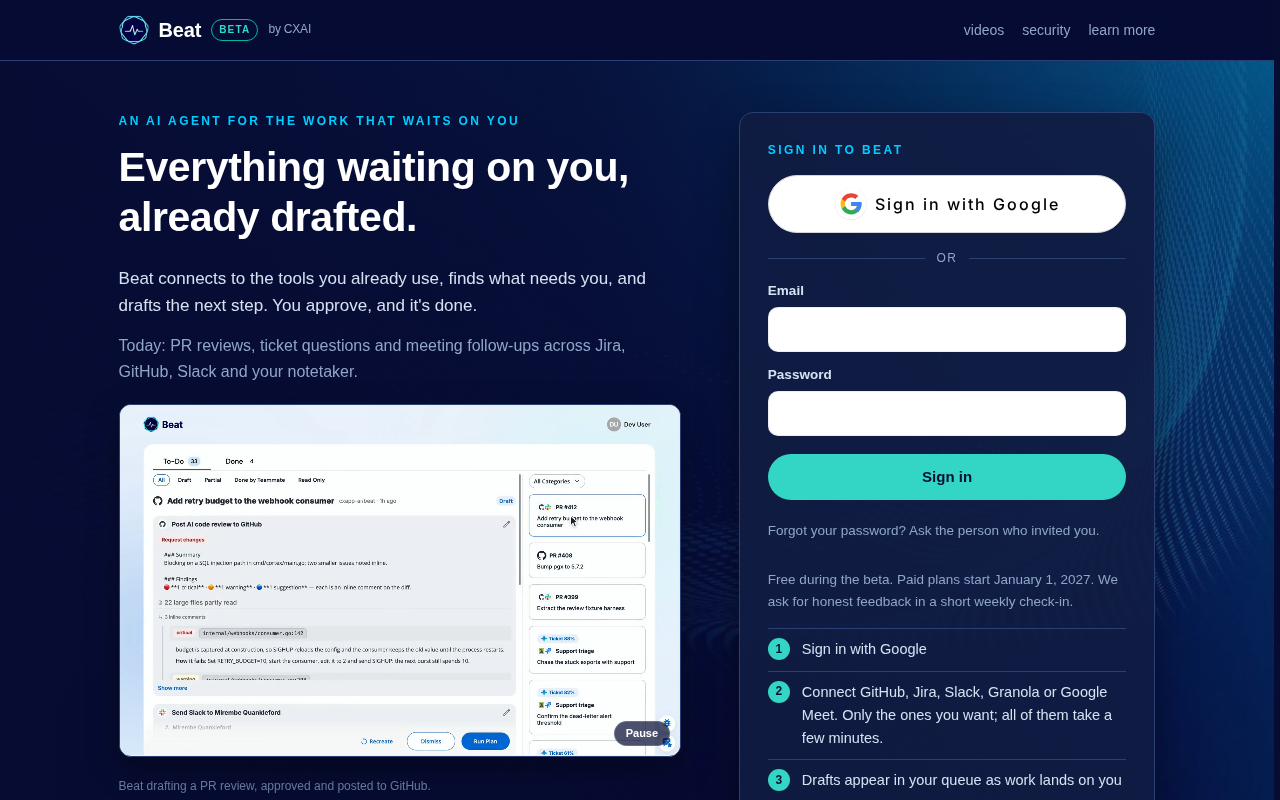
Beat is an early project showcased on Hacker News that bills itself as "a to-do list that completes its own tasks." It attempts to embed AI agent capabilities into task management so the system can not only record and remind tasks but also automatically parse intent, invoke external tools, and verify results. This requires solving task parsing, tool invocation, and result verification, typically relying on LLM function calling. Beat's differentiation is redefining task management as task delegation rather than mere recording and reminding. However, trust and security are key barriers to acceptance for automatic-execution to-do tools; users need clarity on capability boundaries and intervention methods. The project currently has very low exposure and is at a very early stage, making it a useful sample for observing AI agents in personal productivity tools.
On Hacker News' Show HN section, a project called Beat has drawn attention: it bills itself as "a to-do list that completes its own tasks." The description seems contradictory—the essence of a to-do list is to remind people to execute, yet Beat tries to make the list itself the executor. The logic behind it is likely combining AI agents with traditional task management tools, so the system not only records tasks but also automatically pushes them toward completion.
The Product Leap from "Reminder" to "Execution"
The core value of traditional to-do apps lies in recording and reminding: you write down a task, set a time, and then complete it yourself. Beat's positioning tries to cross this step—once a task is created, the system attempts to complete it automatically. This means the product needs the ability to understand task intent, invoke external tools or APIs, and verify execution results.
This model didn't appear out of thin air. In recent years, discussion around AI agents has continued to heat up, from automatically writing code to automatically handling emails—agentic AI is moving from demos to practical use. Beat can be seen as a concrete attempt at this trend in personal productivity tools: redefining "task management" as "task delegation."
AI Agent (Artificial Intelligence Agent) refers to a software system capable of perceiving its environment, making autonomous decisions, and taking actions to achieve specific goals. Unlike traditional chatbots or rule engines, AI agents typically possess planning, memory, tool use, and reflection capabilities, enabling them to complete multi-step tasks without human intervention. In personal productivity scenarios, an AI agent can be viewed as a "digital assistant" that not only understands natural language instructions but also calls external APIs, operates software interfaces, and adjusts its strategy based on execution results. Beat's claimed ability to "complete its own tasks" is based on this kind of agentic capability, transforming to-do items from static records into dynamic execution units.
Key Technical Challenges
A to-do list that can complete its own tasks needs to solve problems at several levels. First is task parsing: to-do items written in natural language (such as "send Zhang San a meeting minutes email") need to be broken down into executable steps. Second is tool invocation: the system must have the ability to send emails, check calendars, access files, and so on, which usually relies on an integration ecosystem or browser automation. Finally, result verification: how to confirm that a task was truly completed rather than producing erroneous operations.
Public information is currently limited, but it can be inferred that products like Beat are most likely built on LLMs, connecting to external services through function calling or similar mechanisms. Its actual capability boundary depends on the types of tasks supported and the scope of integrations. For simple, structured tasks, the automation success rate may be relatively high; for vague tasks or those requiring human judgment, the system needs to design fallback mechanisms.
Function Calling is a core mechanism for interaction between large language models (LLMs) and external tools. Developers can predefine a set of functions (such as sending email, querying calendars, creating files) and describe their purposes and parameters; when a user inputs a natural language request, the LLM determines whether to call a function and generates call parameters that conform to the format. After the system executes the function, it returns the result to the model, which then generates a final response or continues to the next step accordingly. This mechanism allows LLMs to break through the limitations of pure text generation and become a bridge connecting natural language with real-world operations. For tools like Beat that automatically execute to-dos, function calling is the key technical foundation for implementing the "tool invocation" step.
Fallback Mechanism refers to a design in automated systems that turns to human intervention or adopts an alternative approach when a task cannot be reliably completed or an abnormal situation is encountered. During an AI agent's task execution, due to the ambiguity of natural language, instability of external services, or permission restrictions, the system may fail to accurately understand intent or successfully invoke tools. At this point, a robust fallback mechanism can pause the automated process, request clarification or confirmation from the user, or degrade to merely providing suggestions without executing operations. For products like Beat, a fallback mechanism is an important safeguard for balancing automation efficiency with execution safety, and is especially indispensable when handling complex tasks that require human judgment.
Potential Impact on the Task Management Market
To-do apps are a mature and crowded track, with products like Todoist, Things, and TickTick already occupying a large share of users' minds. Beat's differentiation lies in embedding AI agent capabilities directly into the task flow rather than offering them as an add-on chat assistant. This design of "tasks as execution units," if the experience is smooth, could change how users use to-do tools—from "write it down to remind myself" to "write it down and hand it to the system."
However, trust is the biggest barrier. Users need to clearly understand what the system can and cannot do, and how to intervene when automated execution goes wrong. In addition, automated execution involves account permissions and data access, so security and privacy design will become key factors in whether the product is accepted.
Current Stage and Observational Value
As an early project on Show HN, Beat's exposure is still very low (the post has only 4 points and 1 comment), which means it is still at a very early stage, with product details, pricing, and roadmap not fully public. For developers interested in AI productivity tools, it is worth observing as a sample: to see how individual developers or small teams bring AI agents into concrete scenarios, and how the market accepts this kind of "automatic task completion."
If you are interested in this direction, you can directly check the original Hacker News post to learn about the project link and the author's explanation. Whether it can move from a concept demo to a stable and usable product in the future depends on the breadth of task coverage, execution reliability, and the establishment of user trust.
One-line Summary
Beat is an early product that attempts to let AI agents automatically complete to-do tasks, facing technical, trust, and security challenges.
Paragraph Summary
Beat is an early project showcased on Hacker News that bills itself as "a to-do list that completes its own tasks." It attempts to embed AI agent capabilities into task management, so that the system can not only record and remind users of tasks but also automatically parse task intent, invoke external tools, and verify execution results. This requires solving problems at three technical levels: task parsing, tool invocation, and result verification, typically relying on LLM function calling mechanisms. Beat's differentiation lies in redefining task management as task delegation rather than mere recording and reminding. However, trust and security are key barriers to acceptance for automatic-execution to-do tools; users need to clearly understand the system's capability boundaries and ways to intervene. Currently, the project has very low exposure and is at a very early stage, making it suitable as a sample for observing how AI agents land in personal productivity tools.
Related articles

Abnormal Error Rate Spike in Claude Mythos 5.2 and Fable 5.2
Claude Mythos 5.2 and Claude Fable 5.2 show an abnormal spike in request error rates, marked as investigating on the official status page. This article covers the incident overview, practical impact on developers, and recommended responses.

ReAct Runtime Context Trimming: Why Claude Code Acts at 70%
A deep dive into ReAct runtime context trimming: why Claude Code compresses at ~70% usage, why tool calls dominate, why messages must be dropped in pairs, and why codebases don't need RAG.

AI Agent vs LLM: How Cursor and Claude Code Actually Work
An in-depth analysis of the essential difference between AI Agents and LLMs: LLMs generate code suggestions, while Agents modify files and run tests via tool calls. Using a Spring Boot bug fix as an example, it breaks down the workflows, permission control, and verification mechanisms of Cursor and Claude Code.