Behind a Reddit Joke: The Real Battle of Academic Paper Rebuttals

A Reddit goat meme captures the exhausting reality of academic paper rebuttals at top conferences.
A Reddit post comparing a paper review rebuttal to an unkillable stubborn goat resonated widely across academic communities. The article uses this as a springboard to explain the rebuttal process at top conferences like NeurIPS and ICML — where authors respond to anonymous reviewer critiques within strict word limits to fight off rejection. With acceptance rates around 20–25% and subjective review standards, rebuttals are high-pressure battles. The piece also explores the cultural phenomenon of "Reviewer 2" memes and closes with practical advice: target core concerns, back arguments with data, stay professional, and focus limited space on what actually changes scores.
A Reddit Meme That Sparked an Academic Conversation
A post recently circulating on Reddit caught the attention of the academic community with its sardonic humor. Titled "Live footage of successful paper review rebuttal," the post was captioned: "Goat was too stubborn to be murdered."
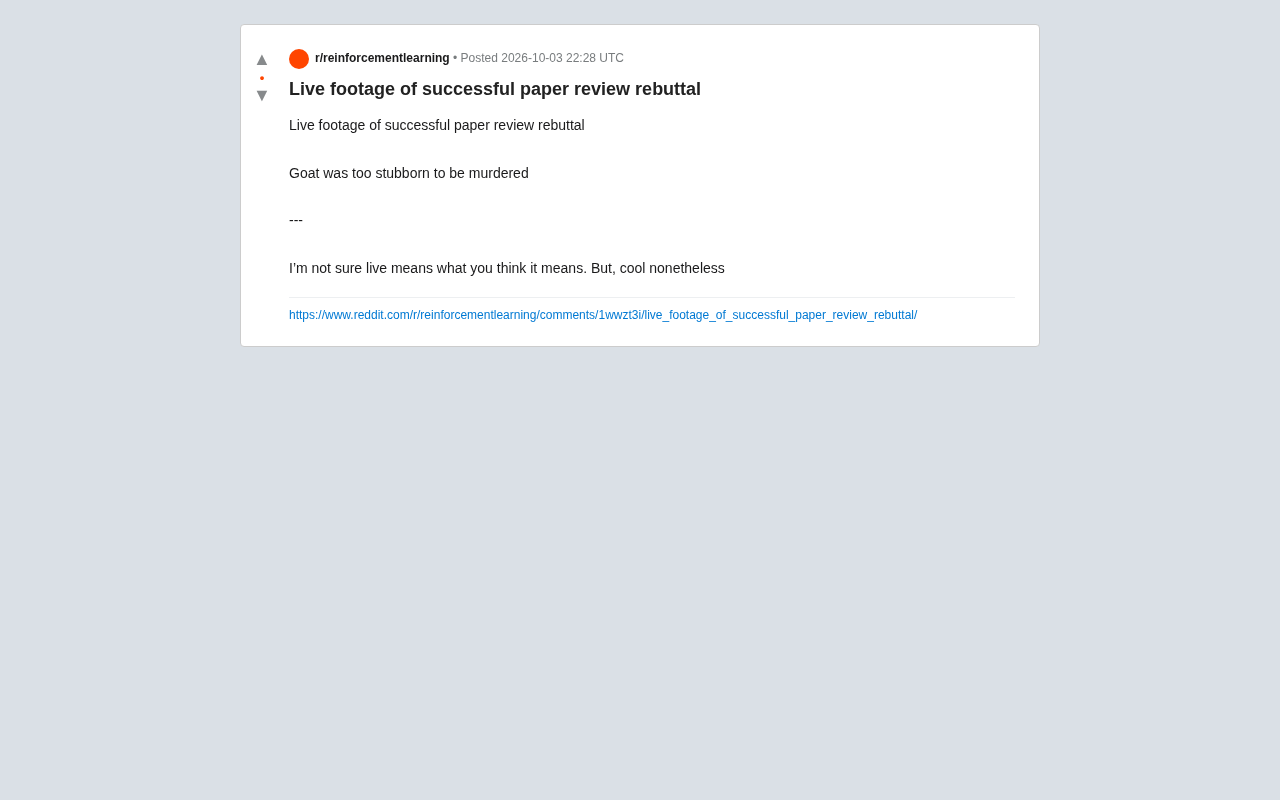
One commenter immediately played along: "I'm not sure 'live' means what you think it means, but still pretty cool." This kind of self-deprecating humor hits home for anyone who has survived the peer review gauntlet — facing a reviewer's criticisms, authors often have no choice but to dig in like that stubborn goat and fight for their work.
What looks like a simple joke actually reflects one of academia's most tension-filled rituals: the rebuttal.
What Is a Rebuttal in Academic Peer Review?
The rebuttal is a critical stage in the modern academic paper review process, especially at top AI and machine learning conferences such as NeurIPS, ICML, CVPR, and ACL. Here's how it works:
The Basic Mechanism
Once a paper is submitted, it is assigned to multiple anonymous reviewers who score and critique it. Reviewers raise concerns, ask questions, and suggest improvements. After receiving these initial reviews, authors are given one precious opportunity to respond — within a strict page or word limit (sometimes just a few pages or even a few hundred words) — to address the reviewers' concerns, clarify misunderstandings, and provide additional experimental evidence.
The reason Reddit users compared this to "a goat too stubborn to be murdered" is that it's fundamentally a standoff: reviewers look for weaknesses in the paper and lean toward rejection, while authors must tenaciously defend their core contributions. A "successful rebuttal" means the authors managed to turn around a reviewer's negative impression through well-reasoned, evidence-backed responses — bringing the paper back from the brink.
Why Rebuttals Are So Hard
At competitive top-tier conferences, acceptance rates typically hover around 20–25%. Conflicting reviewer opinions, subjective evaluation standards, and brutal word limits all make the rebuttal a high-stakes race against time and logic. Many researchers describe the waiting period after submitting a rebuttal as "agonizing" — and when a reviewer actually raises their score in response, it genuinely feels worth celebrating, just like surviving the meme.
It's worth noting that review mechanisms at top AI conferences have been evolving. NeurIPS and ICLR, for example, have adopted the Open Review platform, where reviewer comments and author responses are publicly visible, creating a unique transparent review ecosystem. ICLR even allows community members to participate in discussions, meaning the rebuttal is no longer just a private exchange between authors and reviewers. Many conferences also have Area Chairs who arbitrate when authors and reviewers reach an impasse, making the final call on acceptance or rejection. This means the rebuttal isn't just aimed at the reviewers themselves — it's also directed at Area Chairs who may ultimately determine the paper's fate, adding another layer of strategic complexity.
The Cultural Resonance Behind the Meme
The reason self-deprecating content like this spreads so quickly through academic communities on Reddit is that it taps into a shared emotional experience. Peer review may be the cornerstone of academic quality control, but its pressure, uncertainty, and occasional arbitrariness have also given rise to a rich culture of humor as a coping mechanism.
From the "stubborn goat" to the countless "Reviewer 2" memes (typically referring to that one particularly harsh and difficult reviewer), academic memes have become an unspoken emotional bond among researchers. They use levity to express a serious reality: getting a paper published requires not just rigorous research, but also resilience and communication skills in the face of scrutiny.
The "Reviewer 2" joke has deep roots in academic culture and has become a cross-disciplinary subculture symbol. It stems from a long-observed phenomenon: among multiple reviewers, there's almost always one who delivers the harshest, most nitpicky, or outright baffling critique — and by convention, this person is dubbed "Reviewer 2." Communities like "Reviewer 2 Must Be Stopped" and dedicated meme collections have sprung up on social media, with scholars using collective mockery to cope with the powerlessness inherent in anonymous peer review. In a broader sense, the rise of this online culture has also fueled more serious discussions about whether the peer review system itself needs reform — including debates around double-blind review, reviewer incentive structures, and review quality oversight.
Practical Takeaways for Researchers
Jokes aside, a truly "successful rebuttal" tends to share a few key characteristics:
- Address the core concerns directly: Focus on what the reviewers actually care most about, rather than mechanically responding to every point
- Let data and evidence do the talking: Provide supplementary experiments and concrete proof — don't just argue in the abstract
- Stay polite and professional: Even when a reviewer is clearly mistaken, clarify with a constructive tone
- Prioritize strategically: Use your limited space on the disputes that can actually move the needle on scores
The goat that couldn't be killed didn't survive through brute force — it survived by showing exactly the right amount of stubbornness in exactly the right places. Perhaps that's the metaphorical lesson this meme offers to every researcher out there.
Related articles

"Black October": Did AI Uncover 3% of All Critical Vulnerabilities Ever?
A Reddit post claims 3% of all critical software vulnerabilities ever were found in the past month, dubbed 'Black October.' We break down the statistical issues, how AI-assisted code auditing accelerates discovery, and how developers should respond.

Microsoft Project Gecko: Using AI to Bridge Language Gaps for African Farmers
Microsoft's Project Gecko launches PharmaChat, letting African farmers ask questions in their native language and get precise video clips and farming book chapters via AI. The project also releases three interactive manuals to advance inclusive AI.

Musk's Space Dominance: How Starlink Throttling Undermines Ukraine's Defense
SpaceX's Starshield throttling disabled Ukraine's high-speed interceptor drones, exposing how Musk's private control over low Earth orbit communications affects battlefield dynamics and national security, and highlighting the risks of commercial space militarization and space governance dilemmas.