Behind a Thank-You Tweet: Where Tech Leadership Meets Political Power

A brief thank-you tweet to the U.S. President reflects tech and political power's increasingly public entanglement.
A tech leader's tweet thanking the U.S. President for an honor — with no specific award or partnership details — serves as a lens for examining deeper dynamics. The piece analyzes how such PR gestures reflect AI and semiconductor industries being embedded in national strategy, with tech leaders' White House appearances functioning as identity confirmation and public signals of the business-government relationship. Phrases like "continue together" hint at existing collaboration and future expectations. The author urges caution: symbolic value outweighs substance, context determines meaning, and tracking accumulated signals matters far more than parsing any single post.
A Tweet Worth Examining
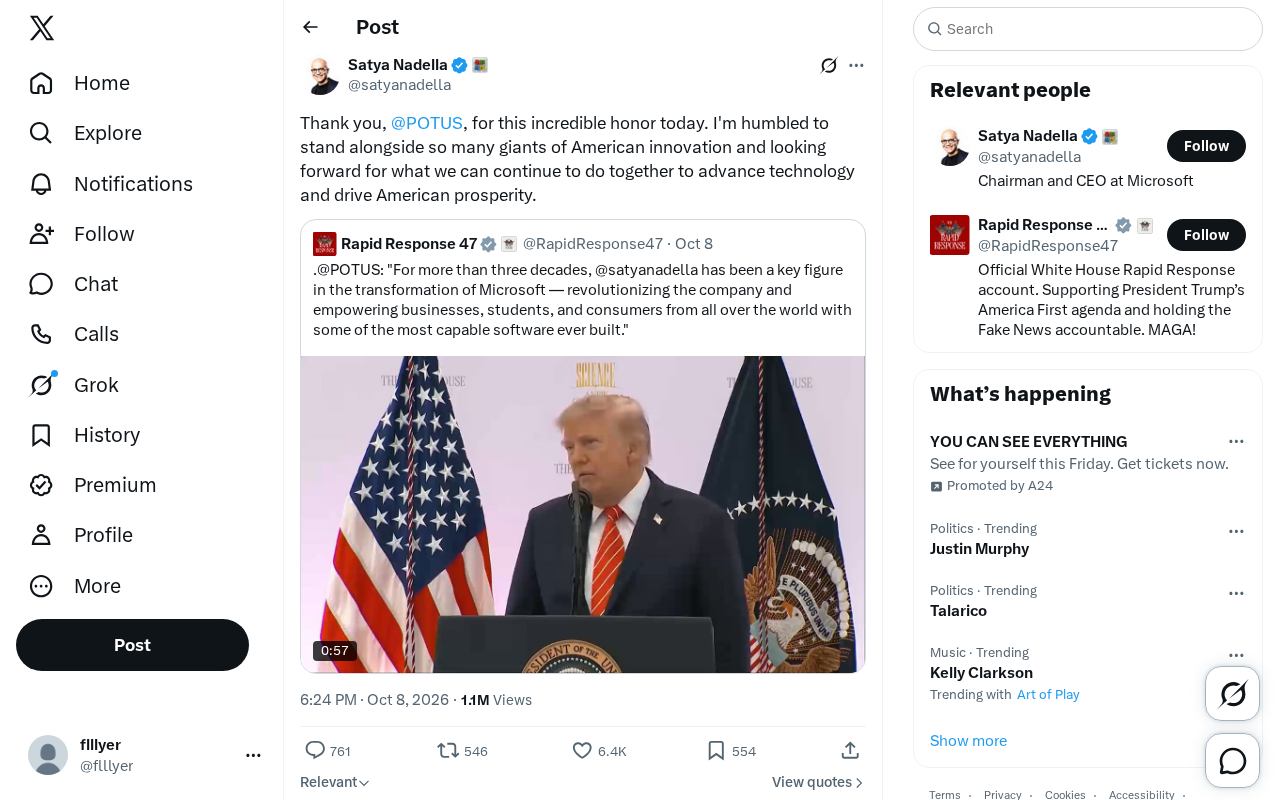
The tweet was brief: a tech leader thanking the President of the United States (@POTUS) for an honor bestowed, expressing humility at standing alongside so many giants of American innovation, and looking forward to continuing to work together to advance technology and drive American prosperity.
On the surface, this is a textbook PR acknowledgment — no specific award named, no partnership details, no technical direction disclosed. Yet these seemingly formulaic gestures often reveal something more significant: the increasingly public and close relationship between the tech industry and political power.
Tech and Politics, Openly Aligned
The phrases "incredible honor" and "giants of American innovation" suggest this was an officially organized event or ceremony bringing together multiple tech leaders — the kind of occasion that carries symbolic weight on two levels: official recognition of individual and corporate contributions, and a public signal of intent for public-private collaboration.
In today's macro environment, AI, semiconductors, and advanced manufacturing have become core national competitiveness issues. Tech leaders appearing regularly at official functions reflects how technological development has been increasingly woven into national strategic narratives. Phrases like "advance technology and drive American prosperity" are a textbook example of aligning corporate goals with national interests.
This institutionalized form of public-private alignment has deep historical roots in the United States. Mechanisms like the President's Council of Advisors on Science and Technology (PCAST) and the National Medal of Technology and Innovation have long served as formal channels for the government to engage the tech community and signal policy direction. In recent years, as AI regulation, chip export controls, and data security have risen to national security concerns, the pace of interaction between Silicon Valley and the White House has accelerated noticeably — from Obama's tech advisory networks, to the Biden administration's AI safety commitment summits, to the Trump administration's Stargate project. The forms of public-private collaboration have grown more varied, and more visible. This trend means tech companies benefit from government endorsement and resource allocation, while facing growing scrutiny over their independence and obligations to the public interest.
Reading the Signals in the Language
The word choices in the tweet are worth unpacking. "Humbled to stand alongside" is a familiar rhetorical move for public figures — it expresses respect for peers while quietly confirming one's own place within that elite circle.
The phrase "what we can continue to do together" is particularly telling. That word "continue" implies an existing foundation of collaboration and signals that further cooperation is anticipated. For observers tracking tech policy, statements like this carry no specific commitments — but they do serve as a reference point for gauging the temperature of the relationship between business and government.
How to Interpret Statements Like This
When engaging with highly PR-managed content, a degree of caution is warranted:
- Low information density: The tweet itself provides no verifiable factual details, making it impossible to draw conclusions about specific policy or business developments.
- Symbolic value outweighs substance: The primary function of statements like this is image management and relationship affirmation, not information disclosure.
- Context is everything: The real meaning only emerges when placed within the specific event and policy backdrop.
The public interplay between tech leaders and political power has always been a sensitive and consequential topic. It shapes the direction of technological development, the loosening or tightening of regulation, and the distribution of innovation resources. A single tweet can't tell us much on its own — but it is a small window into a much larger picture.
From a communications theory perspective, tweets like this function as meta-communication — their meaning lies not in the literal content, but in the act of publishing them. Choosing to publicly thank the president, tagging @POTUS directly, is itself a performance of identity and a confirmation of relationship. The intended audience is not the general public, but industry peers, investors, policy observers, and journalists. This also explains why such tweets tend to be so formulaic: specificity creates risk, while vague positivity achieves maximum image management at minimum informational cost.
Conclusion
The value of this tweet lies not in what it says, but in the context surrounding it. The intersection of tech and politics is becoming more public and more frequent, bringing with it both resources and opportunities — as well as growing debate about the boundaries of influence. For industry observers, tracking the accumulation of signals like this over time is far more meaningful than parsing any single post.
Related articles

"Black October": Did AI Uncover 3% of All Critical Vulnerabilities Ever?
A Reddit post claims 3% of all critical software vulnerabilities ever were found in the past month, dubbed 'Black October.' We break down the statistical issues, how AI-assisted code auditing accelerates discovery, and how developers should respond.

Microsoft Project Gecko: Using AI to Bridge Language Gaps for African Farmers
Microsoft's Project Gecko launches PharmaChat, letting African farmers ask questions in their native language and get precise video clips and farming book chapters via AI. The project also releases three interactive manuals to advance inclusive AI.

Musk's Space Dominance: How Starlink Throttling Undermines Ukraine's Defense
SpaceX's Starshield throttling disabled Ukraine's high-speed interceptor drones, exposing how Musk's private control over low Earth orbit communications affects battlefield dynamics and national security, and highlighting the risks of commercial space militarization and space governance dilemmas.