Behind the US Ban on DeepSeek: 20% API Share and China's Hardware Breakthrough

DeepSeek's global API share exceeding 20% triggers a US ban as large-model competition shifts to unit inference cost.
The US Department of Homeland Security issued an emergency directive requiring federal civilian agencies to remove the Chinese open-source large model DeepSeek. The article notes that open-source models can be forked and deployed locally, so the technical effect of an administrative ban is limited and more of a signal-level action. The backdrop lies in two sets of data: first, DeepSeek's share of global large-model API calls has exceeded 20%, surpassing Google and OpenAI, and open source plus low cost is shaking the commercial foundation of closed-source per-token billing; second, Changxin Storage has developed a 4F2 architecture that reduces cell area by about 30%, raising the capacity ceiling of domestic HBM and constituting a physical breakthrough path under process constraints (single source, pending verification). Together, the two lines point to the same judgment: the focus of large-model competition has shifted from the parameter arms race to unit inference cost, and cost efficiency rather than parameter scale is the real moat.
The US Department of Homeland Security recently issued an emergency directive requiring all federal civilian agencies to completely remove the Chinese open-source large model DeepSeek. Banning an open-source model is itself an unusual move—open-source code can be forked and deployed locally, and an executive order can only remove copies on federal devices; it cannot stop the model's flow through the technical community. So why is the US still in such a hurry? The answer lies in two sets of data.

20% Global API Share: An Open-Source Model Reaches the Center of the Table for the First Time
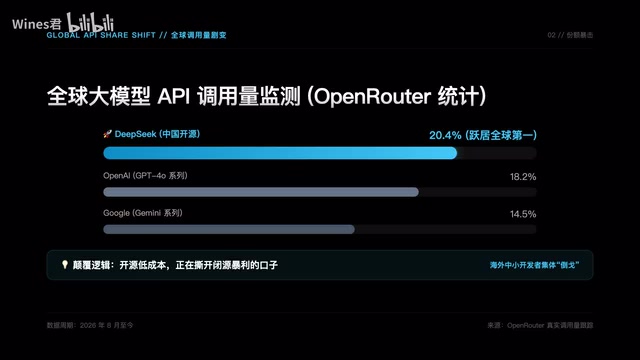
According to third-party monitoring data, DeepSeekAd's share of global large-model API calls has exceeded 20%, surpassing Google and OpenAI. The weight of this number needs to be understood in context: API call volume reflects real production-grade usage, not leaderboard scores or vanity metrics like download counts. A Chinese team's open-source model capturing one-fifth of global call share means a large number of developers and enterprises are voting with their feet.
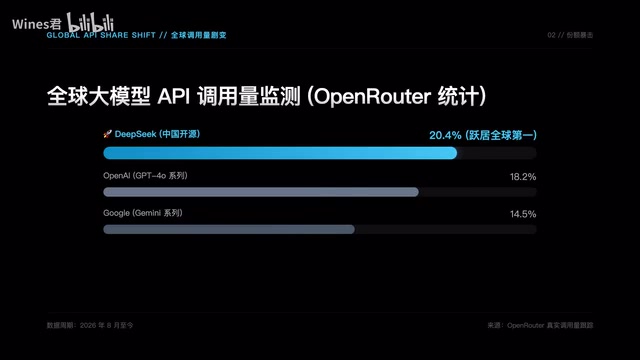
The combination of open source and low cost is tearing open a gap in the closed-source business model. Over the past two years, the main narrative of the large-model race has been parameter scale, but what truly determines commercial victory is unit inference cost—for the same task, whoever can make tokens cheaper and deployment more controllable will capture the long-tail market. DeepSeek's impact is not about how much stronger it is than closed-source models, but about how it spreads "good enough" capability at extremely low prices, directly shaking the commercial foundation of per-token billing.
The technical effect of an administrative ban is limited, but the signal is clear: once an open-source model's call share is enough to affect the market landscape, it is no longer just a technical product but is treated as a variable that needs to be addressed.
API call volume refers to the number of requests developers or enterprises make to a model through an application programming interface, usually billed by token. It is distinct from model benchmarks or download counts: benchmarks reflect the upper limit of capability under laboratory conditions, downloads reflect attention, while call volume reflects real production-grade usage—how many businesses actually embed the model into products and workflows. Therefore, call share is one of the most direct indicators of commercialization progress and a leading signal of the revenue structure of cloud providers and model companies.
Open-source large models refer to models whose weights are publicly downloadable and which allow local deployment and secondary development, such as DeepSeek and the Llama series. Unlike closed-source API services, inference for open-source models can be performed by users on their own hardware, with costs depending on hardware efficiency and deployment scale rather than vendor pricing. This means that once an open-source model's capability is "good enough," users can completely bypass the vendor's per-token billing—which is the fundamental reason open-source models pose a structural threat to closed-source business models.
The Other Side of the Compute Blockade: A Physical Breakthrough in Domestic Storage
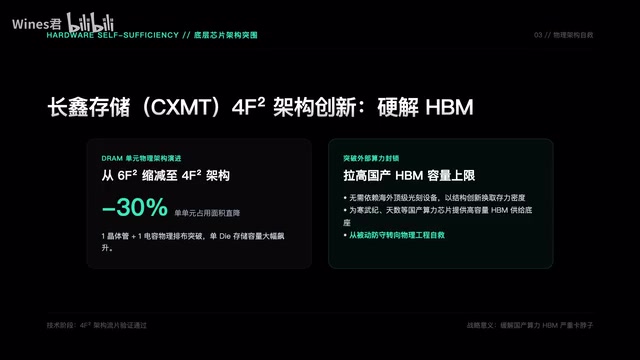
Another thread of the ban lies in hardware. According to a video on Bilibili, Changxin Storage has successfully developed a 4F2 memory architecture, reducing single-cell area by about 30% and raising the capacity ceiling of domestic HBM.
HBM is one of the key bottlenecks in AI compute; the supply of high-bandwidth memory directly determines the scale ceiling of training and inference clusters. The tighter external restrictions on advanced compute exports become, the stronger the incentive for breakthroughs at the physical level of underlying hardware—when process nodes are constrained, improving density through memory cell structure innovation is a realistic path around some restrictions. It should be noted that this hardware information currently comes from a single video source, and specific mass-production progress and performance metrics await cross-verification by more sources; readers should remain cautious.
Putting the software-layer call share and the hardware-layer storage breakthrough together, the logic becomes clear: on one side, the model is capturing the minds of global developers at low cost; on the other, compute infrastructure is seeking alternative paths at the physical level. The two lines叠加together form the backdrop for the US's urgent move—the ban targets not a single model file but the inertia being formed by this combination of "open-source models + domestic hardware."
HBM (High Bandwidth Memory) is a high-performance memory that vertically stacks multiple DRAM chips and interconnects them with through-silicon vias (TSVs), usually packaged together with GPUs to provide AI training and inference with bandwidth far exceeding ordinary memory. The bottleneck of large-model inference is often not peak compute but memory bandwidth—the speed of weight loading and data movement determines how many tokens can be processed per second. Therefore, HBM supply directly constrains the scale ceiling of AI clusters and is also one of the key categories in advanced compute export controls.
4F2 memory architecture is a DRAM cell layout design in which "F" refers to the minimum feature size and 4F2 means each memory cell occupies about 4 square feature sizes. Compared with the traditional 6F2 structure, it can reduce cell area by about one-third. A smaller cell area means the same wafer area can hold more storage capacity, thereby increasing memory density when process nodes are constrained. This is exactly what "physical-level breakthrough" means: not relying on more advanced process nodes but improving storage capacity per unit area through cell structure innovation.
The Commercial Endgame Is Unit Inference Cost, Not Parameter Arms Racing
The most important judgment from this contest is that the focus of large-model competition has shifted from the parameter arms race to unit inference cost. No matter how large the parameters are, if the cost per call cannot be reduced, commercial scaling is impossible; conversely, a model with "good enough" capability and extremely low price can rapidly penetrate cost-sensitive small and medium-sized enterprises and individual developers.
Open source is an amplifier in this logic. Closed-source models have a floor on price cuts because they must sustain commercial organizations; the cost structure of open-source models is determined by the community and hardware efficiency, so the room for price reduction is completely different. The crackdown on DeepSeek, to some extent, precisely proves the effectiveness of this path—if open-source low cost did not pose a threat, administrative means would not be needed.
For domestic AI practitioners, the lesson is not emotional confrontation but a clear view of the competitive dimension: the gap in model capability is narrowing, and the gap in cost efficiency is the real moat. Whoever can push inference costs lower will secure a position in the next phase of the battle for call share.
One-line Summary
DeepSeek's global API call share exceeding 20% triggers a US ban, as large-model competition shifts to unit inference cost.
Paragraph Summary
The US Department of Homeland Security issued an emergency directive requiring federal civilian agencies to remove the Chinese open-source large model DeepSeek. The article notes that open-source models can be forked and deployed locally, so the technical effect of an administrative ban is limited and more of a signal-level action. The backdrop lies in two sets of data: first, DeepSeek's share of global large-model API calls has exceeded 20%, surpassing Google and OpenAI, and open source plus low cost is shaking the commercial foundation of closed-source per-token billing; second, Changxin Storage has developed a 4F2 architecture that reduces cell area by about 30%, raising the capacity ceiling of domestic HBM and constituting a physical breakthrough path under process constraints (single source, pending verification). Together, the two lines point to the same judgment: the focus of large-model competition has shifted from the parameter arms race to unit inference cost, and cost efficiency rather than parameter scale is the real moat.
Related articles

Amphibious Transforming Drone: Beyond 100x Power Savings, What Are the Real Needs?
Is the amphibious transforming drone just a gimmick? Starting from the 100x power difference of the M4 Morphobot, explore real application scenarios and thesis topic ideas, analyzing boundary conditions where pure drones and pure ground robots both fail.

Warhound Raises $200 Million: Genetically Engineered "War Dogs" Paired with Anduril Gear
Warhound raises $200M, backed by Ben Lamm and Palmer Luckey, to genetically engineer dogs for military and law enforcement use and equip them with Anduril gear. This article analyzes its technology direction, funding logic, and ethical controversy.

Claude API Comes to Google Cloud: IAM Integration and SDK Access Guide
Anthropic hosts the full Claude API on Google Cloud with IAM-controlled permissions and unified billing. This guide covers the Vertex AI and Anthropic-hosted entry points, IAM role configuration, and SDK access.