Bengali Medical Text Triage: Are LLMs, Transformers, or Traditional Models Stronger?

Comparison of four model families for Bengali medical triage: Gemini has the highest zero-shot accuracy, but is statistically indistinguishable from tuned SVM and the strongest Transformer.
This study systematically compares traditional machine learning, deep learning, fine-tuned Transformers, and zero-shot LLMs in predicting medical specialties from colloquial Bengali patient narratives, using a unified evaluation framework of 2,730 records across five specialties. Gemini has the highest zero-shot accuracy (90.29%), XLM-RoBERTa leads among fine-tuned models (86.26%), and tuned SVM reaches 84.98%. However, Holm-corrected McNemar tests show most inter-model gaps are not statistically significant, with only SVM significantly outperforming Bi-LSTM. The conclusion: in low-resource language medical text classification, model selection should not blindly pursue architectural complexity—classical models remain cost-effective and competitive when feature engineering is properly done.
Introduction: When Patients Describe Symptoms in Colloquial Speech
In Bangladesh, South Asia, patients often describe their ailments in informal colloquial Bengali rather than using medical terminology. This way of expressing themselves makes triage difficult, and patients may be referred to the wrong department, delaying treatment. A new paper systematically compares four model families—traditional machine learning, deep learning, fine-tuned Transformers, and zero-shot large language models—in predicting medical specialties from Bengali patient narratives.
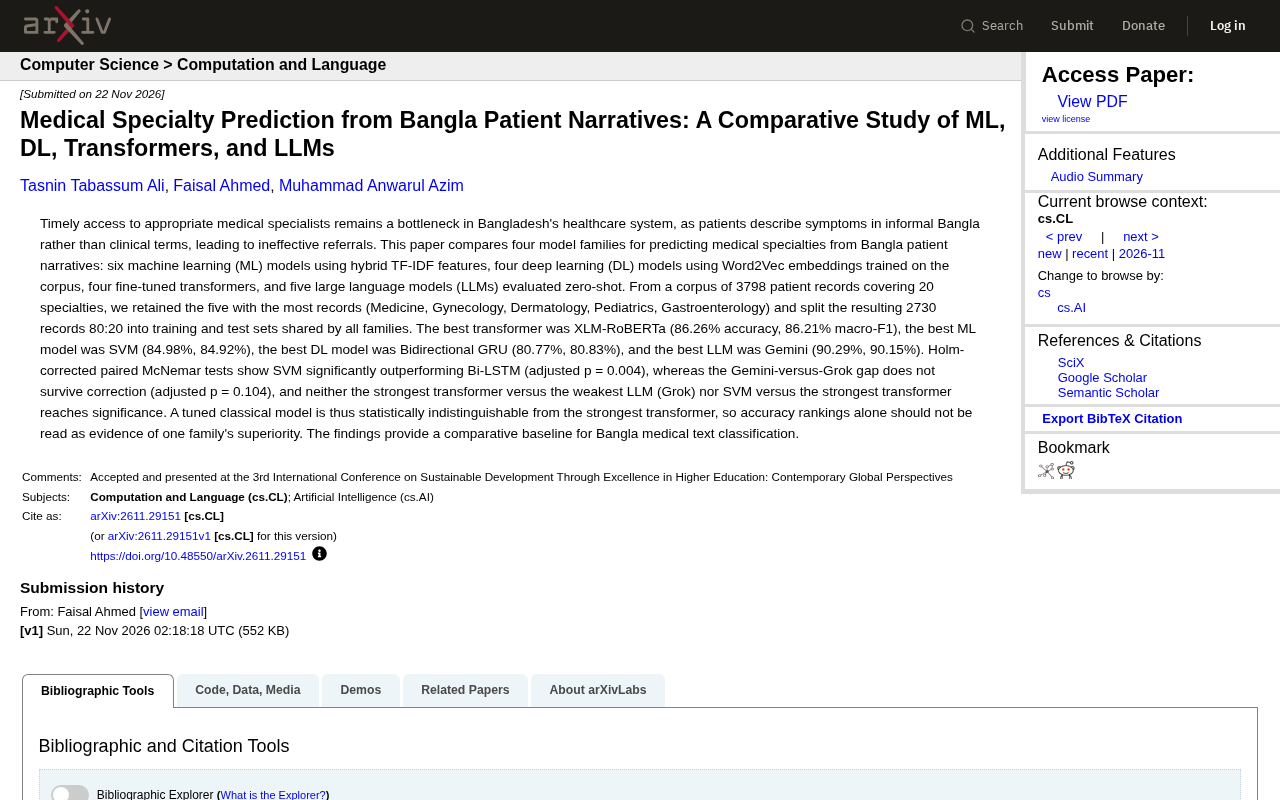
The study selected the five specialties with the largest record counts from 3,798 patient records: internal medicine, gynecology, dermatology, pediatrics, and gastroenterology, yielding a total of 2,730 records, split 80:20 into training and test sets shared across all model families. This unified evaluation framework makes comparisons across different technical approaches more informative.
Performance Comparison of the Four Model Families
Traditional Machine Learning: SVM Most Stable with TF-IDF Features
The study used six machine learning models based on hybrid TF-IDF features. The best performer was support vector machine (SVM), achieving 84.98% accuracy and 84.92% macro-averaged F1. This result shows that on medium-sized corpora, a tuned classical model remains highly competitive.
TF-IDF (term frequency-inverse document frequency) is a classic feature engineering method that converts text into numerical vectors. It consists of two parts: term frequency (TF) measures how often a word appears in a single document, while inverse document frequency (IDF) measures how rare that word is across the entire corpus—the rarer the word, the higher the IDF. After multiplying the two, common but non-distinctive words (such as "the" or "is") are downweighted, while rare words that represent the document's topic are upweighted. TF-IDF's advantages are its simplicity, strong interpretability, and independence from large-scale pretraining; its disadvantage is that it cannot capture word order or semantic similarity. In this study, "hybrid TF-IDF" typically refers to using both word-level and character-level n-gram features simultaneously, to mitigate the problems of numerous spelling variants and rich morphology in colloquial Bengali.
Deep Learning: Bidirectional GRU Leads
The four deep learning models used Word2Vec embeddings trained on the corpus. The best performer was the bidirectional GRU, with 80.77% accuracy and 80.83% macro-averaged F1. Compared with traditional machine learning, deep learning models showed no clear advantage on this task, possibly due to the limited data size.
Word2Vec is a word embedding technique based on a shallow neural network that learns dense vector representations by predicting context words (Skip-gram) or predicting the center word from context (CBOW). Unlike TF-IDF's sparse high-dimensional vectors, Word2Vec produces low-dimensional vectors (typically 100-300 dimensions) in which semantically similar words are closer together in vector space. In this task, Word2Vec embeddings were trained on the Bengali corpus, enabling the models to leverage semantic similarity between words. However, Word2Vec is a static embedding: the same word has only one vector representation regardless of context, so it cannot handle polysemy. In contrast, the contextual embeddings used by fine-tuned Transformers can dynamically adjust word meaning based on the sentence, which is one reason the latter are usually stronger on semantically complex tasks.
Fine-tuned Transformers: XLM-RoBERTa Wins
Among the four fine-tuned Transformers, XLM-RoBERTa performed best, with 86.26% accuracy and 86.21% macro-averaged F1. The adaptability of multilingual pretrained models to low-resource language tasks is once again validated.
XLM-RoBERTa is a multilingual RoBERTa model pretrained by Facebook AI on approximately 2.5TB of filtered CommonCrawl data across 100 languages. It removes BERT's next-sentence prediction task, uses larger batches and longer training, and employs a SentencePiece tokenizer to handle multilingual text uniformly. XLM-RoBERTa's key advantage is cross-lingual transferability: even though Bengali accounts for a modest share of the pretraining data, the model can still achieve good results on downstream tasks in low-resource languages thanks to its shared subword vocabulary and cross-lingual representations. For fine-tuning, one only needs to add a classification layer on top of the pretrained model and update all parameters with a small amount of labeled data to adapt to a specific task.
Large Language Models: Gemini Leads in Zero-Shot
Five large language models were evaluated in a zero-shot manner, with Gemini performing best at 90.29% accuracy and 90.15% macro-averaged F1. Surpassing all fine-tuned models under zero-shot conditions demonstrates the strong generalization ability of large language models on medical text classification tasks.
Statistical Significance: Ranking Does Not Equal Superiority
The paper used Holm-corrected paired McNemar tests to analyze whether differences between models were significant. The results showed that SVM significantly outperformed Bi-LSTM (corrected p=0.004), but the gap between Gemini and Grok was no longer significant after correction (p=0.104). More importantly, neither the difference between the strongest Transformer and the weakest LLM (Grok), nor that between SVM and the strongest Transformer, reached statistical significance.
This means that accuracy rankings alone cannot establish that one model family is superior. A well-tuned classical model is statistically indistinguishable from the strongest Transformer. For practical deployment scenarios with limited resources, this finding has important cost-effectiveness implications.
The McNemar test is a paired statistical test for comparing the performance of two classifiers on the same test set. It focuses on samples where the two models disagree: the number of samples where model A is correct and B is wrong (b) versus where B is correct and A is wrong (c), testing whether these deviate significantly from a 1:1 ratio. If b and c differ significantly, it indicates a systematic difference in the error patterns of the two models. Holm correction is a multiple-comparison correction method: when multiple paired tests are performed simultaneously, the false positive rate accumulates, and the Holm method controls the family-wise error rate by sorting p-values from smallest to largest and progressively adjusting the significance threshold. In this study, after correction only SVM vs Bi-LSTM remained significant (p=0.004), while the original difference between Gemini and Grok disappeared after correction (p=0.104), suggesting that most accuracy gaps between models may stem from random fluctuations in test set sampling.
Implications for Medical AI in Low-Resource Languages
This study provides the first multi-family comparison baseline for Bengali medical text classification. It reminds researchers and developers that in low-resource language scenarios, model selection should not blindly pursue architectural complexity. Traditional machine learning models, when feature engineering is properly done, can achieve results comparable to Transformers at lower computational cost. At the same time, the zero-shot capabilities of large language models offer a new path for rapid prototype validation, but their inference costs and sensitivity to prompt design still need to be weighed.
Future work can extend to more specialties, larger corpora, and explore few-shot fine-tuning and domain adaptation methods to further improve the practicality of Bengali medical triage.
One-line Summary
Comparison of four model families for Bengali medical triage: Gemini has the highest zero-shot accuracy, but is statistically indistinguishable from tuned SVM and the strongest Transformer.
Paragraph Summary
This study systematically compares traditional machine learning, deep learning, fine-tuned Transformers, and zero-shot large language models in predicting medical specialties from colloquial Bengali patient narratives, using a unified evaluation framework of 2,730 records across five specialties. Results show that Gemini has the highest zero-shot accuracy (90.29%), XLM-RoBERTa leads among fine-tuned models (86.26%), and tuned SVM reaches 84.98%. However, Holm-corrected McNemar tests show that most inter-model gaps are not statistically significant, with only SVM significantly outperforming Bi-LSTM. The study concludes that in low-resource language medical text classification, model selection should not blindly pursue architectural complexity, and classical models remain cost-effective and competitive when feature engineering is properly done.
Related articles

A 19-Year-Old's Rental Horror Story: Ceiling Collapse, Bug Infestation, and the Lessons It Taught Me
At 19, my first off-campus rental brought bug infestations, no heat, a collapsed ceiling, and a ruined laptop with no renter's insurance. Here are the hard-won lessons for first-time student renters.

Veda Nurse's Cranial Nerve Exam: Why ASMR Role-Play Is Going Viral
Bilibili creator Veda's cranial nerve exam ASMR video goes viral, blending humor and sensory triggers through nurse role-play. This article analyzes its unique appeal and the audience psychology behind ASMR role-play.

LG Cinebeam AI Review: 120-Inch Giant Screen + 3000 Lumens, a New Choice for the Living Room Theater
LG Cinebeam AI projector review: 3000 ANSI lumens, 4K, 100 inches from about 8 cm and 120 inches from about 18 cm. Built-in webOS, AI Concierge voice recommendations, AI Sound Pro 11.1.2 virtual surround, and Game Optimizer—positioned for fixed living room installation, complementing the portable Cinebeam S.