Better Detection in Heavier Snow? Unpacking Weather Confounders in LiDAR Perception

Heavier snow improves LiDAR detection accuracy — not because detectors are more robust, but because snow alters target geometry and reflectance.
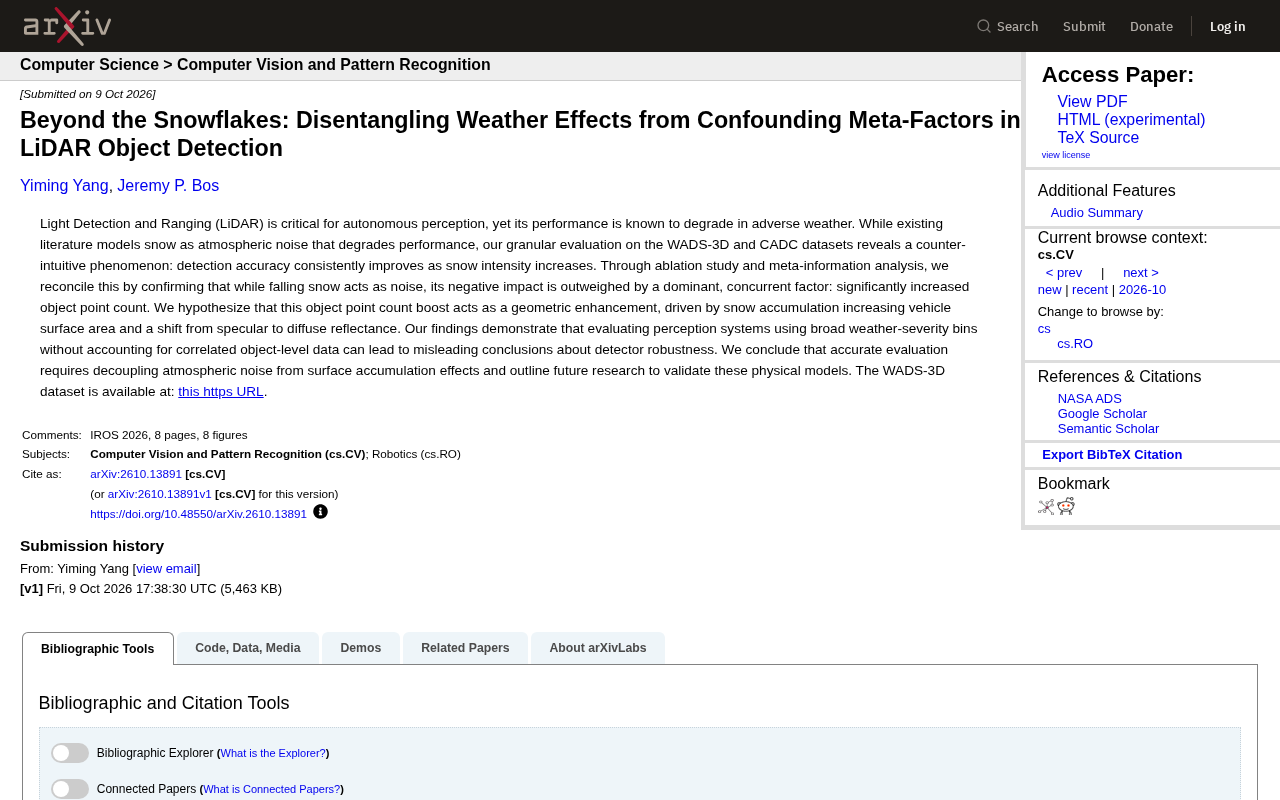
A study using the WADS-3D and CADC datasets found that LiDAR object detection accuracy consistently improves with snowfall intensity — contradicting the industry assumption that adverse weather degrades perception. Through ablation studies, the team revealed that the dominant driver is not snowfall noise but two geometric enhancement effects: snow accumulation enlarging effective target surface area, and snow converting specular vehicle surfaces into diffuse reflectors that return more LiDAR points. The noise penalty is outweighed by this geometric gain. More broadly, the study exposes a systemic flaw in perception evaluation: using coarse weather-severity bins as the sole metric ignores object-level confounding factors and produces misleading robustness conclusions. Accurate evaluation must decouple atmospheric noise from surface accumulation effects. The WADS-3D dataset is publicly available to support validation of these physical hypotheses.
A Counterintuitive Finding
LiDAR is the cornerstone sensor of autonomous driving perception systems, and it's widely accepted that its performance degrades significantly in adverse weather. For years, the research literature has modeled snowfall as a form of atmospheric noise that corrupts point clouds and reduces detection accuracy. Yet a rigorous evaluation based on the WADS-3D and CADC datasets arrived at a conclusion that flies in the face of intuition: as snowfall intensity increases, object detection accuracy consistently improves.
At first glance, this seems absurd — if snowflakes are noise, shouldn't heavier snow make detection worse? But through ablation studies and meta-information analysis, the research team uncovered a far more complex causal structure beneath the surface.
The Dominant Factor Beyond Noise
The core argument of the study is this: snowfall does act as noise and does negatively affect detection — but that negative effect is offset by a simultaneously occurring, more powerful factor: a significant increase in the number of points on target objects.
In other words, when we observe "heavier snow, better detection," the real driver is not the snowfall itself, but rather object-level data changes that are highly correlated with snowfall intensity. The heavier the snow, the more LiDAR points accumulate on the surfaces of vehicles and other targets, providing the detector with richer geometric information.
This exposes a methodological pitfall: if a perception system is evaluated solely by binning results into coarse weather-severity bins — without accounting for correlated object-level data changes — the conclusions drawn about detector robustness can be deeply misleading. What looks like a performance improvement may actually be masking the real damage caused by noise.
An ablation study, in this context, refers to the research team systematically removing or controlling individual variables — for example, isolating the noise contribution of airborne snowflakes, or holding the number of object points fixed — in order to measure each factor's independent contribution to final detection accuracy. This experimental design is the standard approach in deep learning and perception research for disentangling causal relationships. By comparing detection metrics under controlled conditions such as "with/without surface snow accumulation" or "high/low snowfall intensity," the team was able to decompose an apparent positive correlation into two opposing effects: noise-induced harm and geometry-driven gain. Without such decoupling experiments, a researcher looking only at accuracy curves across weather bins could easily misattribute the influence of a confounding variable to improved detector robustness in snow.
The Geometric Enhancement Hypothesis: How Snow Changes Targets
Why does snowfall cause an increase in the number of points on target objects? The research team proposed a "geometric enhancement" hypothesis grounded in two physical mechanisms:
Snow Accumulation Enlarges Target Surface Area
Snow accumulating on the surfaces of vehicles and other targets effectively increases the surface area from which LiDAR can capture return signals. Areas that were previously smooth or geometrically incomplete become filled and covered by snow, forming a more continuous and complete geometric profile — and thus returning more points.
Shift from Specular to Diffuse Reflection
The second key mechanism is a transition in surface reflectance from specular to diffuse reflection. Many vehicle surfaces — such as paint and bare metal — exhibit strong specular reflectance when dry, meaning laser pulses may be reflected away from the receiver direction, resulting in missing points. Once covered with snow, those surfaces become diffuse reflectors, scattering laser energy in all directions so that the receiver can capture a greater proportion of valid return signals.
These two mechanisms act together, causing the gain in object point count to outweigh the noise loss introduced by airborne snowflakes — yielding a net improvement in detection accuracy.
The distinction between specular and diffuse reflection deserves a closer look in the LiDAR context. When a near-infrared laser pulse emitted by a LiDAR sensor strikes a surface, only photons reflected back toward the sensor's receiving aperture are recorded as valid points. Specular reflection (镜面反射) follows the strict rule that the angle of incidence equals the angle of reflection: when a laser hits a high-gloss paint or metal surface at a certain angle, most of the energy is redirected away from the sensor, creating blind spots or sparse point clouds in those regions. Diffuse reflection (漫反射), by contrast, scatters incident light uniformly across a hemispherical space, ensuring that some proportion of reflected energy reaches the sensor regardless of the angle of incidence. Snow is composed of countless tiny ice crystals whose rough, porous microstructure naturally forms a diffuse reflector — meaning a snow-covered vehicle can actually be more detectable than a bare metal one. This physical principle has received surprisingly little attention in the LiDAR object detection community.
Implications for Perception System Evaluation
The most important contribution of this study is not the specific finding that "heavier snow improves detection" — it is what that finding reveals about systemic flaws in current adverse-weather perception evaluation.
When researchers use broad weather-severity bins to measure detector performance, they implicitly assume that weather intensity is the only variable changing. In reality, weather intensity is implicitly correlated with object-level characteristics such as surface area, reflectance, and point cloud density. These confounding meta-factors, if left undisentangled, will corrupt evaluation conclusions.
The research team therefore argues that accurate perception evaluation must separate atmospheric noise effects from surface accumulation effects. Only by decoupling these two classes of effects can we truly measure a detector's robustness under genuine noise conditions — rather than being misled by the "false positive" of geometric enhancement.
Confounding factors are a foundational concept in statistics and causal inference: when variable A and variable B are both correlated with outcome C, and A and B are correlated with each other, observing "how C changes as A changes" without controlling for B will incorrectly attribute B's true effect on C to A. In this study's context, snowfall intensity (A) and the degree of surface accumulation on targets (B) are strongly positively correlated in natural scenes, and B's positive effect on detection accuracy (C) far outweighs A's negative effect. The conventional evaluation framework uses weather severity as the sole stratification dimension — which is equivalent to unknowingly allowing B to vary alongside A, effectively hiding B's contribution under A's label. This suggests that autonomous driving perception benchmarking needs finer-grained data annotation dimensions, such as independently recording surface snow depth on targets and point cloud density, to support genuinely causal evaluation.
Future Directions and Data Availability
The research team notes that the physical models proposed — snow accumulation enlarging surface area, and the specular-to-diffuse reflectance shift — remain at the hypothesis stage and require further experimental validation. They outline a follow-up research agenda to confirm the reality and generalizability of these physical mechanisms.
For researchers who wish to reproduce or extend this work, the WADS-3D dataset is publicly available at https://digitalcommons.mtu.edu/wads-3d/. This provides the autonomous driving perception community with a valuable resource for studying LiDAR behavior in snowy conditions.
Closing Thoughts
This work is a reminder that in the safety-critical domain of autonomous driving, both intuition and coarse-grained metrics can be deceptive. A number that looks better may conceal a physical reality that is precisely the opposite. Only through rigorous causal decomposition — separating noise effects from data distribution shifts — can we truly understand the behavioral boundaries of perception systems in adverse environments. That understanding is an essential step on the path to trustworthy autonomous driving.
Related articles

Amphibious Transforming Drone: Beyond 100x Power Savings, What Are the Real Needs?
Is the amphibious transforming drone just a gimmick? Starting from the 100x power difference of the M4 Morphobot, explore real application scenarios and thesis topic ideas, analyzing boundary conditions where pure drones and pure ground robots both fail.

Warhound Raises $200 Million: Genetically Engineered "War Dogs" Paired with Anduril Gear
Warhound raises $200M, backed by Ben Lamm and Palmer Luckey, to genetically engineer dogs for military and law enforcement use and equip them with Anduril gear. This article analyzes its technology direction, funding logic, and ethical controversy.

Claude API Comes to Google Cloud: IAM Integration and SDK Access Guide
Anthropic hosts the full Claude API on Google Cloud with IAM-controlled permissions and unified billing. This guide covers the Vertex AI and Anthropic-hosted entry points, IAM role configuration, and SDK access.