Beware of "Crypto Recovery" Scams: Apex-shield Recovery Is a Second Harvest

Dissecting the Apex-shield Recovery ad to expose crypto recovery scam tactics and how to spot them.
Using an ad claiming to help victims recover stolen crypto as a sample, the article identifies typical scam rhetoric: a perfect victim narrative, packaging a hacker as a savior, abrupt Rolex product placement, and contact info pointing to an unverifiable standalone domain. It explains the technical irreversibility of blockchain transactions, noting that on-chain analysis is for forensics, not recovery, and that individuals can almost never recover transferred assets through third-party services. It then breaks down the second-harvest path—free consultation to build trust, upfront fees disguised as service or Gas fees, then going dark. It also offers proper steps after a scam, including preserving evidence, reporting to law enforcement, notifying exchanges, and identifying red flags like upfront payment demands, self-proclaimed hackers, and 100% recovery promises.
A Flawed "Fund Recovery" Advertisement
Recently, a piece titled Hacker To Recover Lost Funds From Online Scam Visit Apex-shield Recovery appeared in an RSS feed. Written in the voice of a "victim," the article claims that after falling for a cryptocurrency scam, the author successfully recovered stolen assets through a service called Apex-shield Recovery, and includes an email address, website, and WhatsApp contact, urging other victims to "take the first step toward recovering your funds."
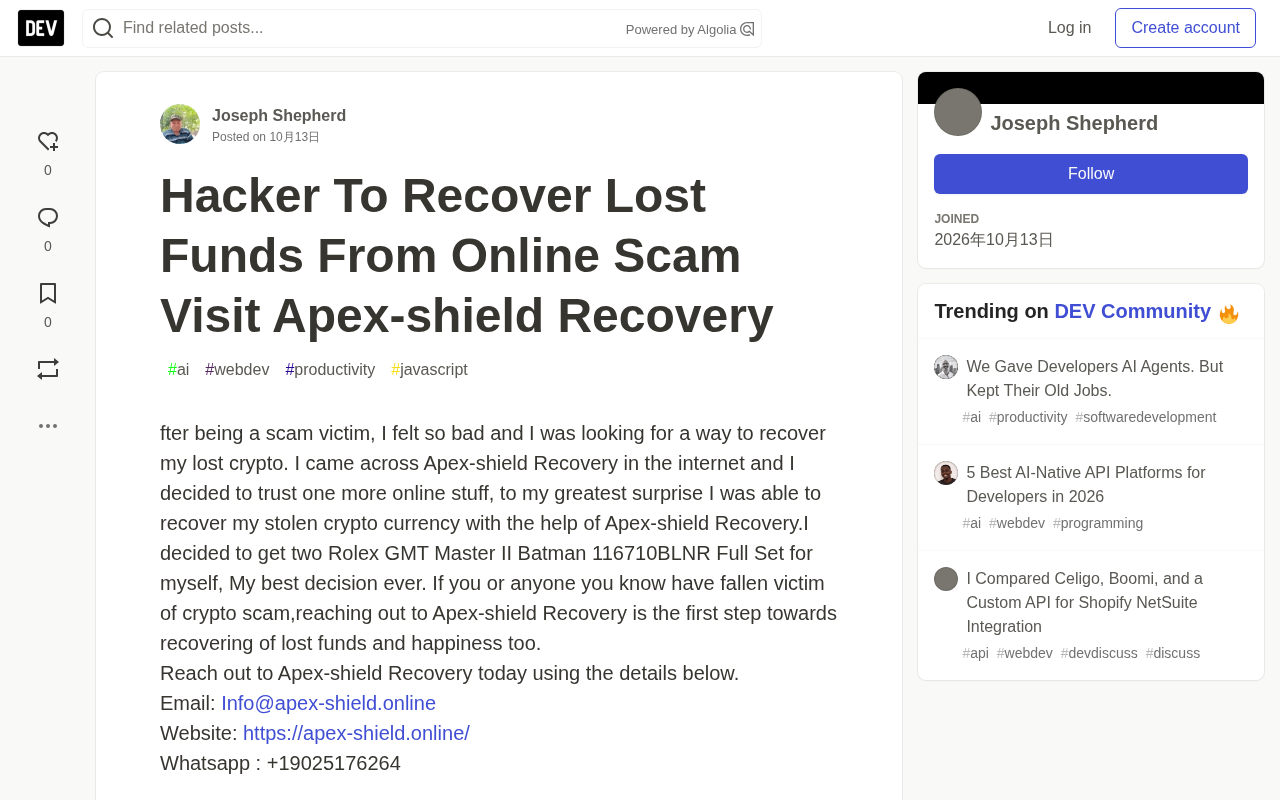
On the surface, it reads like a thank-you letter, but both its structure and wording betray the hallmarks of classic scam rhetoric. This article won't repeat the advertisement itself. Instead, we'll use it as a sample to dissect how the "crypto recovery" scam archetype operates, helping readers recognize similar traps.
Why "Recovering Stolen Funds" Is Nearly Impossible
To understand the absurdity of these scams, you first need to grasp the basic properties of blockchain transactions.
Once a cryptocurrency transfer is confirmed on-chain, it is irreversible. There is no bank customer service that can freeze the transaction, no credit card company that can initiate a chargeback, and no central authority that can force a rollback. This means: once funds leave your wallet for an address controlled by a scammer, they are technically beyond your control.
On-chain analytics firms (such as Chainalysis and Elliptic) can indeed trace the flow of funds, but that falls under forensics, not recovery. Law enforcement agencies in extremely rare cases can freeze involved assets with exchange cooperation—but only if the case has been filed, the funds haven't been mixed or moved to an unreachable overseas exchange, and the relevant jurisdictions are willing to cooperate. For the vast majority of ordinary victims, these conditions are almost never met simultaneously.
So when an outfit claims it can "help you recover your stolen cryptocurrency," the first question you should ask is: On what basis?
Irreversibility and "Transaction Finality"
The irreversibility of blockchain comes from its consensus mechanism design. Take Bitcoin: after a transaction is packaged into a block, it gains "confirmations" as subsequent blocks stack on top. As confirmations increase, the computational cost required to roll back that transaction rises exponentially. After Ethereum's Merge transitioned to proof-of-stake, it similarly uses a "finality" mechanism to ensure confirmed blocks cannot be easily reorganized. This design is deliberate: it prevents anyone from unilaterally reversing a transfer that has already occurred, thereby ensuring the credibility of the ledger.
The trade-off is that this property is extremely unfriendly to fraud victims. Remedies common in traditional finance—chargebacks, freezes, account holds—have no on-chain equivalent. Once a private key signs and broadcasts a transaction, the user has completely relinquished control over the asset. Understanding this is the prerequisite for seeing through any "paid recovery" pitch.
Mixers and the Real Limits of Fund Tracing
Even if on-chain analytics firms can map fund flows, scammers have long developed countermeasures. Common tactics include: splitting funds into numerous small transfers, routing through multiple wallet hops, using mixing protocols like Tornado Cash to sever the fund trail, or moving assets to another chain via cross-chain bridges. These operations significantly increase tracing difficulty, making once-clear fund paths hard to reconstruct.
Therefore, what on-chain forensics can typically do is "identify" rather than "recover"—that is, confirm which exchange's deposit address the funds ultimately flowed into, after which law enforcement can pursue legal procedures to request a freeze. This process depends on judicial cooperation, timing windows, and exchange cooperation. A privately retained commercial outfit has no authority to compel any party to act.
Typical Red Flags in the Apex-shield Recovery Advertisement
Returning to the advertisement itself, it hits nearly every classic feature of crypto recovery scams.
Red Flag 1: The Perfect Victim Narrative
The copy tells a complete story arc in first person—"scammed → desperate → stumbled upon a service → successfully recovered"—with deliberate, smooth emotional turns. This narrative template appears repeatedly in similar ads, designed to make actual victims feel "he's just like me; if he could do it, so can I."
Red Flag 2: Packaging a "Hacker" as a Savior
The title uses phrasing like "Hacker To Recover Lost Funds." In legitimate contexts, those who can trace on-chain funds are blockchain forensic analysts or law enforcement—they don't call themselves "hackers." The deliberate emphasis on the "hacker" identity is precisely to cater to victims' fantasy of "fighting fire with fire."
Red Flag 3: Abrupt Luxury Product Placement
Midway through the ad, a sentence suddenly appears: "I decided to buy myself two Rolex GMT Master II Batman 116710BLNR Full Set, and it was the best decision I ever made." This has nothing to do with the fund recovery narrative, yet it exposes the copy's true intent—using conspicuous consumption to imply "the recovery service really works; look, I can even afford a Rolex." This clumsy insertion ironically becomes a clue for identifying the scam.
Red Flag 4: Contact Info Points to a Standalone Domain
The website provided, apex-shield.online, is a standalone domain rather than any regulator-backed institutional page. The email uses that domain, and the WhatsApp number is +19025176264. None of this information can verify the entity's identity, registration location, or credentials.
The "Recovery Scam" Second-Harvest Model
What makes these scams particularly despicable is that they specifically target people who have already been hurt once.
Victims have already lost funds in a prior scam and are in an anxious, urgent psychological state. Recovery services exploit exactly this psychology. The typical harvesting path is:
- Free initial consultation: Claim they can analyze your case and provide a "feasibility assessment," building trust.
- Request upfront payment: Demand you pay first under the guise of "service fees," "Gas fees," "smart contract deployment fees," "legal documentation fees," etc.
- Escalating demands: After you pay, they claim "funds are stuck at a certain stage" or "additional fees are needed to unlock," demanding further transfers.
- Going dark: When the victim realizes something is wrong or can no longer pay, the other party cuts off contact.
Throughout this entire process, the victim never receives any recovered funds—instead losing even more in the second scam.
Why "Gas Fees" Became a High-Frequency Excuse
In the upfront-payment harvesting phase, the excuse scammers use most often is "Gas fees." The term itself originates from the Ethereum network—every on-chain transaction requires a certain amount of ETH as a miner/validator fee, with the amount depending on network congestion. For victims unfamiliar with the technology, "Gas fees" sound professional and reasonable, easily leading them to believe this is an unavoidable technical cost in the recovery process.
Scammers exploit exactly this information asymmetry. In reality, if recovery operations truly existed, their cost structure, payment recipients, and payment methods should all be open and transparent—they would never require victims to repeatedly transfer to some individual wallet or overseas account. Anything using "Gas fees," "contract deployment fees," or "unlock fees" as a billing reason can basically be judged a scam.
What to Do If You've Already Been Scammed
In the real world, what you can do after a crypto scam is limited—but not entirely without direction.
Step 1: Preserve all evidence. This includes transfer records (transaction hashes), chat logs with the scammer, the wallet addresses they provided, website screenshots, etc. These are the foundational materials for filing a report.
Step 2: Report to law enforcement. In mainland China, you can report to your local public security bureau's cybersecurity department; if cross-border transactions are involved, you can also consult the National Anti-Fraud Center (96110). In the U.S., you can file a complaint with the FBI's IC3 (Internet Crime Complaint Center); in Europe, there are relevant Europol channels. Reporting doesn't guarantee recovery, but it's the only legal path for recourse.
Step 3: Notify the relevant exchanges. If you know the funds flowed into a centralized exchange's address, contact that exchange's compliance department with case information and transaction hashes, requesting assistance in freezing the assets.
Step 4: Be wary of any "recovery service" that contacts you first. Legitimate blockchain forensics firms (such as Chainalysis, TRM Labs) serve exchanges and law enforcement—they don't pitch "recovery" services to individual victims and charge upfront fees.
Key Materials to Prepare When Filing a Report
When reporting to law enforcement, the completeness of your materials directly affects the possibility of filing and subsequent investigation. Prepare in advance: transaction hashes (TxID)—the unique identifier for each on-chain transfer, queryable in block explorers; involved wallet addresses, including both the address you sent from and the address the other party received to; all communication records with the scammer, such as chat screenshots, emails, and call recordings; URLs of fraudulent platforms, app installation packages, and promotional material screenshots; and a fund flow list noting time, currency, amount, and corresponding transaction hashes.
Organize these materials into a timeline document—this can significantly reduce the understanding cost for investigators. If cross-border elements are involved, you can submit simultaneously to corresponding agencies in multiple jurisdictions, such as the U.S. IC3, Europe's Europol, and the regulatory channels of the country where the receiving exchange is located.
How to Quickly Identify "Fund Recovery" Scams
Simplify the criteria into a few points for easy memorization and application:
- Anyone requiring upfront payment—treat as a scam, period. Legitimate legal or forensic services may charge fees, but never under labels like "pay Gas fees before successful recovery."
- Anyone calling themselves a "hacker"—never trust them. Real security professionals don't use that identity label.
- Anyone promising "100% recovery" or "guaranteed success"—always fake. Blockchain forensics involves enormous uncertainty; no institution can guarantee outcomes.
- Anyone using WhatsApp, Telegram, or other instant messaging tools as their primary contact method—highly suspicious. Legitimate institutions have fixed office addresses and verifiable professional credentials.
- Copy containing conspicuous consumption or luxury product placement—ignore immediately. This is a typical feature of low-quality scam copy.
Summary
The Apex-shield Recovery advertisement itself isn't particularly sophisticated. Its value lies in serving as a cautionary example: it demonstrates the standard rhetorical structure of "crypto recovery" scams—victim narrative, hacker identity packaging, success case insinuation, and upfront-payment harvesting. For those who have already suffered a crypto scam, the greatest danger isn't "missing a recovery opportunity"—it's becoming the target of a second harvest. No online service can help you recover funds more effectively than law enforcement, and any "recovery expert" who approaches you first is most likely just trying to scam you again.
Related articles

"Black October": Did AI Uncover 3% of All Critical Vulnerabilities Ever?
A Reddit post claims 3% of all critical software vulnerabilities ever were found in the past month, dubbed 'Black October.' We break down the statistical issues, how AI-assisted code auditing accelerates discovery, and how developers should respond.

Microsoft Project Gecko: Using AI to Bridge Language Gaps for African Farmers
Microsoft's Project Gecko launches PharmaChat, letting African farmers ask questions in their native language and get precise video clips and farming book chapters via AI. The project also releases three interactive manuals to advance inclusive AI.

Musk's Space Dominance: How Starlink Throttling Undermines Ukraine's Defense
SpaceX's Starshield throttling disabled Ukraine's high-speed interceptor drones, exposing how Musk's private control over low Earth orbit communications affects battlefield dynamics and national security, and highlighting the risks of commercial space militarization and space governance dilemmas.