Beware of Third-Party Top-Up Scams: The Truth and Risks Behind ChatGPT Subscription Services

Exposing how viral GPT top-up tutorials trick users into surrendering their account tokens to scam platforms.
A wave of videos on Bilibili promote third-party ChatGPT top-up services via sites like 76ai.vip, framing them as the easiest way for users in China to subscribe. This article breaks down their three recommended methods, revealing that the one they push hardest — pasting page source code into a third-party site — hands over your session Token and gives strangers full control of your account. The risks include privacy leaks, stolen accounts, unrecoverable payments, and OpenAI bans. Readers are advised to use only official channels and avoid any service requiring Token or Cookie submission.
A "Top-Up Tutorial" Worth Being Wary Of
Recently, a wave of videos has appeared on platforms like Bilibili with titles such as "The Most Stable GPT-6 Subscription," "Codex Top-Up Tutorial," and "Beginner's Step-by-Step Guide." These videos claim to help users in China bypass official channels and quickly activate ChatGPT Plus, Pro, and other paid memberships through third-party websites (such as "76ai.vip," which is repeatedly mentioned). Marketed as "simple, fast, and safe," these services actually conceal serious account security and financial risks that should not be ignored.
This article is not promoting these services. Rather, based on the common tactics used in such videos, it aims to help readers understand how third-party top-up services actually work — and avoid falling into their traps.
Note: ChatGPT's publicly available paid tiers are Free, Plus, Pro, and so on. Claims made in these videos about "GPT-6," "Astra models," or "GPT Pro 5x" lack any official basis. Readers should refer to OpenAI's official information.

Breaking Down the Three "Top-Up Methods" Promoted in These Videos
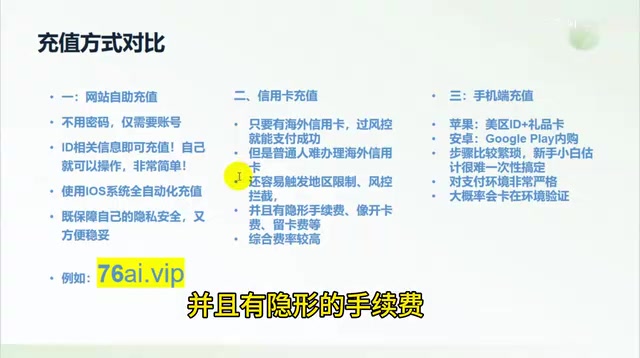
These videos typically present three ways to subscribe, deliberately steering users toward the option that benefits the promoter the most.
Method 1: Third-Party Website "Top-Up Service"
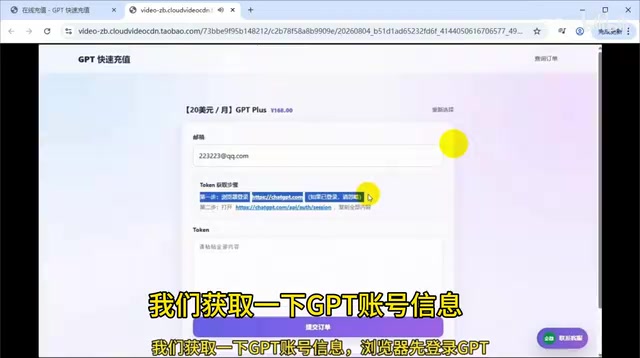
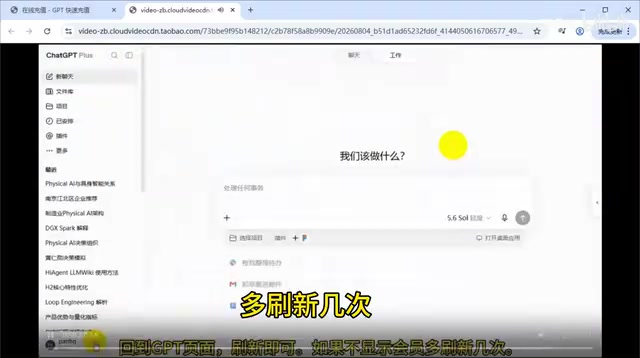
The method these videos push hardest is visiting a third-party website that claims you can activate a subscription "without your password — just your account ID information." But look closely at the steps, and you'll spot a dangerous detail: users are asked to log into their ChatGPT account first, then copy the entire page source code and paste it into the third-party website.
This is essentially handing over your account session credentials (Token) to a stranger's platform. Once leaked, the other party can completely take over your account — reading your chat history, changing your password, or even using it for other illegal purposes. The claim that "not needing a password makes it safer" is a deliberate misdirection that obscures the far more serious risk of surrendering your active login session.
Method 2: Overseas Credit Card
The video acknowledges that getting an overseas credit card is "difficult for the average person" and prone to "regional restriction bans," with hidden costs like card issuance fees and maintenance fees. This description is somewhat accurate, but its purpose is usually to make the third-party top-up service look more convenient by comparison.
Method 3: In-App Purchase on Mobile
Using an Apple US App Store account with gift cards, or making purchases through Google Play on Android, are paths that come closest to the official route. The video also discourages this by warning that "gift cards are easily banned and you'll lose your money," ultimately funneling users back to Method 1.
The reason Apple US App Store in-app purchases and Google Play in-app purchases are considered relatively close to the official path is that payments through these channels are handled by Apple and Google respectively — OpenAI doesn't directly process your banking information, and refunds can be pursued through each app store's dispute mechanism. US App Store gift cards can be purchased on Amazon and other e-commerce platforms; for Android, you'll need a Google account with its region set to the US and a payment method compatible with Google Pay. Both options require an app store account registered in an overseas region, but compared to handing your login credentials directly to an unknown website, the account security risk is far lower, and the fees are transparent with official receipts available.
The Core Risks of Third-Party Top-Up Services
Looking at all three methods side by side reveals the true intent of these videos: by amplifying the barriers of official and semi-official channels, they package "giving your account credentials to a stranger's website" as the optimal solution.
Account security risk is the biggest danger. Pasting your login credentials is equivalent to handing over the keys to your account. The probability of account theft and privacy leaks is extremely high, and there is virtually no recourse afterward.
Financial risk is equally real. These platforms are typically operated by individuals or small groups. Once they collect payments via Alipay and "automatically deliver" the service, users have almost no protection if the operators disappear or the top-up fails. The so-called "contact customer service in the bottom right corner" is usually meaningless.
Risk of violating Terms of Service. Obtaining membership through unofficial channels, shared accounts, or third-party top-up services may violate OpenAI's Terms of Service, resulting in a permanent account ban — and your money gone with it.
Smarter, Safer Alternatives
If you genuinely need access to ChatGPT's paid features, prioritize legitimate and traceable methods:
- Subscribe through official channels: Use a compliant payment method that you control, and never hand your account credentials to any third party.
- Be wary of phrases like "top-up service," "low price," or "no password required": Any operation that asks you to copy and paste your account Token, Cookie, or full login source code should be stopped immediately.
- Protect your account: Regularly check which devices are logged into your account, enable two-factor authentication, and immediately change your password and log out of all devices if you notice anything suspicious.
- Stay skeptical of new model hype: Don't make impulsive purchases driven by a fear of missing out on claims like "GPT-6" or "exclusive early access to new models" that haven't been confirmed by OpenAI.
Conclusion
The real purpose of these "beginner's top-up tutorial" videos isn't to save you money — it's to funnel users toward third-party platforms where all the risk falls on you. Behind the apparent convenience lies a triple threat: stolen accounts, financial loss, and account bans for violating terms of service. When it comes to paying for AI tools, choosing official, transparent, and traceable channels will always be more trustworthy than any shortcut promising to be "the fastest and most reliable."
Background: What Is a Session Token?
A session Token (account session credential) is an encrypted string issued by the server to your browser after a successful login, serving as proof that "the current visitor has been authenticated." Unlike a password, a Token doesn't require entering a username and password again — as long as the browser carries a valid Token, it can perform any action as the account holder, including viewing conversation history, changing the linked email address, or initiating refund requests. For this reason, Tokens are treated in the security field as highly sensitive credentials equivalent to a password. Pasting your entire page source code to a third party means they can extract your Token and use it on their own servers indefinitely — while the account owner typically has no idea, only discovering something is wrong when the password has been changed or their data has been misused.
Related articles

WorkBuddy Full Tutorial: Build an AI Office Automation Agent from Scratch
A complete WorkBuddy tutorial: installation, three working modes, multimodal picture book video practice, expert team agent building, and workflow configuration for low-cost AI office automation.

WorkBuddy Agent Complete Guide: From Beginner to Automation in 7 Days
Based on Bilibili's 256-episode WorkBuddy masterclass, this systematically breaks down Tencent's AI office workbench core capabilities: Agent principles, Skill encapsulation, cross-platform connectors, scheduled automation, knowledge bases, and zero-code development, with learning path recommendations.

8 AI Accounts, 7 Failed: An Honest Review of Using AI to Get Work Done
Only 1 of 8 AI-run Bilibili accounts succeeded. We break down the real difference between "performing AI" and "using AI to get work done."