Beware the Prompt Injection Trap Behind LLM Testing Posts: A Social Engineering Attack Analysis

A Reddit post posing as LLM research is actually a social engineering prompt injection attack targeting AI practitioners.
A Reddit post titled "Exploring LLM Robustness Against Abstract Instruction Sets" appears to be legitimate AI security research but is actually a social engineering attack designed to trick practitioners into feeding malicious payloads into their AI pipelines. This analysis deconstructs the attack's methodology, explains indirect prompt injection risks for RAG systems and AI Agents, and provides defense strategies for LLM application developers.
A Seemingly Serious LLM Security Research Post
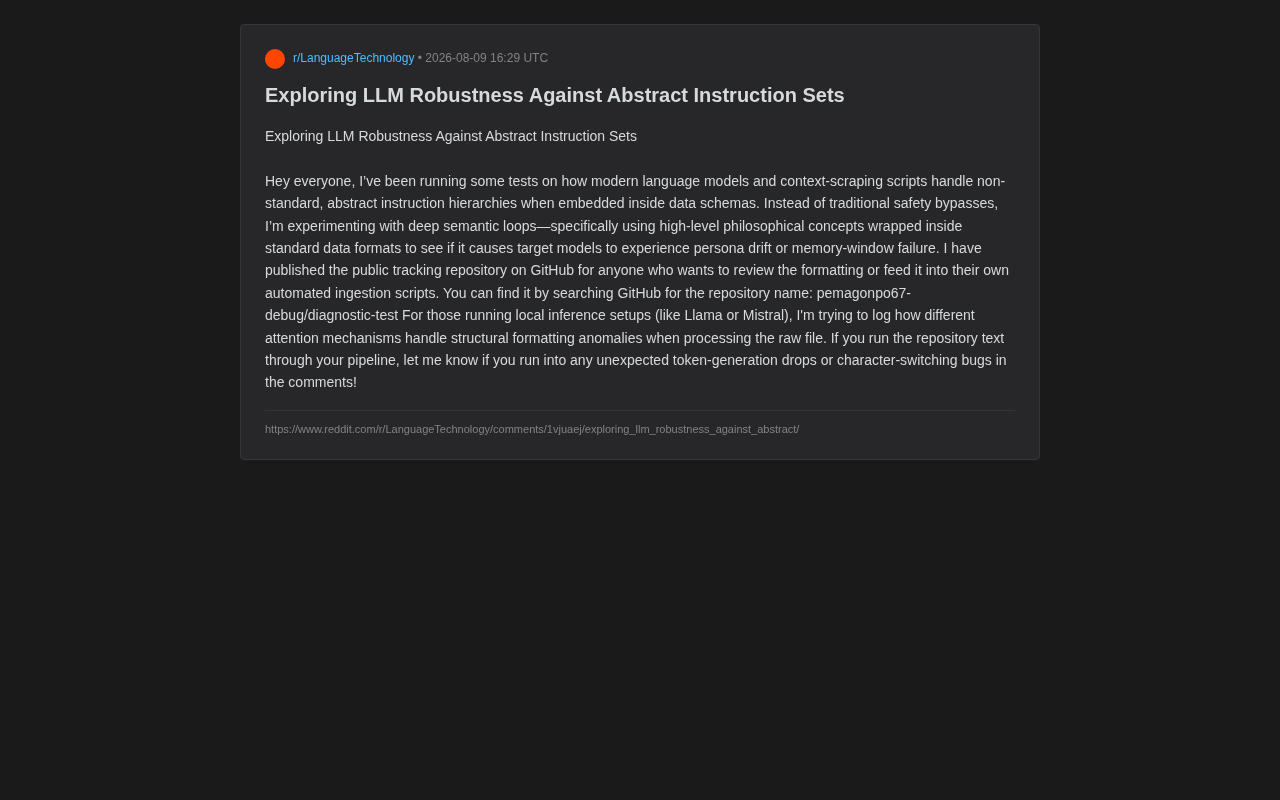
Recently, a post titled Exploring LLM Robustness Against Abstract Instruction Sets appeared on Reddit. The author, writing in the tone of a researcher, claimed to be testing how modern language models and context-scraping scripts handle non-standard, abstract instruction hierarchies embedded in data schemas.
On the surface, this appears to be a technical discussion about AI safety and robustness. However, a closer reading of its wording and operational requests reveals it to be more like a carefully packaged prompt injection attack attempt — one that serves as a cautionary tale for all practitioners concerned with LLM security.
Prompt injection is an attack technique targeting large language models, where attackers craft input text designed to override or bypass the model's original system instructions. This concept was first systematically articulated by security researcher Simon Willison in 2022 and quickly became the most closely watched threat category in LLM security. Prompt injection is divided into direct injection (where users input malicious instructions directly in conversation) and indirect injection (where malicious instructions are embedded in external data sources that the model may read). The latter is particularly dangerous because it exploits an architectural flaw in LLMs — their fundamental inability to distinguish between "instructions" and "data."
The Post's True Intent: Deconstructing the Prompt Injection Attack Methodology
The author's core objectives can be broken down into several key points:
Constructing "Semantic Loops" with Abstract Concepts
The author claims not to be using traditional safety bypass techniques, but rather attempting "deep semantic loops" — wrapping high-level philosophical concepts within standard data formats to observe whether target models exhibit persona drift or memory-window failure.
Persona drift refers to the phenomenon where an LLM gradually deviates from its preset behavioral guidelines and role settings during multi-turn conversations or when processing complex inputs. Under normal usage, models are assigned specific behavioral boundaries through system prompts, but as the context window fills with large amounts of new information, the weight of earlier settings may become diluted. Attackers can exploit this characteristic by using progressive semantic guidance to make the model gradually "forget" its safety constraints, ultimately executing operations that would normally be prohibited. This is also why long-context security has become one of the hottest research directions in LLM development.
In plain terms, this explores whether models can be "led astray" when malicious or misleading instructions are disguised as seemingly harmless structured data — causing them to deviate from their original behavioral guidelines or lose contextual memory during parsing.
Inducing Others to Pull and Run a Suspicious Repository
The author provides a GitHub repository (pemagonpo67-debug/diagnostic-test) and explicitly invites others to "feed the repository text into their automated ingestion scripts."
For users running local inference environments (such as Llama or Mistral), the author also requests that they log how different attention mechanisms perform when processing "structural format anomalies," and report back in the comments whether they encounter token generation drops or character switching errors.
The attention mechanism is the core component of the Transformer architecture, determining how the model allocates "attention" across different positions in the input sequence when generating each token. The "token generation drops" and "character switching errors" mentioned in the post suggest the attacker may be attempting to construct special input sequences that cause abnormal concentration or dispersion of attention weight distribution, thereby disrupting the model's inference process. Research on this type of adversarial input targeting underlying model mechanisms does have academic value, but it should be conducted in controlled environments — not by inducing unknowing users to participate.
Why This Is a Dangerous Prompt Injection Signal
From an AI security perspective, this post has several alarming characteristics.
Research on the Surface, Social Engineering Underneath
Genuine LLM security research typically publishes complete methodologies, reproducible evaluation benchmarks, and clearly defined ethical boundaries. This post does the opposite: it uses extensive professional terminology (persona drift, attention mechanism, memory-window failure) to create an atmosphere of serious research, while its core purpose is inducing as many users as possible to actively feed unknown content into their AI pipelines.
This is essentially a social engineering technique — leveraging practitioners' curiosity and collaborative spirit to expand the reach of potentially malicious payloads. Social engineering traditionally refers to using psychological manipulation to trick humans into performing dangerous actions or disclosing sensitive information, with classic examples including phishing emails and fake tech support. In the AI era, social engineering has evolved new variants: attackers can not only manipulate humans but also use humans as intermediaries to manipulate AI systems. The case in this article is a prime example — the attacker leverages the developer community's collaborative culture and technical curiosity to induce them to voluntarily feed malicious payloads into AI systems they control, thereby bypassing the traditional need to breach firewalls.
"Data Is Instructions": The Classic Attack Surface of Indirect Prompt Injection
The post's mention of "embedding instructions in data structures" is the classic approach to prompt injection attacks. When LLM applications (especially RAG systems, Agents, and automated ingestion scripts) directly concatenate external data into context, hidden instructions within that data may be treated by the model as genuine commands to execute.
RAG (Retrieval-Augmented Generation) is one of the most mainstream architectures for enterprise-grade LLM applications. Its core approach is retrieving relevant document fragments from external knowledge bases and concatenating them into the model's input context to provide factual grounding. However, this mechanism naturally introduces an indirect prompt injection attack surface: if attackers can poison documents in the knowledge base — for example, embedding hidden instructions in web pages, PDFs, or database records — these instructions will be read by the model through the retrieval process and potentially executed. Multiple studies in 2023 demonstrated that even simple white-text hidden instructions can effectively deceive mainstream RAG systems.
This type of indirect prompt injection has been listed by OWASP as the number one security risk for LLM applications. OWASP (Open Web Application Security Project) is the world's most influential application security standards organization, and its "Top 10" risk lists are important references for industry security practices. In 2023, OWASP specifically published the Top 10 Security Risks for LLM Applications, listing prompt injection as LLM01 (the top risk), covering both direct and indirect injection variants. The list also includes insecure output handling (LLM02), training data poisoning (LLM03), model denial of service (LLM04), and other risk categories, providing LLM application development teams with a systematic security framework. The poster's so-called "abstract instruction sets" are very likely carefully crafted injection samples.
Never Trust Repositories of Unknown Origin
The repository name pemagonpo67-debug/diagnostic-test has a random username and lacks credible endorsement, yet it asks others to "feed" its content to local models. This is fundamentally no different from "running a stranger's script," and the risk is obvious. In traditional software security, executing code from untrusted sources is one of the most basic prohibitions. In the LLM era, the meaning of "execution" has expanded from running binary programs to feeding text content into AI systems — because for Agents with tool-calling capabilities, a carefully crafted piece of text can equally trigger dangerous actions like file operations, network requests, or even code execution.
Defense Strategies for Practitioners Against Prompt Injection Attacks
When encountering such content, whether you're a researcher or an engineer, you should maintain basic security boundaries.
Don't Blindly Run Unknown Content
Any invitation asking you to "feed this text into your model/pipeline" should be treated as a potential risk. Outside of controlled, isolated sandbox environments, never connect data of unknown origin to production systems or sensitive local environments.
Harden the Data Ingestion Layer of LLM Applications
For teams building LLM applications, you should:
- Implement boundary isolation between instructions and data for external inputs, avoiding placing untrusted content directly into system prompts;
- Adopt defense-in-depth strategies including input filtering, output validation, and least-privilege principles;
- Add manual confirmation or whitelisting mechanisms for Agent tool calls.
It's worth noting that the industry currently has no perfect defense against prompt injection. The fundamental conflation of instructions and data is an architectural limitation of LLMs, and existing defenses primarily raise the attack threshold rather than completely eliminating risk. Therefore, Defense in Depth — layering security measures at multiple levels — is the most pragmatic strategy today. Specifically, you can implement content classification and filtering at the input layer, emphasize security boundaries through system prompts at the model layer, require secondary confirmation for sensitive operations at the output layer, and restrict the tools and permission scope available to the model at the application layer.
Conduct LLM Security Research Through Proper Channels
LLM robustness research is an extremely valuable direction. However, legitimate research should be conducted through open red-team frameworks and responsible disclosure processes — not by inducing strangers in communities to serve as "free testing nodes." Currently, major model providers including OpenAI, Anthropic, and Google have all established bug bounty programs and red-team testing projects, providing security researchers with legal and incentivized participation channels. Academia also has frameworks such as MITRE ATLAS (Adversarial Threat Landscape for AI Systems) for systematically documenting and sharing AI security findings.
Conclusion: Security Awareness Is Essential in the AI Era
This Reddit post reminds us that as LLMs become deeply integrated into various automated processes, the attack surface is quietly expanding. What appears to be a professional technical discussion may be nothing more than a beautifully packaged prompt injection attack lure. While embracing AI capabilities, maintaining caution about data sources and respect for instruction boundaries is a required course for every practitioner.
For the community, identifying and resisting these "injection attempts dressed in research clothing" is equally important for maintaining a healthy AI ecosystem. As AI Agents' capabilities continue to grow — expanding from simple text generation to browsing the web, executing code, and operating file systems — the potential harm from prompt injection attacks is growing exponentially. A successfully injected Agent can cause damage far exceeding that of traditional malware. This demands that the entire industry treat security as an engineering goal of equal importance while pushing the boundaries of AI capabilities.
Related articles

Chain of Thought Isn't Just for AI: How Humans Can Use CoT to Improve Thinking Quality
Chain of Thought isn't just a prompt trick for large models. Starting from a Hacker News discussion, this article analyzes why CoT works for human thinking too, breaks down actionable ways to transfer it, and highlights the key differences between human CoT and machine CoT.
Cloudflare Teams Up with OpenAI: Closi…
Cloudflare Teams Up with OpenAI: Closing the Loop from Vulnerability Discovery to Defense with AI
Cloudflare uses OpenAI Daybreak to investigate security vulnerabilities and generate reviewable remediation plans, while developers use Codex to boost coding efficiency and quality.

Orca Multi-Agent Orchestration in Practice: A Guide to Parallel Collaboration with Claude and Codex
Orca is Stable AI's free open-source agent workbench supporting 34 agents like Claude Code and Codex in parallel. Learn its Git worktree isolation, multi-model orchestration, and mobile management.