Beyond Single Prompts: What Real-World Problems Actually Deserve an AI Agent?

AI Agents are only worth it when tasks require multi-tool calls, dynamic branching, and state management across steps.
A developer on Reddit asked: what real-world problems actually need an AI Agent? This article provides a practical framework: Agent architecture pays off when tasks require calling multiple tools, autonomous branching decisions, sub-agent delegation, cross-step state management, fault handling, and human approval for high-risk actions. Single LLM prompts and RAG chatbots cover simpler use cases; Agents shine for open-ended, dynamic workflows. DevOps incident diagnosis, travel booking orchestration, and deep research generation are highlighted as naturally fitting scenarios. The key lesson: master concepts with toy projects first, then find real problems — and always ask whether the problem truly needs an Agent before building one.
A Genuine Question from a Learner
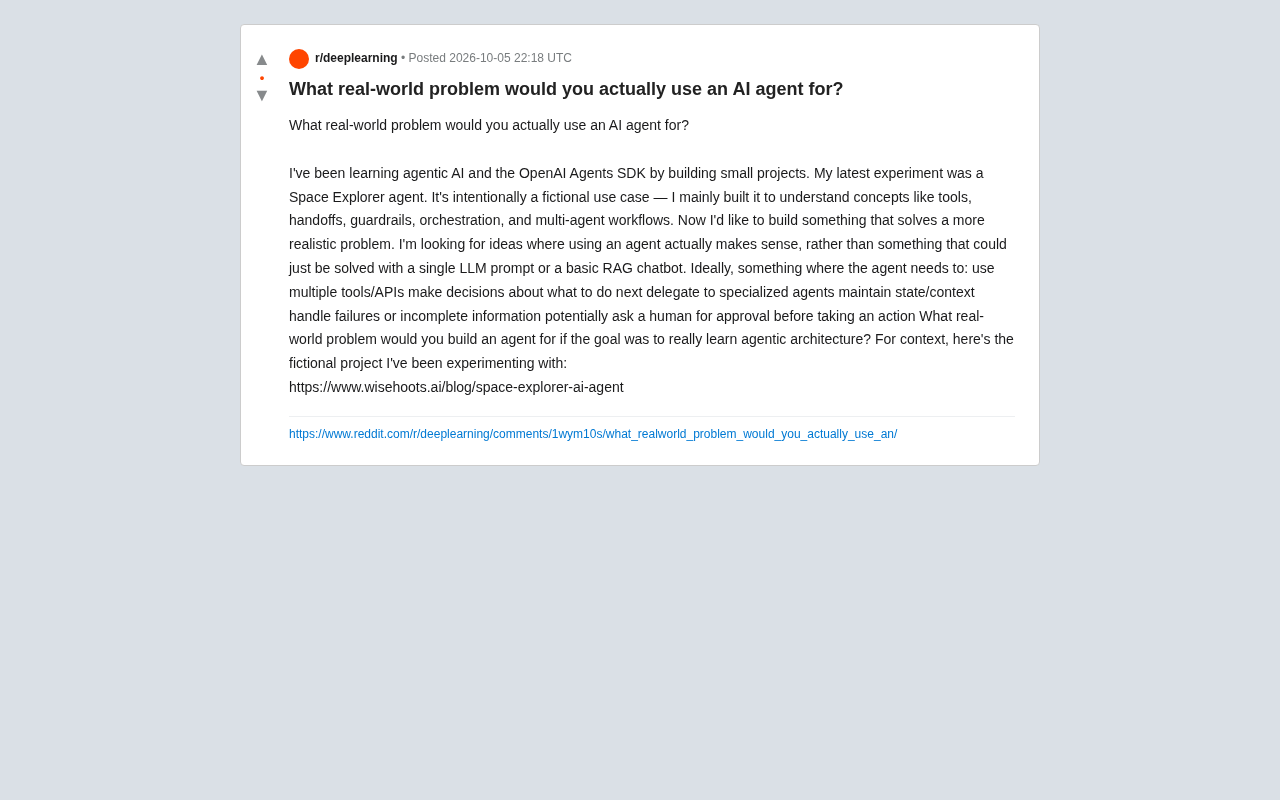
On Reddit, a developer learning Agentic AI and the OpenAI Agents SDK raised a thought-provoking question: What kinds of real-world problems actually require an AI Agent to solve?
The developer admitted that they had previously built a fictional project called "Space Explorer" to understand core concepts like tools, handoffs, guardrails, orchestration, and multi-agent workflows. But they realized that a toy project doesn't truly demonstrate the value of an Agent architecture — so they began searching for scenarios where "an Agent is genuinely more appropriate than a single LLM prompt or a basic RAG chatbot."
This question matters because it cuts to a common misconception in AI application development: many products marketed as "Agents" could actually be handled by a well-crafted prompt or a simple RAG retrieval pipeline. A true Agent architecture carries real costs and complexity — it only pays off when the problem itself has certain characteristics.
What Kinds of Problems Actually "Deserve" an Agent?
The original poster offered a remarkably precise checklist. The scenarios they were looking for required an Agent capable of:
- Calling multiple tools / APIs — not just a single data source or single action
- Autonomously deciding what to do next — with branching logic, not just a linear flow
- Delegating to specialized sub-agents — multi-agent collaboration and division of labor
- Maintaining state and context — preserving memory across multiple turns and steps
- Handling failures or incomplete information — with fault tolerance and retry logic
- Requesting human approval before taking action — a human-in-the-loop mechanism
This checklist serves as a useful ruler: if a problem satisfies three or four of these criteria simultaneously, it's probably worth building an Agent for. Otherwise, you should question whether you're over-engineering.
The Key Distinction Between an Agent and a "Pseudo-Agent"
A single LLM prompt is suited for one-shot input-to-output tasks. A RAG chatbot is suited for retrieval-and-answer knowledge Q&A. The unique value of an Agent lies in its dynamism and autonomy — it faces open-ended problems where the workflow can't be hardcoded in advance, and it must decide its path at runtime based on intermediate results.
In other words, if you can draw the entire process as a fixed flowchart, you probably don't need an Agent at all. Only when "what to do next" depends on "what the last step returned" — and there are multiple possible branches and failure cases — does an Agent architecture start to show its advantage.
RAG (Retrieval-Augmented Generation) is one of the most common LLM application patterns today: the system retrieves relevant document chunks from a vector database based on the user's query, then injects them into a prompt for the model to generate a response. It addresses the problems of knowledge cutoffs and hallucinations, and its flow is fixed — "retrieve → concatenate → generate" — with no branching logic and no behavior change based on intermediate results. By contrast, Agent architecture introduces a "Reason–Act–Observe" (ReAct) loop: at each step, the model decides which tool to call and what parameters to pass based on current observations, then feeds the tool's return value into the next round of reasoning. This loop can iterate indefinitely until the task is complete or a termination condition is triggered. Because of this added dynamic loop, Agent latency, token consumption, and error rates are all significantly higher than RAG — which is the engineering principle behind "use RAG if you can, Agent only if you must."
The OpenAI Agents SDK is an official Python framework released by OpenAI in 2025, evolved from the experimental Swarm project, designed for building multi-agent systems. Its core abstractions include: Agent (an LLM instance with instructions and a toolset), Tool (a function or API the agent can call), Handoff (the mechanism for transferring control from one Agent to another), Guardrail (a validation layer for inputs and outputs), and Runner (the orchestration engine responsible for the execution loop and state management). Compared to third-party frameworks like LangChain or AutoGen, the Agents SDK is designed to be lighter and more "opinionated" — it relies directly on OpenAI's function calling capability to drive tool selection rather than implementing a custom ReAct prompt template. This lowers the barrier to entry but also means limited compatibility with non-OpenAI models.
Real-World Scenario Directions Worth Building
While the original post was primarily soliciting ideas, the author's capability checklist points naturally to several categories of real problems that fit the Agent architecture well.
DevOps and Incident Diagnosis Assistant
An Agent that monitors system alerts needs to call multiple tools — log query APIs, metrics monitoring APIs, deployment system APIs, and more. It decides the next diagnostic step based on log content, delegates to a specialized "database diagnosis Agent" or "network diagnosis Agent" upon finding anomalies, maintains the full incident context throughout, continues gathering data when information is insufficient, and most critically — must request human approval before executing high-risk actions like restarting a service or rolling back a deployment. This hits nearly every item on the checklist.
"Human-in-the-loop" is a safety design pattern in Agent systems where human confirmation is forcibly inserted at critical decision points in an automated workflow, rather than letting the Agent run autonomously from start to finish. The OpenAI Agents SDK natively supports this pattern through an "interrupt" mechanism: when the Agent reaches an action requiring approval, it pauses and serializes its current state, waiting for human input before resuming. This differs from simply having humans review the final output — it happens before the action is executed, and can block irreversible operations (such as deleting database records, sending emails, or triggering deployments). In production-grade Agent systems, human-in-the-loop is often not an optional feature but a hard requirement for high-risk scenarios and a key basis for regulatory compliance.
Travel Planning and Booking Orchestration
Travel planning is a classic case for multi-tool collaboration: querying flight APIs, hotel APIs, weather APIs, and calendar APIs; dynamically adjusting plans based on budget and preferences; handling incomplete information like "your preferred flight is sold out"; and finally letting the user confirm before actually booking and paying. The decision tree is complex enough that a single prompt simply can't handle it.
Research and Report Generation
A deep research Agent needs to decompose a question, call search tools, evaluate information quality, decide whether further retrieval is needed, delegate to a specialized "fact-checking Agent," and make judgments when sources contradict each other. The open-ended nature and multi-step reasoning of this type of task is exactly where Agent architecture earns its keep.
Bridging the Gap from Toy Projects to Real Value
The original poster's learning path is itself worth noting: first use a zero-cost, zero-risk fictional project (Space Explorer) to deeply understand the concepts, then look for real problems to apply them to. This "concepts first, scenario validation second" approach avoids a common beginner mistake — jumping straight into a complex business context and piling on Agent components, only to end up with neither a clear grasp of the concepts nor an actual problem solved.
It's worth noting that this stems from a single Reddit community thread, reflecting one learner's thinking framework rather than broadly validated best practices. But the judgment criteria it offers are universally applicable: before deciding to use an Agent, ask yourself honestly — does this problem genuinely require autonomous decision-making, multi-tool collaboration, and state management? Or am I just excited to use the trendy architecture?
For developers looking to systematically master Agentic architecture, rather than getting lost in the API details of a framework SDK, it's far more valuable to first develop this kind of scenario judgment. Because what ultimately determines whether an Agent project succeeds isn't how elegant the code is — it's whether you chose the right problem for an Agent in the first place.
Related articles

Chain of Thought Isn't Just for AI: How Humans Can Use CoT to Improve Thinking Quality
Chain of Thought isn't just a prompt trick for large models. Starting from a Hacker News discussion, this article analyzes why CoT works for human thinking too, breaks down actionable ways to transfer it, and highlights the key differences between human CoT and machine CoT.
Cloudflare Teams Up with OpenAI: Closi…
Cloudflare Teams Up with OpenAI: Closing the Loop from Vulnerability Discovery to Defense with AI
Cloudflare uses OpenAI Daybreak to investigate security vulnerabilities and generate reviewable remediation plans, while developers use Codex to boost coding efficiency and quality.

Orca Multi-Agent Orchestration in Practice: A Guide to Parallel Collaboration with Claude and Codex
Orca is Stable AI's free open-source agent workbench supporting 34 agents like Claude Code and Codex in parallel. Learn its Git worktree isolation, multi-model orchestration, and mobile management.