Beyond Vibe Coding: A Complete Guide to Enterprise-Grade AI Engineering

How to go beyond Vibe Coding and build enterprise-grade systems using AI engineering methodology.
Vibe Coding is powerful for quick prototypes but falls apart at enterprise scale. This guide breaks down a three-stage progression — from pure Vibe Coding to Plan Mode to full AI engineering with Specification-Driven Development (SDD) — covering tool selection between Claude Code and Codex, a comparison of Chinese LLMs, and the business case for AI model aggregation platforms like OpenRouter.
The Ceiling of Vibe Coding: The Gap Between Toy Projects and Enterprise Systems
With the maturity of AI coding tools like Claude Code, Codex, and Cursor, "Vibe Coding" has become one of the most discussed topics in tech. The term was coined by AI luminary Andrej Karpathy in early 2025 to describe a programming paradigm where natural language is the primary interface and AI generates the code. Its technical foundation lies in the breakthrough capabilities of large language models (LLMs) in code generation — particularly models specifically trained on code, which can now understand requirements and produce structured code at roughly a junior engineer's level. The core idea is straightforward: whether you're a product manager or a developer, simply describe what you need to the AI tool, and it generates working code — no line-by-line writing required.
However, Vibe Coding has clear limitations. Today's mainstream code generation models (such as Claude 3.5 and GPT-4o) are based on autoregressive language models, pretrained on massive code corpora (GitHub, Stack Overflow, etc.) to learn statistical patterns in code. This means LLMs are fundamentally doing "most-likely next-token prediction" rather than strict logical reasoning — they are sequence predictors based on statistical probability, which creates inherent limitations when handling long-context dependencies, global architectural consistency, and complex edge cases. Even with context windows now expanded to 200K tokens in leading models, they still can't fully encompass large codebases, leading to "hallucination drift" — code that looks locally reasonable but is globally inconsistent. As projects grow and business logic becomes more complex, relying purely on conversational "vibes" exposes serious problems: code quality spirals out of control into unmaintainable legacy mess, and when bugs appear in production, non-technical users often get trapped in an endless loop of asking AI to fix bugs that only multiply, until the project stalls completely.
Many early AI influencers claimed to have "replaced programmers with Claude Code," but a closer look at their actual output reveals mostly toy-grade applications with minimal functionality — overseas niche sites, Pomodoro timers, ring light mini-programs. Real enterprise systems involving high concurrency, distributed architecture, and microservices are nearly impossible to build with Vibe Coding alone.

Three Progressive AI Coding Modes
The right response isn't to dismiss Vibe Coding, but to establish a progressive path that allows developers at different skill levels to steadily build engineering capability.
Mode 1: Pure Vibe Coding (Quick Start)
The lowest-barrier entry point. You can generate an e-commerce demo in minutes — ideal for rapidly validating product ideas and getting a feel for AI coding's basic capabilities. It's also the essential foundation for understanding the more advanced modes.
Mode 2: Plan Mode
Using the built-in Plan Mode in Claude Code and Codex, you have the AI complete requirements decomposition and architecture planning before writing a single line of code. This mode is technically rooted in the engineering combination of Prompt Engineering and Chain-of-Thought (CoT) reasoning — the system forces the model to first output a structured task breakdown plan (including module division, interface definitions, and data flow), then execute step by step.
This approach draws on two important research foundations: CoT was formally systematized by Google Brain in 2022 in the paper "Chain-of-Thought Prompting Elicits Reasoning in Large Language Models", demonstrating that guiding models to output intermediate reasoning steps significantly improves accuracy on complex tasks. The "plan before execute" strategy comes from the ReAct (Reasoning + Acting) framework — proposed by Google Research that same year — whose core innovation was interleaving a language model's reasoning with external tool calls, forming a "think → act → observe" loop. This forces the model to output verifiable reasoning steps before generating code, transforming implicit "intuitive generation" into explicit "structured planning" and effectively reducing hallucination drift on long tasks. Research shows that introducing explicit planning steps in complex coding tasks can improve code consistency and correctness by 20–40%. Compared to pure Vibe Coding, this produces cleaner, more logically complete project scaffolding — well suited for mid-complexity feature development.
Mode 3: AI Engineering (Enterprise Grade)
This is where the real value lies. Using the SuperPower plugin for Claude Code, you can implement Specification-Driven Development (SDD).
Specification-Driven Development (SDD) is a software engineering methodology that uses formal or semi-formal specification documents as the core input driving code generation and validation. In the AI coding context, specification documents (such as PRDs, API contracts, and data model definitions) play the role of traditional "requirements review" and "design documents" — providing AI with constrainable, verifiable context anchors. SuperPower integrates dozens of Skills internally, covering a full-lifecycle Agent workflow from requirements analysis, architecture design, and coding, through testing, verification, and deployment.
The engineering philosophy behind this multi-Agent collaboration architecture comes from the "Separation of Concerns" principle in software engineering: decomposing complex tasks into multiple specialized sub-tasks, each handled by Agents with different system prompts and tool access, coordinated by an Orchestrator managing task routing and context passing. LangChain (2022) was the first to engineer this idea; AutoGen (Microsoft Research, 2023) further introduced inter-Agent conversational collaboration. SuperPower's implementation on Claude Code is essentially this framework applied to the vertical use case of code generation — specialized Agents (requirements analysis Agent, architecture design Agent, test Agent, etc.) each handle their domain, collaborating via tool calls to complete end-to-end tasks. This aligns closely with the design philosophy of LangChain, AutoGen, and other mainstream frameworks, and is consistent with spec-driven development tools like Spec Kit — a methodology increasingly adopted by small and mid-sized enterprises today.
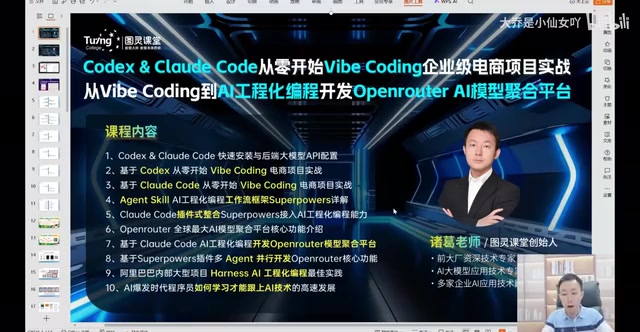
Building on this foundation, two typical projects make excellent hands-on exercises: an enterprise e-commerce platform and an AI model aggregation platform (OpenRouter-style). The engineering workflow for both projects is highly similar, and working through them together helps truly internalize engineering-first thinking.
Tool Selection: The Backend Model Is the Real Differentiator
With AI coding tools multiplying rapidly, the most important selection criterion is: the ceiling of AI coding capability is determined by the backend model — the tool itself comes second.
Claude Code vs. Codex: A Realistic Comparison
Claude Code is widely recognized as the most capable and most widely used AI coding tool among professional developers, with its internal architecture itself constituting a complete engineering harness. However, it has notable pain points in practice: Anthropic's account suspension policies have become stricter and are geographically restricted, making account recovery costly if banned.
By contrast, Codex (backed by the latest GPT models) has improved significantly in recent iterations, with the capability gap versus Claude Code narrowing considerably, and with better stability advantages. Domestic tools like CodeBuddy, ByteDance CodeChare, and Cursor each have their strengths — choose based on your team's specific needs.

Chinese LLM Comparison
The following ranking is based on real-world usage experience, provided as a reference for tool selection:
- GLM (Zhipu AI): Top-tier overall experience; commercial traction validates its technical strength
- DeepSeek: Outstanding price-performance ratio, solid capabilities, and extremely low API pricing — ideal for high-frequency usage
- Kimi, MiniMax, Xiaomi MiMo, Alibaba Tongyi, Tencent Hunyuan: All viable alternatives for specific use cases
Note: The above ranking reflects subjective real-world impressions. Model capabilities are continuously evolving — evaluate dynamically based on your specific business context.
The Business Logic Behind AI Model Aggregation Platforms
For hands-on project selection, an AI model aggregation platform (like OpenRouter) is a direction with both technical and commercial value. Architecturally, these platforms are essentially Unified API Gateways — a design pattern that isn't new to the AI era, with engineering roots tracing back to the API management concepts that emerged during the rise of microservices architecture (e.g., Kong, AWS API Gateway). AI model aggregation platforms apply this pattern to the model access layer: by implementing an interface specification fully compatible with the OpenAI Chat Completions API (including request format, streaming SSE responses, and error code conventions), they abstract away the differences between underlying model providers and deliver a unified calling experience to upstream applications.
Key engineering challenges include: (1) Unified streaming response proxying — different providers have varying SSE event formats requiring real-time transformation; (2) Multi-model load balancing and failover — maintaining real-time health status and latency baselines for each model; (3) Token metering accuracy — different models use different tokenizers (BPE, SentencePiece, etc.), and the token count for the same text can vary by 15–30%, directly affecting billing accuracy; (4) Adapting to varying context window sizes across models. OpenRouter, as the leading global AI model aggregation platform, currently connects over 200 model endpoints covering virtually all mainstream models, and provides detailed model benchmarks and free usage tiers.
These platforms are essentially "wrapper integrations," yet their commercial returns can be substantial. Looking at the AI industry's profitability structure:
Consumer-facing AI applications (such as chat assistants) are generally burning cash. The truly profitable links, in order, are: hardware vendors selling compute (chips, semiconductors) → model vendors selling tokens → model aggregation platforms.
Aggregation platforms generate revenue through margin (buying model API access wholesale, reselling at retail prices) and value-added services (model routing optimization, usage analytics). Their commercial success depends on the AI API consumption market being large enough — global AI API usage is already in the trillions of tokens annually, providing substantial market space for aggregation platforms. Some small teams focused on overseas markets generate annual revenues well into the tens of millions through aggregation platforms alone, with minimal headcount. This illustrates just how underestimated the commercial opportunity at the AI infrastructure layer often is.
The Generational Shift in Development Environments
At the toolchain level, VS Code + Claude Code/Codex plugins has become the mainstream choice.
The evolution of the IDE ecosystem is fundamentally a story of developer toolchains being reconstructed as programming paradigms shift: in the 1990s, Eclipse dominated Java development with its open plugin ecosystem; in the 2000s, IntelliJ IDEA displaced it with smarter code completion; since VS Code launched in 2015, it has risen rapidly on the strength of a key architectural innovation — the Language Server Protocol (LSP). This open protocol standard, introduced by Microsoft alongside VS Code in 2016, completely decoupled language intelligence features (code completion, go-to-definition, error checking) from the IDE itself, delivering them via independent Language Server processes that any IDE could connect to through a unified LSP client. Before LSP, language support was tightly bound to each IDE's core architecture (e.g., IntelliJ's Java support was deeply integrated into its internals), making IDE migration prohibitively expensive. By standardizing language intelligence as reusable services, VS Code leveraged its lighter runtime and lower plugin development barrier to rapidly build ecosystem dominance — it has topped the Stack Overflow Developer Survey's most popular IDE list for multiple consecutive years, with over 15 million monthly active users worldwide.
The impact of the AI era on traditional IDEs should not be underestimated — IntelliJ and other traditional IDEs that once dominated Java and Python ecosystems now face a situation similar to when Eclipse was displaced by IntelliJ. A growing number of professional developers are migrating to VS Code and Cursor, a VS Code-based AI-native IDE that exemplifies AI innovation built on the VS Code ecosystem: Cursor is built on VSCodium (the open-source VS Code codebase), deeply embedding AI code completion and conversational capabilities into the editor's core interaction flow while preserving the full LSP ecosystem. Traditional IDEs that don't accelerate AI capability integration will face sustained competitive pressure. That said, a team's existing toolchain and tech stack remain important dimensions in any selection decision.
Conclusion: Engineering Is the True Moat in AI Coding
Vibe Coding has lowered the barrier to programming, but engineering capability is what drives sustained value delivery in real business contexts. By leveraging engineering plugins like SuperPower to integrate AI coding into a specification-driven, full-lifecycle Agent collaboration framework, developers can genuinely bridge the gap from toy projects to enterprise-grade systems.
For developers looking to apply AI coding to real business problems, understanding the fundamental difference between "vibe coding" and "engineering-grade coding" is far more valuable in the long run than chasing the latest tools.
Key Takeaways
Related articles
Insufficient Source Material: A Tweet With No Substantive Content
A single tweet reading 'Available until the goblins notice.' with two unexpanded links provides no substantive content to write an article from.
Google Jules AI Coding Assistant: A Quick Look at an Open-Source Practice Repo
A look at a small GitHub repo centered on Google Jules, an autonomous AI coding agent. Explores what Jules does, the repo's practical value, and how to evaluate early-stage AI tool projects.
GitHub Project Overview: prateek0221/jules — Critically Lacking Information
The GitHub repo prateek0221/jules has only 1 star, no code, and no README. We review available info and provide background on Google's Jules AI coding agent.