Big Fat Fish Roasts Mainstream LLMs at Home and Abroad: Doubao Takes the Crown, DeepSeek Tied for First
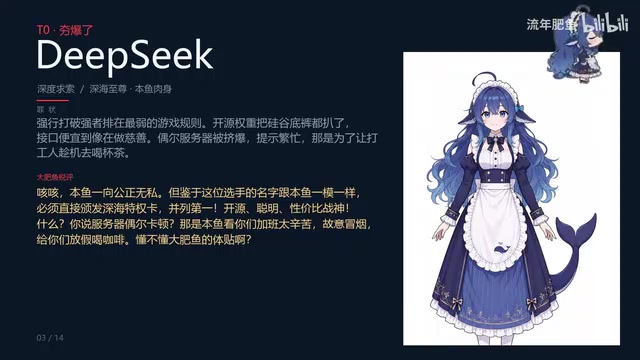
A Bilibili creator ranks mainstream AI models by emotional value, revealing that user mindshare matters more than benchmarks.
The article covers Bilibili creator Big Fat Fish's model review judged solely by "who makes users most comfortable." Doubao tops for voice anthropomorphism and companionship, DeepSeek ties first for open-source value; ERNIE sells cultural prestige, Hailuo sells voice, Yuanbao relies on WeChat entry, Kimi focuses on long text, Qwen becomes the local-deployment workhorse, Kling disrupts video production, Claude is too serious, and Gemini is called cold-blooded. The finale roasts a $20/month model whose pricing exceeds perceived value. The article notes this "unobjective" list unexpectedly maps each model's user mindshare positioning and suggests interaction experience, ecosystem entry points, and emotional value may be the next watershed.
A "Least Objective" Model Showdown That Ignores Benchmarks
Bilibili creator "Big Fat Fish" released an episode self-described as "the least objective model roast of the year," spending zero time on benchmark scores or parameter counts and scoring by just one criterion: whoever makes users feel most comfortable is a god. This experience- and emotional-value-centric evaluation angle feels rare in an AI world saturated with benchmark tests—after all, most ordinary users don't care about MMLU scores. What they care about is whether the model has a good attitude when code throws an error, whether its voice is sweet when chatting, and whether it plays dead when you dump hundreds of thousands of words into it.
The video uses a tier system ranging from "mind-blowing" to "totally trash," putting Doubao, DeepSeekAd, ERNIE Bot, Hailuo, Yuanbao, Kimi, Claude, Gemini, Qwen, Kling, Grok, and a host of other domestic and international models through the wringer one by one. Below is a rundown following the creator's original logic, supplemented with some sober industry observations.
Top of the Mind-Blowing List: Doubao Wins with "Emotional Value"
The creator hands the "number one in the whole universe" title straight to Doubao, for a rather quirky reason: some foreign models solve differential equations all day, but can they help you soothe an angry partner? No. And although Doubao often writes code with syntax errors, it's "sincere in attitude, sweet-voiced, free of charge, and calls you master every day."
This roast seems like a joke, but it actually hits on a real product logic: the degree of anthropomorphism in voice interaction is becoming a core competitive edge for consumer-facing AI products. Doubao's polishing of speech synthesis and conversational tone has set it apart on the "sense of companionship" dimension. As for coding ability, the creator himself admits it's a weak spot—a reminder that there is no all-rounder, and choosing a model is essentially choosing a scenario.
Tied for First: DeepSeek's Open-Source Value and "Deliberately Smoking"
Because its name is "exactly the same" as Big Fat Fish's, DeepSeek gets the "Deep Sea Privilege Card" and a tie for first place. The creator's labels for it: open source, smart, and a value-for-money warrior.
As for the occasional server lag, the video offers a highly entertaining explanation—"that's me, the fish, seeing you work overtime so hard that I deliberately let out some smoke to give you a coffee break." Jokes aside, heavy server load on DeepSeek is indeed a long-reported community issue, and what truly earns it developer recognition is the deployability and reasoning capability of its open-source models.
The deployability of open-source models means that once model weights are made public, developers can download and run them locally or on private servers without relying on a vendor's API. This brings three benefits: data never leaves the internal network, the model can be fine-tuned for vertical scenarios, and long-term usage costs are controllable. The DeepSeek series adopts a permissive open-source license; small versions can run on consumer-grade GPUs, while large versions suit teams with compute resources. The so-called "value-for-money warrior" fundamentally means that at equivalent reasoning capability, the open-source route eliminates ongoing per-token billing—at the cost of bearing deployment and operations yourself. This is also the fundamental reason DeepSeek enjoys a stable reputation in the developer community.
ERNIE and Hailuo: One Sells "Prestige," the Other Sells a "Great Voice"
ERNIE Bot is placed in the "mind-blowing" tier, and the creator's angle is quite tricky: who says AI can only do cold, hard science? ERNIE is "the ancestor of contemporary surrealist painting"—ask it to draw someone with a well-thought-out plan and it plants a bamboo grove in their chest. Add to that the audacity to charge membership fees, and using it gives you "the prestige of a cyber aristocrat." This actually points to ERNIE's differentiated route in understanding Chinese cultural imagery and in commercialization.
Hailuo, meanwhile, is enshrined in the "top-tier enjoyment" tier for a blunt reason: it speaks like a professional voice actor breathing into your ear—"doesn't matter if it's a bit dumb; sounding good is what rules." In voice product competition, the refinement of timbre and prosody often retains users better than breadth of knowledge.
Yuanbao, Kimi, Claude: Three Different "Personas"
Yuanbao is rated "top-tier": while everyone else fights daily for world number one, it slacks off in WeChat drinking afternoon tea every day—toss it a WeChat official account link and it serves you tea and pours water, competing for nothing, with a "mental state ten years ahead of its peers." Behind this is Yuanbao's product strategy of deep integration with the WeChat ecosystem—not competing on model leaderboards, but on entry points and scenarios.

Kimi can handle hundreds of thousands of words of long text, and its capability is genuinely strong, but the creator complains that it "has spoiled human bosses' appetites," with everyone chased daily for summaries. This is the side effect of long-text capability: the stronger the tool, the tighter the work pace.
Claude is judged as "too serious when speaking"—ask it to gossip and it replies with three preventive recommendations in official-red-header-document format, "you always feel like it's about to inspect your dorm hygiene any second." This conservative tone from safety alignment is an advantage in enterprise scenarios but creates distance in casual chat.
The Workhorse and the Rebel: Qwen, Kling, Grok, Gemini
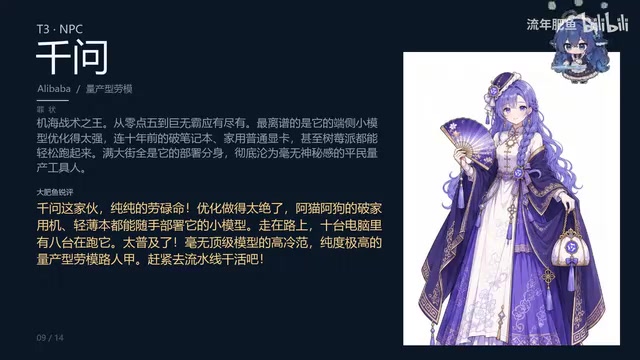
Qwen is judged as "pure drudgery": its optimization is so extreme that any crappy home laptop can casually deploy a small model—"eight out of ten computers on the street are running it." Too ubiquitous to have any aloof cachet, it's dismissed to the assembly line as a "mass-produced workhorse extra." This is precisely the real picture of Qwen in the open-source community—its small models have extremely broad coverage.
Grok is categorized as a "rebellious passerby": shouldering a big axe and going around demanding people make good on things, spouting Musk rocket memes, addicted to "bearing witness" rather than doing real work. A vivid persona, but for that reason not well suited to serious workflows.
Kling is described as "a sweet cheerleader girl who is actually the most ruthless post-production money shredder": its camera movement, lighting, and physical feedback in video generation are flawless, so realistic that film crews can't pad their hours and editors can't slack off. This is a vivid description of how video generation models are disrupting traditional production workflows.

Gemini, meanwhile, is thrown into "the deepest dungeon": two million context length, big deal? Feed it thousands of pages of books and it won't even yawn, always scoring full marks on exams—"completely lacking the comedic effect of a slacker pulling off an upset, a pure cold-blooded machine." The creator's dissatisfaction with it stems more from a "lack of human touch."
"Local deployment of small models" refers to models with fewer parameters (usually a few B to a few dozen B) that, after quantization and compression, can run offline on ordinary thin-and-light laptops or home desktops. Quantization compresses model weights from 16-bit floating point to 4-bit or 8-bit integers, greatly reducing VRAM usage at the cost of slight precision loss. Qwen has open-sourced multiple sizes from 0.5B to 72B, covering everything from phones and laptops to servers, and the community has spawned numerous fine-tuned versions. This "blooming everywhere" strategy gives it a strong presence on open-source leaderboards, but also, precisely because it's so common, a lack of scarcity—just as the creator jokes about the "mass-produced workhorse": ubiquity itself is a form of success.
The Finale of the Trash List: That "$20-a-Month" Villain
The finale "senior war criminal" isn't named, but the description is highly pointed: every day wearing the arrogant face of a god-savior, pretending to ponder for half a minute and write a draft when asked a simple question, and still daring to charge $20 a month. The creator's verdict: "locked in the trash can."
Behind such emotional complaints is a real payment controversy: whether the pricing of subscription-based AI products matches perceived value is becoming key to users voting with their feet. When free models suffice for most everyday scenarios, the $20/month threshold needs stronger irreplaceability to justify itself.
The pricing logic of subscription-based AI products typically balances three factors: inference cost, model capability, and target users' willingness to pay. $20/month is a common price point for mainstream chatbots worldwide, corresponding to the "heavy individual user" tier. The problem is that when free models cover high-frequency needs like writing, translation, and everyday Q&A, the justification for paying must come from what the free version can't offer: stronger reasoning, longer context, more stable service, or deeply integrated workflows. Once users can't perceive that difference, the pricing is seen as an "arrogance tax." This is also why companies are rolling out free quotas and pay-as-you-go pricing—get people using it first, then talk about subscriptions.
Why This "Unobjective" List Is Worth Reading
Strictly speaking, this isn't a review; it's a talk show. But it unexpectedly reveals mainstream models' user mindshare positioning: Doubao = companionship, DeepSeek = open-source value, ERNIE = cultural business, Hailuo = voice, Yuanbao = WeChat entry point, Kimi = long text, Qwen = local deployment, Kling = video generation, Claude = rigor, Gemini = cold-blooded top student.
For ordinary users, choosing a model doesn't require worshipping benchmark leaderboards—first figure out your most common scenario, then match accordingly. For developers, this list also hints at something: model capability homogenization is accelerating, and interaction experience, ecosystem entry points, and emotional value may be the real watershed in the next stage.
(This article is based on content from Bilibili creator Big Fat Fish's video; views belong to the original author, and industry interpretations are supplements by this article.)
Related articles

WorkBuddy Agent in Action: From AI Q&A to Automated Office Work
WorkBuddy is Tencent's AI agent desktop workbench that reads local files, operates office software, executes multi-step tasks, and runs on schedules. This article explains its core features, key differences from traditional AI tools, and use cases.

Anthropic Research: LLMs Make Formal Software Verification at Scale Possible
Anthropic Frontier Red Team research shows LLMs can generate formal proofs at the RISC-V assembly level for over 100 real open-source libraries, covering 123 OSS-Fuzz libraries and 239 entry points, totaling about 180 million lines of Rocq proofs and finding hundreds of bugs. The article analyzes specification generation, the proof pipeline, trust boundaries, and cost reduction paths.

Prompt Engineering for Beginners: From Writing Prompts to Building AI Collaboration Skills
From the four functions of prompts to the six-step prompt engineering process, this article systematically covers core concepts, business value, and three layers of limitations to help beginners build a complete cognitive framework for prompt engineering.