Big Tech's AI Infrastructure Frenzy: The Arms Race That Won't Stop

Earnings from the four AI giants show infrastructure spending still climbing, but returns remain far off.
After four leading AI companies released earnings in the same period, the market saw two signals: big tech's AI data center investment shows no sign of slowing, and the infrastructure spree is still far from delivering returns. The core contradiction is that capex is climbing steeply while AI service revenue hasn't reached a scale that covers costs. No company wants to brake first, since unilaterally contracting means ceding ground in model capability and ecosystem positioning. The cloud business offers another narrative for expansion, but outsiders can't judge whether AI revenue covers depreciation and operating costs. Only capital markets running out of patience, rising financing costs, or a major player publicly admitting a far-longer payback period and contracting first could slow the wave. Investors should watch the efficiency of converting investment into revenue, not absolute capex scale.
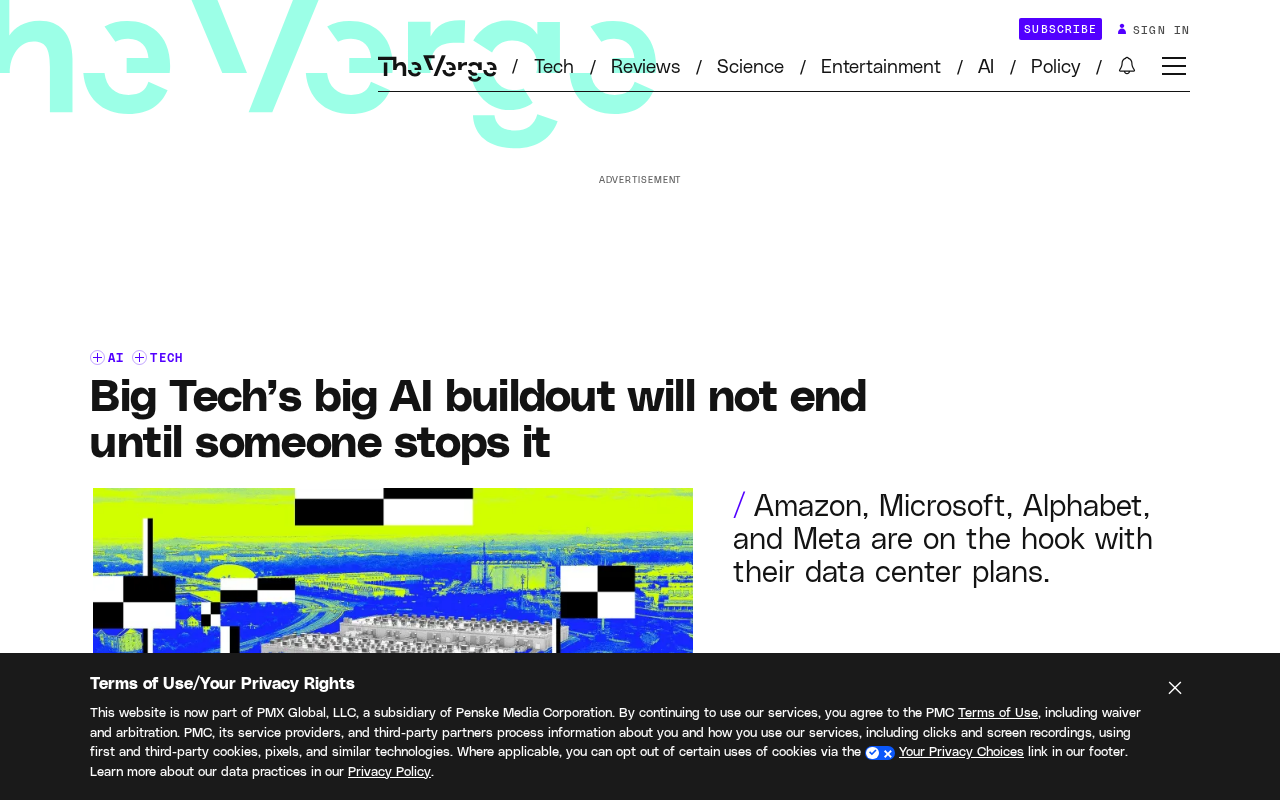
After four leading AI players released quarterly earnings in the same period, the market picked up on two clear signals: big tech's investment in AI data centers shows no sign of slowing down, and this infrastructure spending spree is still far from delivering the promised returns.
The Gap Between Investment and Returns Keeps Widening
The core contradiction revealed by earnings season is that the capex curve is still climbing steeply, but the revenue story hasn't kept pace. Data centers, GPU clusters, power infrastructure—the scale of these heavy-asset investments has reached historic levels, yet the corresponding AI service revenue has not yet grown large enough to cover costs.
This mismatch is no secret. The problem is that no company is willing to be the first to hit the brakes. Stopping means ceding ground in model capability, inference scale, and ecosystem positioning—and the benchmark for this race is still dominated by "who can train a stronger model" rather than "who can earn back their investment first."
Why It Can't Stop
A Prisoner's Dilemma-Style Competitive Logic
When all major players believe scale is the only path to next-generation AI capability, unilaterally cutting spending amounts to strategic surrender. Every company is betting that a rival will buckle first, or that it can sustain cash flow until returns arrive. This structural game makes "rational retrenchment" nearly impossible at the collective level.
The prisoner's dilemma is a classic model in game theory: two accomplices are interrogated separately; if both stay silent, each gets a light sentence; if one betrays while the other stays silent, the betrayer goes free and the silent one gets a heavy sentence; if both betray each other, both get heavy sentences. For the individual, betrayal is always the dominant strategy—but when both sides rationally choose betrayal, the outcome is worse than cooperation.
The structure of the AI infrastructure race is highly similar: every company treats "keep expanding" as its individual optimum, because unilaterally contracting means bearing the risk that a rival breaks through first. So everyone falls into a paradox—all parties know total investment has exceeded foreseeable returns, yet no one has the incentive to turn first. This is precisely the game-theoretic root of what the article calls "rational retrenchment being nearly impossible at the collective level."
The Inertial Push of Cloud Business
For companies with cloud businesses, AI infrastructure carries another meaning: these data centers are both costs and compute assets rented out to customers. Cloud providers' AI-related revenue growth has to some extent supported the narrative for continued expansion, though it's hard for outsiders to judge precisely whether this revenue can cover depreciation and operating costs.
Depreciation and operating costs are the key accounting measures for judging the economics of AI infrastructure. Data centers and GPU clusters are heavy assets; their purchase costs aren't charged to current profit and loss all at once, but amortized as depreciation over their useful lives. Because GPUs iterate quickly, their depreciation cycles are typically far shorter than those of traditional servers. Operating costs include power, cooling, bandwidth, and maintenance labor.
This is exactly why it's hard for outsiders to judge precisely whether cloud providers' AI revenue covers costs: earnings reports often disclose only the growth rate of AI-related revenue, rarely breaking out the corresponding depreciation and operating expenses separately. Revenue growth may come from grabbing customers at low prices, while the true profitability per unit of compute is buried in consolidated statements. This is also why the article emphasizes "conversion efficiency" rather than "absolute scale."
What Conditions Would Bring It to a Halt
For now, only a few variables could slow this construction wave: capital markets running out of patience, persistently rising financing costs, or a major player publicly admitting the payback period is far longer than expected and contracting first. The first two are external constraints; the last requires the industry to produce its first "quitter."
Until then, quarterly earnings will most likely keep showing the same pattern—higher capex guidance paired with a still-blurry timeline for AI monetization.
Capex guidance is management's forward-looking forecast of capital expenditure for the next period in a tech company's earnings report, typically covering data center construction, server and accelerator card purchases, and so on. The market watches it closely because it directly reflects management's confidence in future demand: an upward revision is often read as strong demand, while a downward revision can trigger stock price volatility.
The article's mention that earnings will keep showing "higher capex guidance paired with a blurry AI monetization timeline" points precisely to the signal value of this combination—certainty on the investment side is increasing, but uncertainty on the revenue side is not narrowing in tandem. For investors, the direction of guidance changes reveals more about when an industry inflection point will appear than the absolute numbers of any single quarter.
What It Means for the Industry
For startups and smaller players, big tech's continued investment both limits how far compute prices can fall and raises the competitive bar. For investors, the thing to watch isn't the absolute capex number but whether the speed at which these investments convert into revenue is improving. If that conversion efficiency fails to improve for several consecutive quarters, the market's tolerance will eventually shift.
The end of this infrastructure race may not come from a company voluntarily announcing a stop, but from external conditions forcing everyone to recalculate their input-output ratio at the same time.
One-line Summary
Earnings from the four AI giants show infrastructure spending still climbing, but returns remain far off.
Paragraph Summary
After four leading AI companies released earnings in the same period, the market saw two signals: big tech's investment in AI data centers shows no sign of slowing, and this infrastructure spree is still far from delivering returns. The core contradiction is that the capex curve is climbing steeply while AI service revenue has yet to reach a scale that covers costs. No company wants to hit the brakes first, because unilaterally contracting means ceding ground in model capability and ecosystem positioning. The cloud business provides another layer of narrative support for expansion, but outsiders can't judge whether AI revenue covers depreciation and operating costs. The only variables that could slow the construction wave are capital markets running out of patience, rising financing costs, or a major player publicly admitting the payback period is far longer than expected and contracting first. Investors should focus on the efficiency of converting investment into revenue, not the absolute scale of capex.
Related articles
 Tech Frontiers
Stylome Bot Slammed as Useless Junk: Why Do AI Detection Tools Keep Failing?
Reddit users test the Stylome AI detection bot: Gemini-rewritten text judged human-written, consistently low confidence. An analysis of AI text detection's technical dilemmas, privacy concerns, and credibility crisis in community governance.
 Tech Frontiers
When AI Becomes a Productivity Divide: Clarity or "AI Psychosis"?
A civil engineer's deep use of agentic AI boosted efficiency but bred contempt for peers who refuse to learn. Is this clarity or AI psychosis? An analysis of the cognitive and psychological challenges behind the AI productivity divide.
 Tech Frontiers
Opus 5.5 Benchmark Scores Climb, Community Says Its "Weights Are Blessed"
Reddit community discusses Opus 5.5's rising scores on the Benchmaxxing Bench, with users describing its performance as "weights are blessed." This article interprets the community reaction and cautions against conflating benchmark scores with real capability.