Bilibili Hit Pi Agent Course: A Complete Guide to Building Agents from Scratch

Pi Agent's stars keep accelerating, positioned as a lightweight differentiated choice and a good starting point for learning agent development.
The article discusses a Bilibili Pi Agent course, focusing on the framework's GitHub star growth curve divided into four stages: slow early accumulation, take-off to around 20K, sustained rise to nearly 70K, and current acceleration—showing sustained rather than one-off popularity. It notes Pi Agent draws attention not for richer features than Claude Code or Codex but possibly fewer, with value in differentiated positioning and lower learning barriers. The beginner-friendly course with video and notes helps learners understand task decomposition, tool invocation, and failure retry in agent architecture.
Why Is Pi Agent Worth Watching?
A practical course on Pi Agent on Bilibili has recently sparked a lot of discussion, with a title that directly claims to "beat paid tutorials." Setting aside the marketing hype, Pi Agent itself is indeed an agent framework worth developers' attention. Its GitHub star growth curve shows a continuously accelerating trend—from slow growth during the early accumulation phase, to a clear uptick later on, and now further acceleration. This sustained momentum indicates it is not just a flash-in-the-pan viral project.
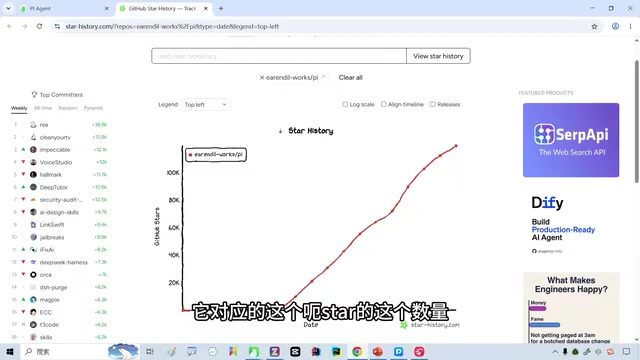
For developers who haven't yet encountered Pi Agent, this may be a signal: if your sensitivity to new AI technologies isn't sharp enough, you may already be lagging behind in information gathering. The creator admits in the course that they have recorded multiple Agent-related courses in recent months—from Agent Scope to Girder to Pi Agent—which precisely reflects how fast this field is iterating.
GitHub Stars are one of the most intuitive popularity indicators in the open-source community. When users click Star, they are essentially bookmarking the repository—expressing approval while making it easy to find later. The growth curve of star counts often reflects a project's popularity better than the absolute number: a one-time surge usually comes from media exposure or list recommendations, while sustained growth with an increasingly steeper slope indicates that new users are continuously joining and retaining. Therefore, observing the historical trend of stars is often used by developers as a reference signal to judge whether an open-source project has entered a healthy growth phase.
The Four Development Stages of Pi Agent
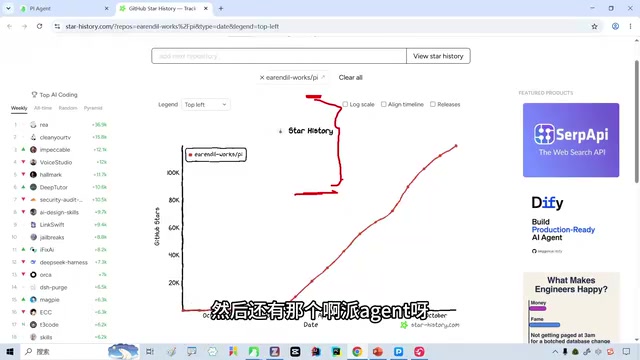
The star trend chart shown in the course divides Pi Agent's growth into four stages, a classification that helps understand the typical path of an open-source project from cold start to explosive growth.
Early Accumulation Phase: Slow but Solid
The first stage corresponds to when the project was just getting started, with very few stars and a flat growth curve. Projects in this phase are often still polishing core features with a limited community, but code quality and design philosophy are being tested by early users. The creator mentioned that this stage doesn't even count as "taking off" because the base is too small and the absolute growth is unremarkable.
Cold Start for an open-source project refers to the phase from zero to gaining its first batch of users and contributors. During this period, the star base is small—even if dozens are added per day, it's barely visible on the curve and easily misjudged as "no traction." However, this stage often determines whether the project's code quality, documentation completeness, and core design can withstand scrutiny. Many projects that later exploded experienced months or even longer of low growth during their cold start period, so looking at the early curve alone is not enough to dismiss a project.
Take-off Phase: From a Few Thousand to Twenty Thousand
The second stage is a clear inflection point. Star counts jumped from the few-thousand range to around twenty thousand, indicating the project began attracting significant developer attention. This phase is characterized by a noticeably steeper growth slope, increasingly active community discussion, and possibly accompanying key version releases or major feature iterations.
Sustained Rise Phase: Approaching Seventy Thousand
The third stage corresponds to sustained growth "breaking out of the lag phase." Star counts continued climbing from around twenty thousand to nearly seventy thousand, and the project entered a stable upward channel. The creator specifically noted that projects in this phase are no longer in the "slow accumulation" category but have formed self-reinforcing growth momentum.
Acceleration Phase: Still Going
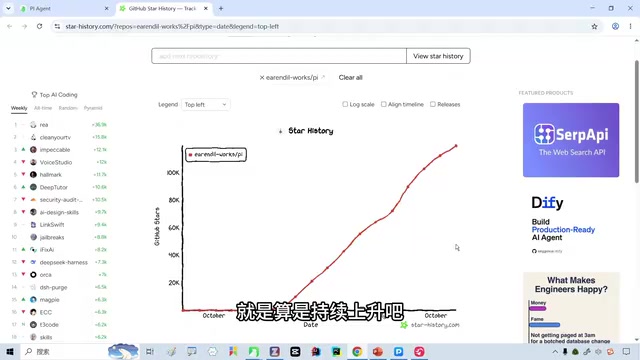
At the current stage, Pi Agent's star growth is still accelerating further. Judging from the trend chart, the curve shows no signs of flattening, meaning the project continues to attract new developers. For technology decision-makers, this kind of sustained rather than pulse-like growth curve is more valuable as a reference than a single viral moment.
With Claude Code and Codex Already Available, Why Pi Agent?
The course raises a key question: with AI coding tools like Claude Code and Codex already on the market, how does Pi Agent still manage to attract so much attention?
The creator's preliminary assessment is somewhat counterintuitive—Pi Agent is attracting attention not because it is richer in features than Claude Code or Codex. On the contrary, it may have fewer features. This statement leaves suspense for subsequent lessons, but also reveals an important piece of information: Pi Agent's positioning is not as an "all-encompassing" replacement but as a differentiated choice with deliberate trade-offs.
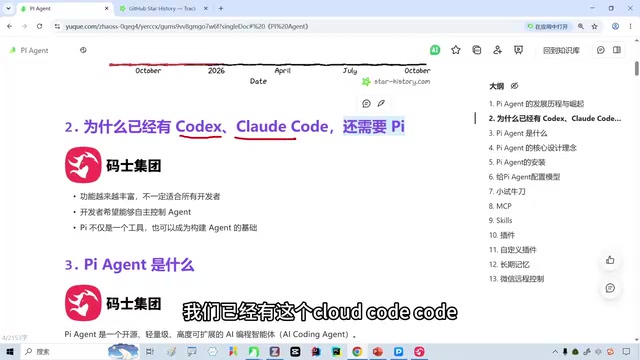
In terms of what agents have in common, Pi Agent and tools like Cursor both fall under the AI Agent category, but their design philosophies may be entirely different. Claude Code and Codex lean more toward the "coding assistant" role, while Pi Agent may have its own trade-offs in autonomy, composability, or lightweight design. Feature count is not the only dimension for evaluating an agent framework—applicable scenarios and onboarding cost are equally important.
Claude Code is a command-line AI coding tool launched by Anthropic that can read codebases, execute commands, and complete multi-step development tasks; Codex is OpenAI's early series of code generation models, also used in products like GitHub Copilot. Both follow the "AI coding assistant" path, emphasizing assistance with writing code within existing development workflows. AI Agent refers to systems that can autonomously plan, invoke tools, and iterate based on feedback to accomplish goals, emphasizing task closure rather than single code completions. Understanding this distinction helps assess Pi Agent's positioning: it is oriented toward "building agents" rather than "assisting coding."
Course Content and Learning Path
This Bilibili course is positioned as "beginner-friendly," focused on building agents independently from scratch with hands-on code guidance. What the course emphasizes is not restating documentation but sorting out the technical development lineage of Agent development to help learners build a complete knowledge framework.
For beginners, the barrier to agent development often lies not in any specific technology but in understanding the overall architecture—how to design task decomposition, how to manage tool invocation, how to handle failure and retry. As a lightweight framework, Pi Agent may precisely lower the barrier to understanding these core concepts.
The course provides accompanying notes that viewers can obtain through the comments section. This "video + notes" combination is quite practical for code-based tutorials, since following along with code purely from video can easily lead to omissions.
Takeaways for Developers
Pi Agent's rise curve provides developers with a sample for observing the lifecycle of open-source projects. From slow accumulation to sustained growth to accelerated ascent, the characteristics of each stage are clearly identifiable. For technology selection, paying attention to projects in an upward phase with healthy growth curves is often more valuable than chasing a single viral hit.
At the same time, the differentiated positioning between Pi Agent and Claude Code/Codex is also worth considering. In an era where AI coding tools are proliferating, the criterion for choosing a tool should not be the length of its feature list but how well it matches your own needs. If you are looking for a framework suitable for learning the core principles of agents, Pi Agent may be a good starting point.
Related articles

AI Coding Enters the Team Collaboration Era: Interpreting Three Major Moves from Meta, GitHub, and Mistral
Meta acquires Conductor, GitHub Copilot Fusion becomes available, Mistral opens Large 4 weights—three moves show AI coding shifting from code generation to organizing development workflows. This article explains task orchestration, model collaboration, and cost control for developers.

Building a RAG Assistant with Dify: A Practical Guide to Knowledge Bases, Workflows, and Agent Nodes
How should knowledge bases, workflows, and Agent nodes connect in a Dify RAG assistant? We break down the division of labor and wiring logic for a shippable app.
 Tech Frontiers
The AI Industry Doesn't Lack Marketing—It Lacks Good Products
AI faces market selloffs and public skepticism—is marketing really the problem? This analysis of market signals and product experience argues the core困境 is incomplete products and a gap between promises and experience; the only way to change perceptions is to ship better products.