Bilibili's 100-Episode Agent Development Course: A Complete Guide from Zero to Employment

Bilibili creator launches a 100-episode Agent development course covering the full path from principles to employment.
This article introduces a Bilibili creator's "Complete 100-Episode Agent Development System Course," designed to address fragmented knowledge in existing tutorials and the inability to independently build agents after learning. It covers four sections: Fundamentals (Agent principles, Prompt engineering, workflows), Advanced (RAG, Agent architecture, multi-agent collaboration, tool calling), Practical (knowledge base assistant, customer service agent, office automation projects), and Employment (resume, portfolio, interview prep). Supporting resources include a roadmap, source code, and interview questions. Suitable for zero-foundation learners, though results depend on hands-on practice.
A Bilibili creator's "Complete 100-Episode Agent Development System Course" attempts to solve a common pain point: there are plenty of Agent tutorials on the market, but the knowledge is scattered, and after finishing them, learners still can't independently build an agent. This course builds a complete path from fundamentals to employment across four major sections, making it quite appealing to zero-foundation learners.

The Core Logic of Course Design: Systematization and Practicality
In the opening, the creator mentions that they studied a large number of Agent tutorials on Bilibili over the past month and found that both popular hits and niche content share the same problem—fragmented knowledge. Therefore, the course reorganizes the learning path from the perspective of zero-foundation learners, compiles a core Agent knowledge system, incorporates real cases, and took three months to produce.
This "research first, then design" approach is commendable. Most tutorials dive straight into technical details while neglecting overall learning path planning. This course is clearly divided into a Fundamentals section, an Advanced section, a Practical section, and an Employment section, each with clear goals, avoiding the dilemma of "finishing the course without knowing what you can do."
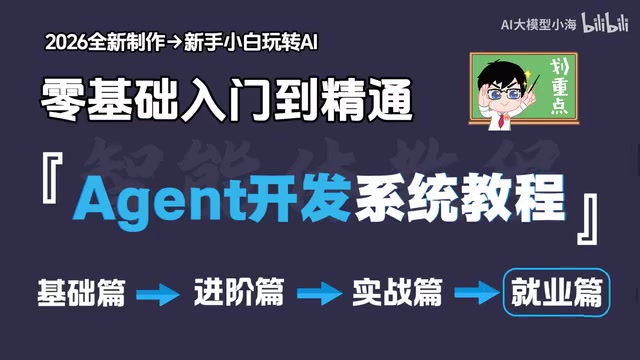
Breaking Down the Four Sections: A Closed Loop from Beginner to Job Seeker
Fundamentals: Building a Cognitive Framework
The Fundamentals section covers Agent principles, Prompt engineering, and workflow design. This is the cornerstone for understanding how agents operate. Many beginners skip the principles and go straight to writing code, only to find themselves unable to troubleshoot when problems arise. This course puts principles first, which helps build solid foundational understanding.
Prompt engineering refers to the technical method of designing, optimizing, and structuring input prompts to guide large language models toward expected outputs. Its core includes techniques such as role setting, task decomposition, few-shot examples, and Chain-of-Thought. In Agent development, Prompt engineering determines how an agent understands instructions, plans steps, and invokes tools—it is the key link connecting natural language intent with executable actions. Mastering Prompt engineering can significantly improve an Agent's response accuracy and task completion rate, so it is usually listed as the first foundational skill to train.
Advanced: Mastering Core Development Capabilities
The Advanced section focuses on RAG knowledge bases, Agent architecture, multi-agent collaboration, and tool calling, combined with hands-on development using mainstream frameworks. These are precisely the key technical points in current Agent development. RAG and tool calling are essential for making agents practical, while multi-agent collaboration represents a more complex application direction.
RAG (Retrieval-Augmented Generation) is a technical architecture that combines external knowledge retrieval with large model generation. Its process typically involves: splitting documents and vectorizing them into a knowledge base; when a user asks a question, first retrieving relevant fragments, then injecting the retrieval results as context into the Prompt, and having the large model generate an answer. RAG can effectively mitigate the problems of outdated knowledge and hallucinations in large models, enabling agents to answer based on private or real-time data. In Agent development, RAG is often combined with tool calling to form the core capability of knowledge-based agents.
Multi-agent collaboration refers to multiple agents with different roles or capabilities working together to complete complex tasks through message passing, task allocation, and negotiation mechanisms. Common patterns include supervisor-worker architectures, debate-style collaboration, and pipeline division of labor. Compared to single agents, multi-agent systems can break down complex problems, process subtasks in parallel, and leverage role specialization to improve overall effectiveness. However, their design also brings new challenges such as communication overhead, state consistency, and coordination logic, making them an important direction in the evolution of Agent architecture.
Practical: Project-Driven Learning
The Practical section includes projects such as a personal knowledge base assistant, an intelligent customer service Agent, and an automated office assistant. Through hands-on project building, knowledge from the first two stages is transformed into practical experience. The project selections cover common enterprise application scenarios and are directly helpful for job seeking.
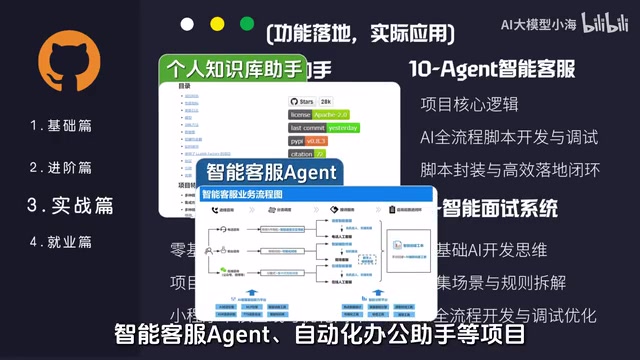
Employment: Bridging the Last Mile
The Employment section analyzes the job map and hiring standards, guides resume and portfolio polishing, and provides detailed explanations of high-frequency interview questions. This section is relatively rare in most technical tutorials, reflecting the course's emphasis on translating learning outcomes into results. For learners whose goal is employment, this content has clear practical value.
Supporting Resources and Learning Experience
To help zero-foundation students learn efficiently, the creator has compiled resources including a complete learning roadmap, project source code, prompt templates, deployment tools, research notes, practical cases, and big-tech interview questions. The learn-by-doing approach lowers the learning barrier and improves knowledge retention.
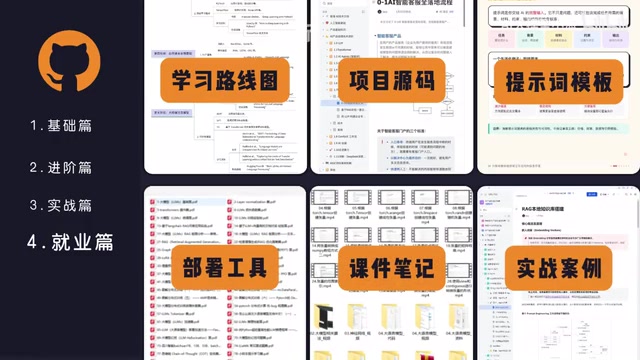
The course emphasizes that "every second is packed with useful knowledge." In terms of content density, 100 episodes can indeed cover a broad range of knowledge. However, learning outcomes ultimately depend on the learner's level of engagement and frequency of practice. It is recommended to practice repeatedly with the project source code rather than passively watching.
Who Is This Course For?
This course is clearly aimed at zero-foundation learners, especially those who want to systematically learn AI Agent development and improve practical skills through projects. If you already have some development experience, you may find the Fundamentals section a bit slow; but for complete beginners, this full-chain design from principles to employment can effectively prevent getting lost in fragmented knowledge.
It should be noted that the quality of a tutorial ultimately depends on the depth of explanation and the usability of the project code. The creator invites viewers to "like, coin, and favorite" the video, which also indirectly reflects their desire for feedback to continuously optimize the content. For ordinary people who want to seize the AI Agent trend, this course provides a structured starting point, but real skill improvement still requires hands-on practice and continuous learning.
One-line Summary
A Bilibili creator launches a 100-episode Agent development system course covering the full chain from principles to employment.
Paragraph Summary
This article introduces the "Complete 100-Episode Agent Development System Course" produced by a Bilibili creator. Addressing the problems of fragmented knowledge in market tutorials and learners being unable to independently develop agents after finishing, the course is designed into four major sections: Fundamentals, Advanced, Practical, and Employment. The Fundamentals section builds understanding of Agent principles, Prompt engineering, and workflows; the Advanced section focuses on RAG, Agent architecture, multi-agent collaboration, and tool calling; the Practical section strengthens hands-on skills through projects such as a knowledge base assistant and intelligent customer service; and the Employment section guides on resumes, portfolios, and interviews. The course also provides supporting resources such as a roadmap, source code, and interview questions, making it suitable for zero-foundation learners to systematically get started—though learning outcomes depend on practical investment.
Related articles

T3 Code: The Open-Source AI Coding Assistant's Comeback Story
T3 Code is an open-source AI coding assistant that unifies subscriptions like Codex and Claude, with powerful remote control and parallel task management.

Never Elected, Yet Ruled New York for 30 Years: The Ultimate Case Study in the Mechanics of Power
Robert Caro's biographies reveal how unelected Robert Moses ruled New York for 30 years through legal drafting and public authorities, and how Lyndon Johnson built leverage as a "powerless" Senate Majority Leader. Unpacking the underlying logic of accumulating and sustaining power.

The CPython 3.10 Recursion Trap and Synthetic Recovery in TokenGuard, an LLM Circuit Breaker
TokenGuard's author recounts a recursion crash caused by OrderedDict.pop in CPython 3.10 and introduces v0.3.0's Loop Nudge synthetic recovery, inline DLP scanning, and other new LLM agent circuit-breaker capabilities.