Bilibili's 532-Episode AI Agent Development Course: A Roadmap Analysis for Zero-Base Career Switchers

Breaking down Bilibili's 532-episode AI Agent tutorial's four-week roadmap and analyzing its reasonableness and career transition feasibility.
Based on a 532-episode AI Agent development tutorial on Bilibili, this article breaks down its content and learning roadmap to help programmers judge whether the career transition is worth taking. The tutorial provides a four-week plan: core Agent components (LLM, planning, memory, tools), classic paradigms like ReAct and Code with common difficulties, multi-agent collaboration and Prompt tuning, and hands-on small projects. The article affirms the AI Agent growth trend and the roadmap's framework value, while noting that "double your salary" is marketing language—four weeks builds only a cognitive framework, not job readiness. Zero-basis learners should first build programming foundations and avoid the misconception that finishing tutorials equals mastering the material.
Bilibili's 532-Episode AI Agent Development Course: A Roadmap Analysis for Zero-Base Career Switchers
AI Agent development is becoming one of the most talked-about directions in the tech world. A tutorial series on Bilibili claiming to span "a full 532 episodes" has appeared, branding itself with slogans like "switch careers from zero basis, double your salary after completion," drawing attention from many programmers looking to transition from traditional development.
What exactly does this tutorial cover? Is the learning roadmap it provides reasonable? This article breaks down and analyzes the tutorial content to help you judge whether this path is worth taking.
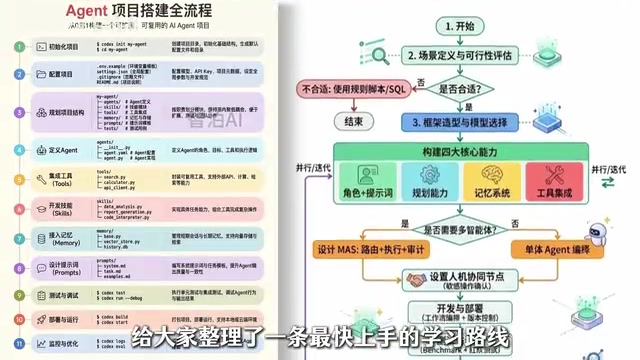
Why Has AI Agent Development Suddenly Become So Popular?
The tutorial opens with a realistic backdrop: competition for traditional development roles is fierce, and news of pay cuts and layoffs is relentless. On the other side, demand for AI Agent-related positions continues to grow. Mastering Agent development skills can both enrich your resume and give you more bargaining power when switching jobs.
This judgment has some basis. As large language model capabilities improve, enterprise demand for agents that "can call tools, plan autonomously, and complete complex tasks" is indeed increasing. Agent development spans multiple skill points including Prompt engineering, tool calling, and multi-turn dialogue management, and talent supply is temporarily unable to keep up with demand growth.
But we need to view things rationally: "double your salary after completion" is a typical marketing phrase. Salary increases depend on multiple factors such as your existing foundation, city, and target position level—they can't simply be attributed to learning a single skill.
Breaking Down the Four-Week Learning Roadmap
The core framework provided by the tutorial is a four-week check-in style learning plan, progressing layer by layer from theory to practice.
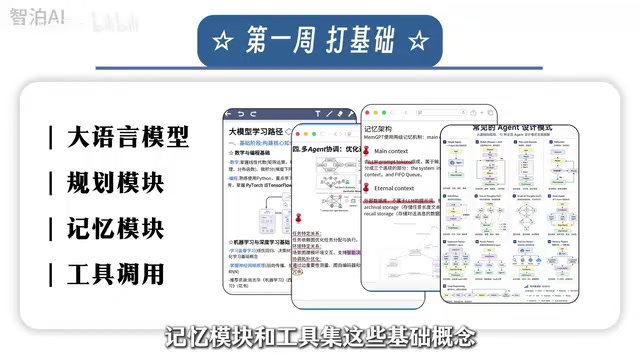
Week One: Build Foundations, Understand Agent Core Components
The goal of week one is to master the core theory of AI Agents, with focus on understanding three major components:
- Large Language Model: The "brain" of the Agent, responsible for understanding instructions and generating decisions
- Planning Module: Enables the Agent to break down complex tasks and formulate execution steps
- Memory Module: Gives the Agent short-term and long-term memory capabilities, supporting context continuity
- Tool Set: The means by which the Agent interacts with the external world, such as search, code execution, and API calls
These four modules form the basic skeleton of an Agent. Understanding their collaborative relationships is more important than memorizing concepts.
Prompt Engineering is a prerequisite concept for understanding Agents. A Prompt is the input text provided by a user or system to a large language model, used to guide the model toward producing expected output. Prompt engineering refers to a set of methods for improving model performance by designing and optimizing prompt structures (such as role setting, task description, output format constraints, few-shot examples, etc.). In Agent scenarios, Prompts are no longer one-time Q&A templates, but rather require dynamically concatenating context, tool descriptions, historical dialogue, and current goals, thus placing higher demands on structured design.
Tool Calling (Function Calling) is the core mechanism for large language models to interact with external systems. Developers pre-define tool names, parameter structures, and function descriptions. During reasoning, the model determines whether a tool needs to be called and outputs a call request conforming to the format, which is executed by an external program and returns results to the model for continued reasoning. This mechanism gives Agents the ability to query databases, call APIs, execute code, and more, breaking through the limitations of pure text generation.
Week Two: Focus on Working Principles and Classic Paradigms
Week two enters the theoretical level. The tutorial mentions learning classic Agent paradigms such as React and Code.
Here "React" refers to the Reasoning + Acting paradigm—the Agent reasons first, then acts, adjusting the next reasoning step based on action results, forming a loop. This is the underlying logic of most current Agent systems. The Code paradigm focuses on enabling Agents to complete tasks by writing and executing code, which is particularly common in data analysis and automation scenarios.
This week also covers common difficulties in Agent development and their solutions, such as handling tool call failures and error accumulation in multi-step tasks.
The ReAct paradigm was proposed by Shunyu Yao and others in 2022, with the full name Reasoning and Acting. The core idea is to have large language models alternate between reasoning and acting. In each cycle, the model first outputs a thought (Thought), then decides what action to take (Action). The environment returns an observation (Observation), and the model continues the next round of reasoning based on the new information. This alternating structure enables Agents to dynamically adjust strategies based on intermediate results, making it more flexible than solutions that generate a complete plan at once—it is currently one of the most widely adopted underlying paradigms for Agent systems.
Week Three: Multi-Agent Collaboration and Prompt Tuning
Week three has two focus areas: multi-agent collaboration logic and Prompt tuning techniques.
Multi-agent collaboration refers to multiple Agents dividing work and cooperating to complete complex tasks—for example, one responsible for planning, one for execution, and one for review. This architecture is becoming increasingly common in scenarios requiring multi-role coordination.
Prompt tuning is a key means of enabling Agents to understand requirements more precisely. Good Prompt design can significantly improve Agent output quality and task completion rates.
Week Four: Hands-On Practice
The final week requires combining everything learned previously to independently complete several small projects.

This step is the most critical part of the entire learning roadmap. Agent development is highly dependent on practical experience. Just watching tutorials without hands-on work makes it hard to truly master operational details like tool calling and state management.
Who Is This Roadmap Suitable For?
Based on the tutorial's positioning, it targets career switchers with zero basis or weak foundations. The four-week pace is relatively tight, and theoretically can help learners establish a complete knowledge framework.
But there are several practical issues to think through in advance:
Can you truly learn in four weeks? Four weeks is enough to establish a cognitive framework, but reaching job-ready level typically requires longer deliberate practice and project accumulation. The tutorial itself emphasizes "don't give up halfway, follow along steadily," implying the learning period may far exceed four weeks.
Can zero-basis learners jump right in? Agent development involves Python programming, API calls, and basic software engineering thinking. If you have no programming experience at all, it's recommended to fill in the basics before entering the Agent field.
What does 532 episodes mean? A large number of episodes indicates broad content coverage, but it may also include a lot of repetition or foundational groundwork. When learning, you need to selectively skip ahead to avoid falling into the illusion that "finishing the series equals mastering it."
Viewing AI Agent Career Transition Rationally
AI Agent is indeed a direction worth investing in, but treating it as a "shortcut to rapid transformation" easily leads to disappointment. A more pragmatic approach is: first assess your programming foundation and learning time, then use small projects to validate your interest, and finally decide whether to commit fully.
The tutorial can serve as an introductory reference, but true skill growth comes from hands-on building and repeated debugging.
One-line Summary
Breaking down the four-week learning roadmap of Bilibili's 532-episode AI Agent tutorial, analyzing its reasonableness and career transition feasibility.
Paragraph Summary
Based on a 532-episode AI Agent development tutorial on Bilibili, this article breaks down its content and learning roadmap to help programmers judge whether the career transition is worth taking. The tutorial provides a four-week check-in style plan: week one understanding Agent core components (large language models, planning, memory, tool set), week two learning classic paradigms like ReAct and Code along with common difficulties, week three mastering multi-agent collaboration and Prompt tuning, week four hands-on practice completing small projects. The article affirms the growth trend of AI Agent and the framework value of the learning roadmap, while pointing out that "double your salary after completion" is marketing language—four weeks can only build a cognitive framework rather than reaching job-ready level. Zero-basis learners need to first fill in programming foundations and avoid the misconception that finishing tutorials equals mastering the material.
Related articles

"Black October": Did AI Uncover 3% of All Critical Vulnerabilities Ever?
A Reddit post claims 3% of all critical software vulnerabilities ever were found in the past month, dubbed 'Black October.' We break down the statistical issues, how AI-assisted code auditing accelerates discovery, and how developers should respond.

Microsoft Project Gecko: Using AI to Bridge Language Gaps for African Farmers
Microsoft's Project Gecko launches PharmaChat, letting African farmers ask questions in their native language and get precise video clips and farming book chapters via AI. The project also releases three interactive manuals to advance inclusive AI.

Musk's Space Dominance: How Starlink Throttling Undermines Ukraine's Defense
SpaceX's Starshield throttling disabled Ukraine's high-speed interceptor drones, exposing how Musk's private control over low Earth orbit communications affects battlefield dynamics and national security, and highlighting the risks of commercial space militarization and space governance dilemmas.