Bilibili's Hardcore AI Coding Course: Full-Stack Vibe Coding in Practice, Building a Commercial-Grade Product Solo

Vibe Coding lets people direct AI to write code; the course teaches full-stack engineering for solo product building.
This article introduces an AI development course by Bilibili creator 分镜影院, centered on Vibe Coding—directing AI to generate pages, write logic, connect databases, fix bugs, and produce promotional content. It corrects the misconception that workflow tools like Coze and Dify represent real AI development, arguing that industrial-grade deployment requires 'AI + Code + Agents + Engineering.' The course covers the full closed loop—requirements, UI, frontend/backend, database, testing, deployment, and operations—using Claude Code, Stitch, MCP, Skills, and Figma. UniApp with AI generation enables write-once, run-anywhere, while AI operations automate copy, scripts, and promo videos. The goal: equipping students for the era of super-individuals and one-person companies.
AI is evolving from a tool into an entirely new form of productivity. In the past, developing a product required collaboration across multiple roles—product managers, designers, frontend and backend developers, testers, and operations. Today, one person can do it all. The course "Vibe Coding, Claude Code, Stitch for UI, to MCP, Frontend & Backend, Mini Programs, and Deployment" by Bilibili creator "分镜影院" (Storyboard Cinema) is a direct response to this trend: the future of software development is being completely restructured by AI.
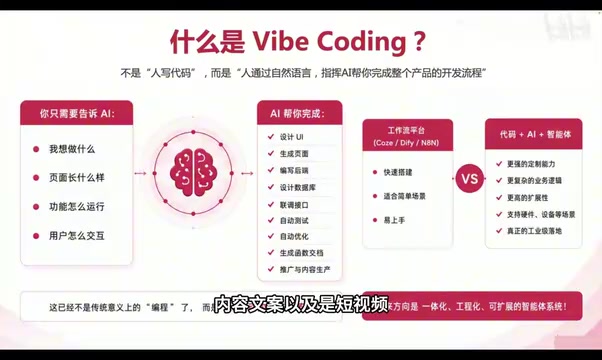
What Is Vibe Coding? From Writing Code to Directing AI
The core idea of Vibe Coding in one sentence: people no longer write code—they direct AI to write it. You tell AI what page you want and how a feature should work, and AI can generate the page, write the code, connect to the database, automatically test and fix bugs, generate documentation, and even produce promotional copy and short videos.
This sounds like the era of "anyone can develop software" has arrived, and the creator believes the answer is yes. But he also points out a common misconception: many people equate AI development with workflow orchestration tools like Coze, Dify, or n8n—thinking that wiring up a few nodes and running a few flows counts as AI development. In reality, these are just entry-level approaches. What can truly be deployed at an industrial level, build complex systems, and construct future AI products is fundamentally the system of AI + Code + Agents + Engineering. What will be valuable in the future isn't simple chatbots, but AI-powered applications—AI e-commerce, digital human automation systems, AI enterprise platforms, and more—all of which ultimately come back to engineering capability.
Claude Code is a command-line AI coding agent released by Anthropic. Unlike IDE plugins that autocomplete code, it can directly read project files, execute terminal commands, run tests, and autonomously iterate on fixes—essentially a "virtual engineer" that can be delegated tasks. This "Agentic Coding" is fundamentally different from traditional code completion: the latter only predicts the next chunk of code, while the former autonomously plans multi-step operations around a goal. Vibe Coding's ability to cover the entire cycle from page generation to test-and-fix relies precisely on this kind of agent with tool-calling and long-context capabilities—it elevates the human role from "writing every line" to "defining goals and reviewing results."
MCP (Model Context Protocol) is an open protocol proposed by Anthropic that enables AI models to connect to external tools and data sources in a standardized way, often compared to "the USB interface of the AI application world." Traditionally, every database or third-party service integration requires custom adapter code. With MCP, any AI client that supports the protocol can uniformly call capabilities like file systems, databases, design tools, and deployment platforms. This is the technical foundation the course emphasizes for "AI to truly participate in design, development, testing, and deployment"—agents gain the "hands and feet" to operate external systems through MCP, rather than being confined to generating text in a chat box.
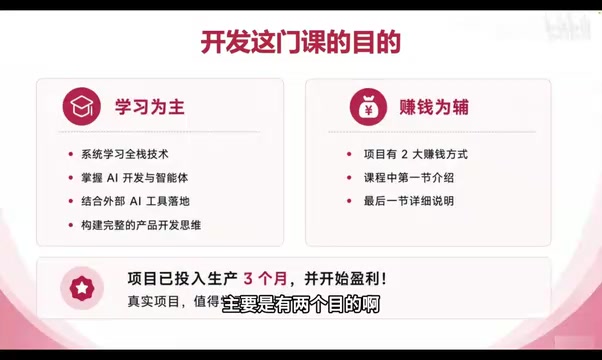
Two Goals of the Course: Learn Skills, and Learn to Earn
The creator explicitly states two purposes for the course. The first is learning: helping people truly master AI development and the engineering product implementation of Vibe Coding, rather than just knowing how to use a few AI tools. The second is earning: the future will see a surge of one-person companies, AI entrepreneurs, and super-individuals. For many, the future may no longer be about finding a job, but about using AI to build products. So this course isn't just a tool tutorial—it's more like a hands-on course for one-person companies in the AI era.
Full-Stack Closed Loop: Not a Demo, a Complete Product
The course's standout feature is its full-stack closed loop. A real product isn't just hand-written code—it's requirements analysis, UI design, page development, backend logic, database, testing, deployment, and operations promotion all connected end to end. The course covers the complete zero-to-one workflow and emphasizes: "We're not building a simple demo—we're genuinely guiding you through building a complete product."
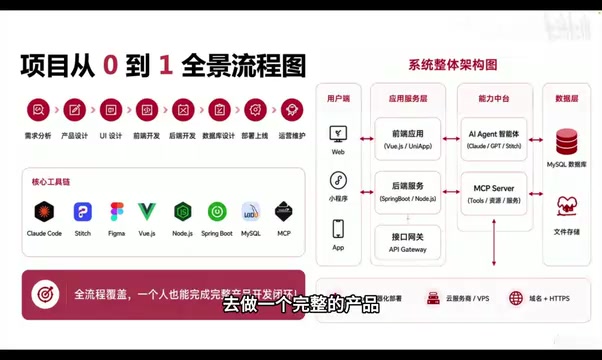
In terms of AI development system architecture, future software development is no longer about isolated capabilities but AI collaborative development: Claude Code, Stitch, MCP, Skills, Figma, and other tools working in concert. AI is no longer just chatting—it's genuinely participating in design, development, testing, optimization, and operations.
Multi-Platform Development and AI Operations: Two Pieces of the One-Person Company Puzzle
In the past, multi-platform development was painful: one codebase for web, another for app, yet another for mini programs. Now AI dramatically lowers the barrier to multi-platform development. The course teaches UniApp, combined with AI code generation and component reuse, to achieve write-once, run-anywhere development—one of the reasons a one-person company is now possible.
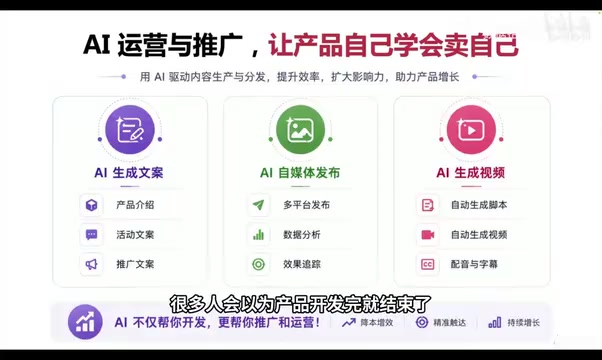
And shipping the product isn't the finish line—the real challenge is promotion. AI has entered the operations domain: automatically generating WeChat official account articles, promotional copy, video scripts, and even auto-generating product promo videos, letting the product promote itself.
UniApp is a cross-platform development framework based on Vue that compiles a single codebase to WeChat Mini Programs, H5, iOS, Android, and multiple mini-program platforms. Its core approach is to abstract away platform differences through conditional compilation and a unified component layer. For a one-person company, its value lies in compressing the high-cost task of "multi-platform adaptation" into a single development effort. And when AI participates in code generation and component reuse, the framework's conventions become an advantage—the more structured and consistent the patterns, the higher the accuracy of AI generation and rewriting. This is why the course teaches UniApp alongside AI code generation.
What You'll Gain
The course promises to equip students with: independent product development capability, full-stack AI collaboration capability, AI engineering capability, multi-platform development capability, and AI-automated operations capability—ultimately, the ability to build products solo. The creator predicts that in the coming years, AI will eliminate massive amounts of repetitive labor while giving rise to a wave of super-individuals, one-person companies, and AI entrepreneurs. The opportunities belong to those who prepare ahead.
For developers who want to advance from "knowing how to use AI tools" to "being able to deliver products with AI," this course offers a complete path from Vibe Coding to engineering implementation.
One-line Summary
Vibe Coding lets people direct AI to write code, and the course advocates a full-stack engineering approach to solo product building.
Paragraph Summary
The article introduces an AI development course by Bilibili creator "分镜影院," centered on Vibe Coding—where people no longer hand-write code but direct AI to generate pages, write logic, connect databases, test and fix bugs, and produce promotional content. The author corrects a common misconception: workflow orchestration tools like Coze, Dify, and n8n are just entry-level; what can truly be deployed at an industrial level is the system of "AI + Code + Agents + Engineering." The course has two goals—learning and earning—and emphasizes a full-stack closed loop rather than a demo, covering requirements, UI, frontend and backend, database, testing, deployment, and operations promotion, with tools like Claude Code, Stitch, MCP, Skills, and Figma working in concert. Multi-platform development uses UniApp with AI generation for write-once, run-anywhere capability, while AI operations can automatically produce copy, scripts, and promo videos. The ultimate goal is to give students independent product development, full-stack AI collaboration, and automated operations capabilities to seize the opportunities of super-individuals and one-person companies.
Related articles

Prompt Engineering for Beginners: From Writing Prompts to Engineering Thinking
Starting from the essence and four functions of prompts, this article systematically explains the six-step process, four success criteria, learning value, and practical limitations of prompt engineering to help you build a complete understanding.

Anthropic Launches Nasdaq IPO: AI Giant's Listing and Risk Disclosures
Anthropic officially launches its Nasdaq IPO under ticker ANT, with market valuation expected to potentially exceed SpaceX's record. The prospectus devotes nearly 100 pages to AI risks, while first-half revenue grew over 14x but net losses widened sharply, reigniting the AI bubble debate.

Rust cURL Clone Uses 4,832 unsafe Blocks—Is the Memory Safety Myth Broken?
A Rust cURL clone uses 4,832 unsafe keywords, challenging Rust's memory safety narrative. We analyze what unsafe really means, compare Fil-C, and examine rewrite motives.