Bilibili's Ultra-Detailed RAG Enterprise Knowledge Base Tutorial: Four Stages from Beginner to Practice

Break down Bilibili's four-stage RAG enterprise knowledge base learning path and assess its suitability and engineering gaps.
Based on a Bilibili tutorial called the "most complete and most detailed" RAG enterprise knowledge base course, this article breaks down its four stages: understanding RAG logic and basic Python; learning LangChain and LlamaIndex; practicing data conversion, retrieval optimization, and chunk tuning; and validating through literature retrieval and workplace Q&A projects. It affirms the path's value while noting that real enterprise knowledge bases also require permissions, update sync, and evaluation systems.
Enterprise data security and scattered, hard-to-find internal documents are the first hurdle many teams hit when implementing AI. Industries such as finance, healthcare, and customer service have already started using RAG (Retrieval-Augmented Generation) to build private knowledge bases to solve these problems. On Bilibili, there is a tutorial series viewers call the "most complete and most detailed" RAG enterprise knowledge base building course. It's designed for zero-basis learners, avoids grinding through papers, and asks for just one to two hours a day; by sticking with four stages, learners can independently build a private knowledge base. This article breaks down the goals, tools, and practice methods of each stage based on the tutorial's roadmap, and adds some practical judgment to help you decide whether this path suits you.
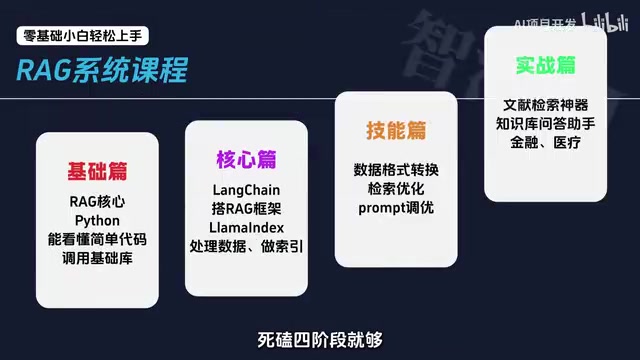
Stage 1: Build the Foundation and Understand What RAG Actually Does
The tutorial sets a very clear entry-level baseline: first understand the core logic of RAG — feed your own external data to a large model so it gives dedicated answers based on that data rather than generic content. This definition seems simple, but it determines the direction of all subsequent work: RAG is not about training a model; it's about attaching a searchable knowledge source to the model.
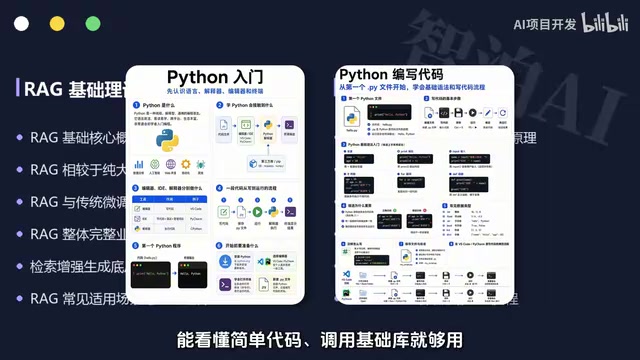
The accompanying skill requirement is basic Python. You don't need to go deep — being able to read simple code and use basic libraries is enough. The tutorial explicitly warns here: "don't be lazy," because the sample code for LangChain and LlamaIndex later is built on Python reading and writing skills. For readers with no programming experience at all, this stage may require a longer adaptation period than "one to two hours," but the threshold is indeed low.
The Difference Between RAG and Model Fine-Tuning: RAG (Retrieval-Augmented Generation) and fine-tuning are the two mainstream paths for getting a large model to use private data, and understanding their differences helps clarify the learning direction. Fine-tuning "writes" knowledge into model parameters through additional training; it is costly, time-consuming, and requires retraining when knowledge updates. RAG, by contrast, dynamically retrieves external knowledge bases at inference time and feeds relevant snippets to the model as context. Updating knowledge only requires updating the document library, with no need to modify the model itself. RAG's advantages are traceability (it can provide cited sources), easy updates, and low cost; its disadvantage is that performance depends heavily on retrieval quality. For scenarios where internal enterprise documents change frequently, RAG is usually the more pragmatic choice, which is why the tutorial uses it as the entry point.
Stage 2: Master the Two Core Tools, LangChain and LlamaIndex
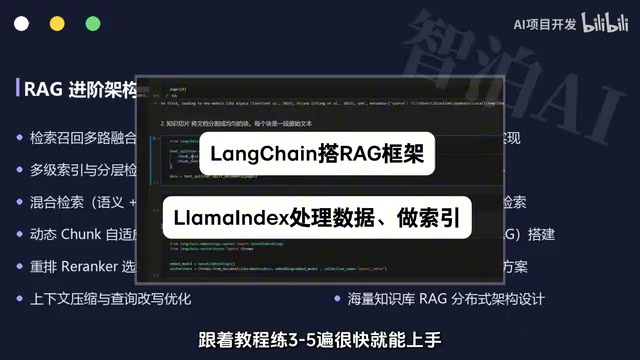
The focus of this stage is two "magic weapons" for RAG: LangChain and LlamaIndex. The tutorial's positioning for beginners is pragmatic — you don't need to understand underlying principles; just be able to use them first. In terms of division of labor, LangChain is responsible for building the RAG framework, and LlamaIndex handles data processing and indexing.
Practice along with the tutorial three to five times, and you'll basically get the hang of it. This "practice a few times" advice is worth taking seriously: most pitfalls in the RAG toolchain are not in the concepts but in configuration and API call details, and repeated practice turns these details into muscle memory. One reminder: both frameworks iterate quickly, so when learning, prioritize the current version's syntax in the official documentation and avoid copying outdated examples.
The Basic Concept of Chunk: A chunk refers to splitting a long document into small pieces of text suitable for retrieval and input to a large model. Chunk granularity directly affects RAG performance: if chunks are too large, retrieval tends to mix in irrelevant information and exceed the model's context window; if chunks are too small, context may be lost and semantics incomplete. Common strategies include splitting by a fixed number of characters with overlap, splitting by semantic boundaries such as paragraphs or headings, and handling special formats like tables and code separately. The tutorial lists chunk tuning as a core skill in Stage 3 precisely because different Q&A scenarios (such as clause lookup versus summary Q&A) require different chunk granularities, and you need to find the balance through experimentation.
Stage 3: Align with Job Requirements and Practice Three Core Skills
The tutorial directly aligns this stage with AI job requirements and lists three priorities: data format conversion, retrieval optimization, and chunk (written as "Trunked" in the tutorial) tuning. These three exactly cover the key links that determine RAG performance — whether data can smoothly enter the pipeline, whether retrieval can recall the correct snippets, and whether chunk granularity matches the Q&A scenario.
The practice method is to work on one or two small cases each day and gradually develop a feel for it. This small-step, high-frequency rhythm suits beginners better than grinding through a big project at once, because RAG tuning relies heavily on intuition about specific data, and intuition can only be built through volume of cases.
Vector Retrieval and Reranking in Retrieval Optimization: The core of retrieval optimization is enabling the system to recall the most relevant snippets from the knowledge base. A common approach is vector retrieval: use an embedding model to convert text into vectors, then search by semantic similarity. But pure vector retrieval may fail in scenarios involving exact keyword matching or proper nouns, so in practice hybrid retrieval (vector retrieval + keyword retrieval) is often used to improve recall. After recalling multiple candidate snippets, a reranker model is used to rescore and reorder the results, placing the most relevant snippets first. Understanding this process helps you determine in Stage 3 practice whether the problem lies in the embedding model, the retrieval strategy, or the reranking step.
Stage 4: Validate Results with Two or Three Practical Projects
The tutorial emphasizes "don't just watch without doing" — only by building two or three simple projects have you truly learned it — and offers two directions: a literature retrieval tool and a workplace knowledge base Q&A assistant. After completing these two projects, you can handle most basic RAG work.
From an enterprise implementation perspective, these two projects are quite representative: literature retrieval focuses on long-document chunking and citation traceability, while workplace Q&A focuses on multi-format document ingestion and permission boundaries, exactly corresponding to the two most common needs for private knowledge bases.
Who This Path Suits and What to Watch Out For
The greatest value of the four-stage path is compressing vast RAG knowledge into an executable sequence: first understand the goal, then master the tools, then practice key skills, and finally wrap up with projects. One to two hours a day, without slacking or giving up, is the rhythm the tutorial repeatedly emphasizes.
What needs to be viewed calmly is that this is a path aimed at entry-level and basic positions. Real enterprise knowledge bases also involve engineering issues such as document permissions, update synchronization, and evaluation systems, which the tutorial does not cover. Treat it as a starting point rather than an endpoint; after finishing, continue iterating on real data to turn "can build it" into "can rely on it." At the end, the tutorial also mentions that if you can't find the tutorial cases, you can leave a comment to request RAG learning materials, which is a usable supplementary channel for self-learners.
Engineering Considerations for Enterprise-Level RAG: The engineering issues the tutorial does not cover are precisely the key to moving a private knowledge base from "can build it" to "can rely on it." In terms of document permissions, you need to ensure that different roles can only retrieve content within their authorized scope, usually by implementing permission filtering at the retrieval layer. In terms of update synchronization, after documents are added, deleted, or modified, index rebuilding or incremental updates need to be triggered to avoid the knowledge base drifting out of sync with source documents. In terms of evaluation systems, you need to establish metrics such as recall rate and answer accuracy, and continuously evaluate performance using annotated Q&A sets. There are also concerns such as sensitive information masking, retrieval log auditing, and concurrency performance. It is recommended that after completing the tutorial projects, you prioritize filling in permissions and evaluation, as they have the greatest impact on actual implementation.
One-line Summary
Break down Bilibili's four-stage RAG enterprise knowledge base learning path and assess its suitability and engineering gaps.
Paragraph Summary
Based on a Bilibili RAG enterprise knowledge base tutorial called the "most complete and most detailed," this article breaks down its four-stage learning path: Stage 1 understands the core logic of RAG and masters basic Python; Stage 2 learns the two core tools LangChain and LlamaIndex; Stage 3 aligns with job requirements and practices data format conversion, retrieval optimization, and chunk tuning; Stage 4 validates results through two practical projects — a literature retrieval tool and a workplace knowledge Q&A assistant. The author affirms the value of compressing vast knowledge into an executable sequence, while reminding readers that this is a path aimed at entry-level and basic positions. Real enterprise knowledge bases also involve engineering issues such as document permissions, update synchronization, and evaluation systems, which require continued study after completion.
Related articles

AI Tools Quietly Altering Settings: Postman Silently Installs Plugin, Codex Sharing Option Auto-Resets
AI Daily reports: Postman silently installs a Mac plugin and self-approves startup hooks, logged as auto-existing upgrade; Hacker News developers say Codex data-sharing opt-out flips back. Plus Simon Willison's raw float weight experiment with QEN 3.8-27B.

AI Learns to Rewrite AI: MIT's "Weightspace Programming" Redraws the Path to Recursive Self-Improvement
MIT team proposes weightspace programming: GPT-6 Astra reads and edits AI model weights directly. Math scores jump several-fold, hand-written networks beat trained models. Eight experiments analyzed, plus Anthropic's same-day warning and the real boundaries of recursive self-improvement.

Running Qwen 3.8 on a Laptop to Read Raw Weights: 46 Minutes Per Answer
Simon Willison reproduced weight space programming with Qwen 3.8 27B on a laptop: a 17GB model file, 46 minutes per answer, 43,506 reasoning tokens, Pong over an hour, Freeway failed. Suited for interpretability researchers.