Bilingual Language Models Capture Cross-Linguistic Influence in Second Language Reading

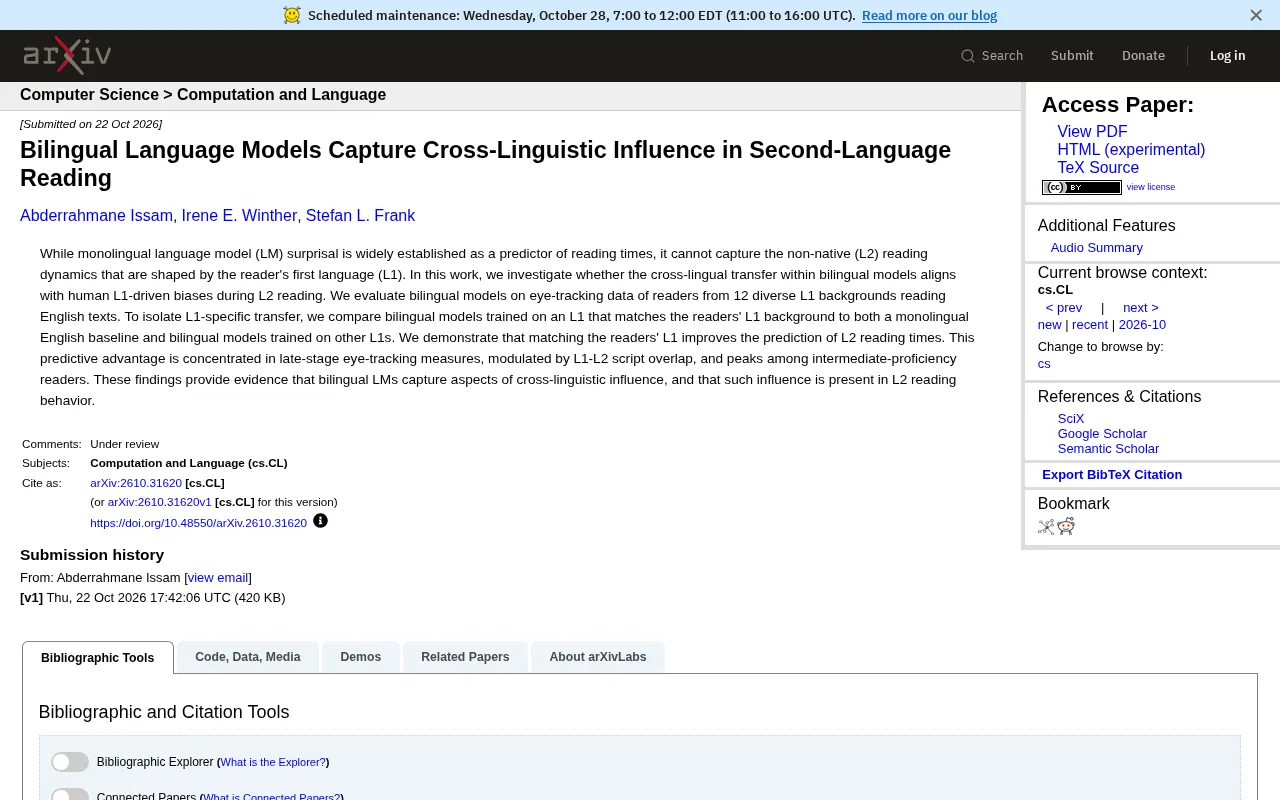
Bilingual models matching the reader's native language predict L2 reading time more accurately, with effects concentrated in late measures.
The study compared bilingual and monolingual language models in predicting L2 reading time. Participants from 12 native language backgrounds read English texts. Using matched-L1, monolingual baseline, and mismatched-L1 predictors, the multi-control design isolated native-language-specific transfer effects. L1-matched bilingual models predicted more accurately, but the advantage concentrated in late eye-tracking measures reflecting semantic integration and reanalysis; it was moderated by L1-L2 writing system overlap and peaked among intermediate-proficiency readers.
Why Aren't Monolingual Models Enough?
Reading time prediction has long been a classic task in computational psycholinguistics. Over the past decade, the surprisal of monolingual language models has been repeatedly validated as an effective predictor of reading time—the more unexpected a word, the longer the reader pauses. But this framework carries a hidden assumption: the reader is a native speaker.
When readers read in a second language (L2), things get much more complicated. The lexicon, syntax, and even writing system of the native language (L1) all exert cross-linguistic influence on L2 processing. Monolingual models are powerless here because they only model the statistical regularities of the target language and cannot see the other language system quietly at work in the reader's mind.
According to the study, prior reading time prediction work was "largely built on monolingual models" but "unable to capture the non-native reading dynamics shaped by the reader's L1." This is the starting point of the research: does the cross-lingual transfer inside bilingual models align with the L1-driven deviations in human L2 reading?
Surprisal is a concept from information theory referring to the negative log probability of a word appearing in a given context: the less likely a word, the higher its surprisal. In computational psycholinguistics, it is used as an operational measure of "processing difficulty"—the lower a language model's predicted probability for a word, the more cognitive resources a reader theoretically needs to process it. This metric can predict reading time because it implicitly captures the reader's statistical expectations about language; but precisely for this reason, surprisal depends entirely on the quality of the language model used and its training data. Monolingual models are trained only on target-language corpora, so their surprisal reflects monolingual statistical expectations and cannot capture the expectation deviations arising from the interaction of two language systems in a bilingual mind.
Experimental Design: Cross-Validation with Eye-Tracking Data from 12 L1 Backgrounds
The research team's approach was quite direct: compare the predictive performance of bilingual models on eye-tracking data. Participants came from 12 different L1 backgrounds, all reading texts in English.
The key design lies in the "matched" versus "mismatched" contrast. To isolate L1-specific transfer effects, the researchers set up three types of predictors:
- Matched group: the L1 used in training the bilingual model matches the reader's native language background;
- Monolingual baseline: a pure English monolingual model;
- Mismatched group: the L1 used in training the bilingual model does not match the reader's native language background.
If the matched group consistently outperforms the other two, it shows that the model has indeed captured some signal related to the reader's native language, rather than just the statistical regularities of English itself. This multi-control design rules out confounds better than simply comparing "bilingual vs. monolingual."
Three Core Findings
Matching L1 Does Improve Prediction, but the Effect Is Concentrated in Late Measures
The results confirmed the hypothesis: when the model's training L1 matches the reader's native language, predictions of L2 reading time are more accurate. But this advantage is not evenly distributed—it is "concentrated in late eye-tracking measures."
Late measures typically reflect integration and reanalysis processes, such as regressions and second-pass fixation durations; early measures more reflect the automaticity of lexical access. This distribution pattern suggests that cross-linguistic influence mainly acts during semantic integration and syntactic reanalysis, rather than initial word recognition. In other words, the shadow of the native language becomes more visible when the reader "savors" the sentence.
Eye-tracking research typically divides fixation measures into early measures and late measures. Early measures include first fixation duration and first-pass time, mainly reflecting relatively automatic processes such as word recognition and initial syntactic parsing; late measures include regression time, second-pass time, and total fixation time, reflecting the process of rereading, semantic integration, and syntactic reanalysis when readers encounter comprehension difficulty. The two types of measures differ in sensitivity to linguistic manipulations, so "the effect appearing late rather than early" is itself a theoretically meaningful distribution pattern, often used to infer which stage of processing a factor acts on.
The Effect Is Moderated by Writing System Overlap
The study also found that the predictive advantage from matching L1 is "moderated by L1-L2 writing system overlap." This is intuitive: readers whose native language shares the Latin alphabet with English (e.g., Spanish or German speakers) should show different transfer patterns from readers using Cyrillic, Chinese characters, or Arabic script. The degree of writing system sharing determines which levels of linguistic knowledge can be directly transferred and which need to be relearned.
The existence of this moderating effect also supports, in turn, that what the model captures is not some generic "foreign language difficulty" but concrete signals related to native language structure.
Intermediate Proficiency Readers Benefit Most
The most intriguing finding is that the effect "peaks among intermediate-proficiency readers."
This can be understood as an inverted U-shape: beginners have too little automaticity in L2, their reading behavior is dominated more by general processing difficulty, and the native language transfer signal is drowned out; advanced learners' L2 processing is already close to native-like, and the L1 influence is diluted. It is precisely intermediate readers who have enough L2 fluency for eye-tracking data to reflect fine-grained processing differences, yet have not shaken off the deep shaping of the native language system, so the traces of cross-linguistic influence are clearest.
Proficiency in second language acquisition research is usually measured through standardized language tests (e.g., vocabulary tests, cloze tests, or CEFR level ratings) to classify beginning, intermediate, and advanced learners. Proficiency is a key moderating variable because it affects two directions simultaneously: on the one hand, L2 automaticity rises with proficiency, enabling eye-tracking data to reflect processing differences more finely; on the other hand, the influence of the L1 system does not decay linearly with proficiency but coexists and competes with the developing L2 system at the intermediate stage. The inverted U-shape hypothesis is precisely the combined result of these two directions, and is also consistent with theoretical expectations in second language acquisition that "cross-linguistic influence is most active in developmental stages."
What This Research Means
Methodologically, it serves as a reminder for reading time prediction research: modeling L2 readers with monolingual surprisal amounts to systematically ignoring a known source of variance. For studies targeting L2 readers, bilingual model surprisal may be a more appropriate predictor.
Theoretically, these results provide behavioral evidence that "bilingual models capture some aspects of cross-linguistic influence," and further show that this influence "exists in L2 reading behavior." There is a measurable alignment between the language transfer inside the model and the native language deviations of human readers, opening up space for using computational models to test language transfer hypotheses.
The limitations are also clear: the study measures predictive power rather than mechanistic explanation, and the model "aligning" with human behavior does not mean the model processes language "like" a human. The interaction details between writing system overlap and proficiency also require data from more L1 combinations to characterize.
Frequently Asked Questions
Can bilingual model surprisal replace monolingual models for reading prediction?
For L2 readers, a bilingual model matching their L1 predicts more accurately, especially on late eye-tracking measures. For native readers, the monolingual baseline remains a reasonable starting point.
Why is the effect concentrated in late measures?
Late measures reflect integration and reanalysis, precisely the stage where native language knowledge most easily intervenes; early lexical access relies more on automatic recognition and is less affected by L1.
Which readers are most worth modeling with bilingual models?
Readers at intermediate proficiency whose native language and target language writing systems partially overlap show the strongest cross-linguistic influence signals.
One-line Summary
Bilingual models matching the reader's native language predict L2 reading time more accurately, with effects concentrated in late measures.
Paragraph Summary
The study compared bilingual language models and monolingual models in predicting L2 reading time. Participants came from 12 native language backgrounds, all reading English texts. Researchers set up three types of predictors—matched L1, monolingual baseline, and mismatched L1—using a multi-control design to isolate native-language-specific transfer effects. Results showed that bilingual models matching the reader's native language predicted more accurately, but the advantage was concentrated in late eye-tracking measures reflecting semantic integration and reanalysis; the effect was moderated by L1-L2 writing system overlap and peaked among intermediate-proficiency readers. The study provides behavioral evidence that bilingual models capture cross-linguistic influence, but it measures predictive power rather than processing mechanisms.
Related articles

DeepSeek Open-Sources DeepInfer: What Is an Inference Framework Actually For?
DeepSeek open-sources its inference framework DeepInfer under Apache 2.0, supporting DeepSeek V4.1 Flash offline inference. This article explains its request scheduling, FlashMLA/DeepGEMM compute optimization, DSPark speculative verification acceleration, and what it means for developers and ordinary users.

Open-Source AI Learning Agent: A Full Workflow Experience from Topology Graphs to Exam Generation
Explore an open-source AI learning agent: built on DeepSeek API, it constructs knowledge systems via topology graphs, with automatic document generation, notes, super documents, and exams. Learn about its Agent workflow and design highlights.

DeepSeek Whale Girl Open-Source MV Meme: AI Industry Coded Slang About Pivoting to Closed Source
Bilibili's DeepSeek Whale Girl rap MV uses fictional memes to tease the AI open-source vs. closed-source debate, with lyrics full of industry slang. This article explains the meme culture, the Whale Girl symbol, and the open/closed tension.