Bilingual Real-Time Transcription Model Selection Guide: Balancing Accuracy, Latency, and Steerability

A practical guide to choosing bilingual transcription models, balancing accuracy, latency, and steerability.
This guide analyzes the current landscape of bilingual real-time transcription models, comparing solutions like OpenAI GPT Transcribe, Whisper, Deepgram Nova, and others across three key dimensions: accuracy in code-switching scenarios, prompt-based output steerability, and latency control. It provides actionable selection advice based on different priorities including real-time performance, output flexibility, cost, and privacy considerations.
The Demand for Bilingual Transcription Is Exploding
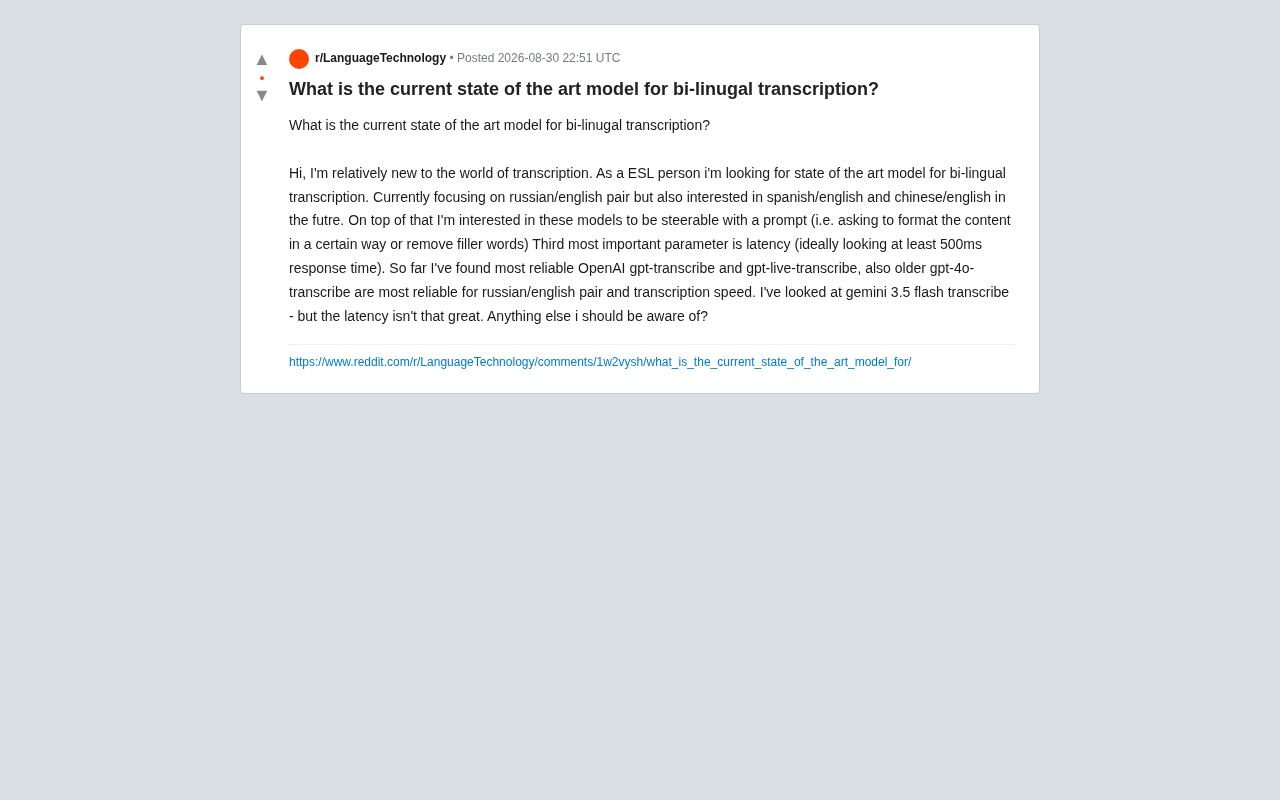
With the rise of global collaboration and cross-language content production, bilingual speech transcription is becoming a high-demand and technically challenging requirement. Recently, a Reddit user raised a highly representative question: as an ESL (English as a Second Language) speaker, they wanted to find the current state-of-the-art bilingual transcription model, focusing on Russian/English mixed scenarios, with plans to expand to Spanish/English and Chinese/English in the future.
This seemingly simple requirement actually involves trade-offs across three key dimensions: accuracy, steerability, and latency. This article draws on practical experience from that discussion to outline the current landscape and selection strategy for bilingual transcription models.
Three Core Dimensions of Bilingual Transcription
Recognition Accuracy in Code-Switching Scenarios
The biggest challenge in bilingual transcription is code-switching — where a speaker mixes two languages within the same sentence. Code-switching is a classic concept in sociolinguistics, referring to the phenomenon where bilingual or multilingual speakers alternate between two or more languages within the same conversation or even the same sentence. In the speech recognition field, code-switching is considered one of the most challenging scenarios because models need to perform language identification switching, acoustic model adaptation, and language model probability adjustment at the millisecond level. Traditional monolingual ASR (Automatic Speech Recognition) models typically require the language to be specified in advance and produce numerous errors when mid-utterance switching occurs. Earlier solutions usually employed a language ID detection module to identify the language first and then dispatch to the corresponding monolingual model, but this pipeline approach significantly increases both latency and error rates during intra-sentence switching. In recent years, end-to-end multilingual models trained jointly on large-scale multilingual data have unified language identification and speech recognition into a single model, significantly improving performance in code-switching scenarios.
According to this user's hands-on testing, for the Russian/English language pair, OpenAI's gpt-transcribe, gpt-live-transcribe, and the earlier gpt-4o-transcribe performed most reliably. This aligns with industry-wide observations: OpenAI's transcription models inherit Whisper's strong multilingual foundation while demonstrating good robustness in mixed-language scenarios.
It's worth noting that Whisper is a general-purpose speech recognition model released by OpenAI in 2022. It uses an encoder-decoder Transformer architecture and was trained on 680,000 hours of weakly-labeled multilingual audio data. Its core design philosophy unifies speech recognition, language identification, voice activity detection, and translation into a sequence-to-sequence generation problem, using special task tokens and language tokens to control output behavior. This multi-task joint training gives Whisper inherent cross-language acoustic representation capabilities, laying a solid foundation for the subsequent GPT Transcribe series' multilingual transcription.
Steerability Through Prompt-Guided Output
Steerability is a key capability that distinguishes next-generation transcription models from traditional ASR. Users want models that can:
- Output transcription content in specific formats
- Automatically remove filler words (such as "um," "uh," "嗯," "那个")
- Adjust transcription style based on instructions
Traditional models like Whisper can only output "faithful" raw transcriptions, while transcription services based on large language model architectures (such as the GPT series transcribe interfaces) support post-processing and formatting of output through prompts. This "steerability" greatly expands transcription use cases, enabling one-stop solutions from meeting minutes to subtitle generation. This capability relies on the LLM's conditional control mechanism during the language generation phase — the model generates text not only based on audio features but also uses prompt instructions as generation conditions, simultaneously satisfying both "faithful transcription" and "format constraints" during decoding. In essence, it merges speech recognition and text post-processing into a single end-to-end process.
Latency Control: The Lifeline of Real-Time Scenarios
The user set a fairly demanding target: ideal response time under 500ms. For real-time subtitles, simultaneous interpretation assistance, or voice assistants, latency directly determines whether the experience is usable.
In real-time transcription scenarios, end-to-end latency can typically be decomposed into three components: audio buffering latency — the system needs to accumulate audio segments of a certain length before feeding them to the model, usually ranging from 200ms to 2 seconds; model inference latency — dependent on model complexity and hardware compute power; and network transmission latency — unavoidable when using cloud APIs. A 500ms target means the sum of these three latencies must be kept under half a second, placing extremely high demands on system architecture design. Streaming ASR typically employs chunked processing or CTC (Connectionist Temporal Classification)-based online decoding strategies to balance latency and accuracy.
You might not have noticed, but the user tested Gemini's flash series transcription capabilities and reported poor latency performance. This reminds us that even models marketed as "fast" still need real-world testing for actual first-token latency and end-to-end latency in streaming transcription scenarios — paper specifications are unreliable.
Overview of Current Mainstream Bilingual Transcription Solutions
OpenAI GPT Transcribe Series (Current Top Choice)
- gpt-live-transcribe / gpt-transcribe: Suitable for streaming real-time transcription scenarios, with excellent Russian-English mixed performance
- gpt-4o-transcribe: Balanced stability and speed
- Core advantages: Prompt-guided output, solid multilingual foundation, mature API ecosystem
The GPT Transcribe series inherits Whisper's multilingual acoustic capabilities while integrating the generative control capabilities of large language models. Whisper comes in multiple versions by parameter count — tiny, base, small, medium, and large — with large-v3 having approximately 1.5 billion parameters and delivering the best performance on multilingual benchmarks. The GPT Transcribe series builds on this by deeply integrating speech understanding with language generation, enabling the model to respond to natural language instructions while transcribing — a leap from "passive dictation" to "active understanding."
Open-Source Solutions: Whisper and Its Optimized Variants
whisper-large-v3 and its community-optimized versions (such as faster-whisper and WhisperX) offer exceptional cost-effectiveness in offline, self-deployable scenarios, supporting 99 languages. However, additional engineering optimization is needed to meet real-time requirements in streaming low-latency scenarios.
faster-whisper is a community reimplementation of the Whisper model based on the CTranslate2 inference engine. By converting PyTorch models to an optimized computation graph format and combining INT8 quantization, batch processing optimization, and KV cache reuse, it achieves 4-6x inference speedup while maintaining near-original accuracy, with approximately 50% reduction in VRAM usage. WhisperX further addresses timestamp alignment and speaker separation — it employs forced alignment technology, using pre-trained phoneme models like wav2vec2.0 to precisely align Whisper's text output to the audio timeline, then combines speaker diarization models like pyannote-audio to achieve multi-speaker conversation separation and labeling. The combination of these two projects provides near-commercial-service-level feature completeness for self-deployment scenarios.
Other Commercial Services Worth Evaluating
- Deepgram Nova Series: Known for low-latency streaming transcription, specifically optimized for real-time scenarios and enterprise-friendly. The Deepgram Nova series models use an end-to-end deep learning architecture. Unlike Whisper's Transformer encoder-decoder architecture, their design leans toward streaming-friendly architectures (such as Conformer-based or similar causal attention mechanisms), enabling them to start outputting interim results after receiving very short audio segments and continuously refining them as more audio arrives. Deepgram also provides a WebSocket API interface supporting continuous bidirectional audio stream transmission, avoiding the connection establishment overhead of HTTP requests — particularly suitable for real-time subtitles, customer service systems, and voice assistants that require continuous transcription.
- AssemblyAI: Offers rich audio understanding capabilities, including speaker diarization and content formatting
- ElevenLabs Scribe: A recently launched transcription model focused on high-accuracy multilingual support
For the Chinese/English language pair, special attention is warranted: Chinese-English code-switching is considered one of the most difficult language pairs in speech recognition. First, Chinese is a syllable-timed language while English is a stress-timed language, and the prosodic rhythm differences cause acoustic models to easily become confused at switching points. Second, Chinese is a tonal language where four tones plus a neutral tone carry word-meaning differentiation, while English intonation primarily conveys mood — this fundamental difference in fundamental frequency (F0) usage increases acoustic modeling complexity. Third, Chinese has no explicit word boundary markers (unlike English which uses spaces), so models must implicitly perform word segmentation when generating Chinese text. Additionally, the common "embedding" phenomenon in Chinese-English mixing — such as using English for technical terms while the sentence body is in Chinese — places extremely high demands on the language model's context-switching ability. It's recommended to run separate benchmark tests for the Chinese-English language pair during model selection.
Bilingual Transcription Selection Advice: No Silver Bullet, Only Trade-offs
Based on the above analysis, here are specific recommendations for different priorities:
Latency-First (Target <500ms): Prioritize services specifically designed for streaming, such as Deepgram Nova or OpenAI's live-transcribe interface. Open-source Whisper requires significant engineering optimization to achieve this latency target — specifically, implementing sliding window mechanisms for audio chunking, adapting the model for streaming inference (such as replacing self-attention with causal attention or limiting the attention window), and GPU inference optimization and result caching strategies at the deployment level.
Steerability-First (Flexible Output Formats Needed): LLM-based transcription interfaces (GPT transcribe series) are virtually the only solution that can flexibly control output through natural language prompts.
Cost and Privacy-First: Self-deploying faster-whisper + WhisperX is the best choice, capable of running completely offline to avoid API costs and data exfiltration risks. For small to medium-sized teams, a single consumer-grade GPU (such as an NVIDIA RTX 4090 with 24GB VRAM) can smoothly run the whisper-large-v3 model, with per-inference costs for 30-second audio clips being virtually negligible, while commercial API fees in high-frequency calling scenarios can accumulate rapidly.
Multi-Language Pair Expansion: Don't assume any model performs consistently across all language pairs. A model that excels at Russian-English may not handle Chinese-English well. It's recommended to establish independent evaluation sets for each target language pair and test accuracy and latency with real mixed-speech data. During evaluation, pay special attention to WER (Word Error Rate) and MER (Mixed Error Rate) — the latter specifically measures recognition accuracy near code-switching points and is a more precise metric for evaluating bilingual transcription capabilities.
Conclusion: Validation with Real Data Is King
There is currently no single "one-size-fits-all" perfect solution for bilingual real-time transcription. OpenAI's GPT Transcribe series stands out in accuracy and steerability and is the mainstream choice for most bilingual transcription scenarios; however, for ultra-low-latency scenarios, dedicated streaming services like Deepgram deserve serious consideration; and for teams sensitive to cost and data privacy, the open-source Whisper ecosystem remains an option that cannot be overlooked.
For serious production applications, the most reliable approach is always: run end-to-end comparative tests on your target language pairs with your own real data, rather than blindly trusting any single benchmark leaderboard or vendor claims. It's worth noting that publicly available benchmark datasets in speech recognition (such as LibriSpeech, Common Voice, FLEURS, etc.) are predominantly monolingual, and standardized evaluation sets specifically targeting code-switching scenarios remain scarce. This means building evaluation datasets tailored to your own business scenarios is not just a recommendation — it's a necessary condition for reaching reliable model selection conclusions.
Related articles
OpenCodex and CodexBar: Solving Two Key Pain Points — Model Switching and Quota Tracking in Codex
Discover OpenCodex and CodexBar — two tools that solve Codex's model switching and quota tracking pain points, enabling tool-model decoupling and centralized quota visibility.
How Ramp Rebuilt Its GTM Orchestration System with AI Agents: From Intent to Automated Execution
Deep dive into how Ramp built an AI-driven GTM orchestration system from scratch — covering unified CDP, unstructured data, skill libraries, and MCP tooling for intent-to-execution automation.
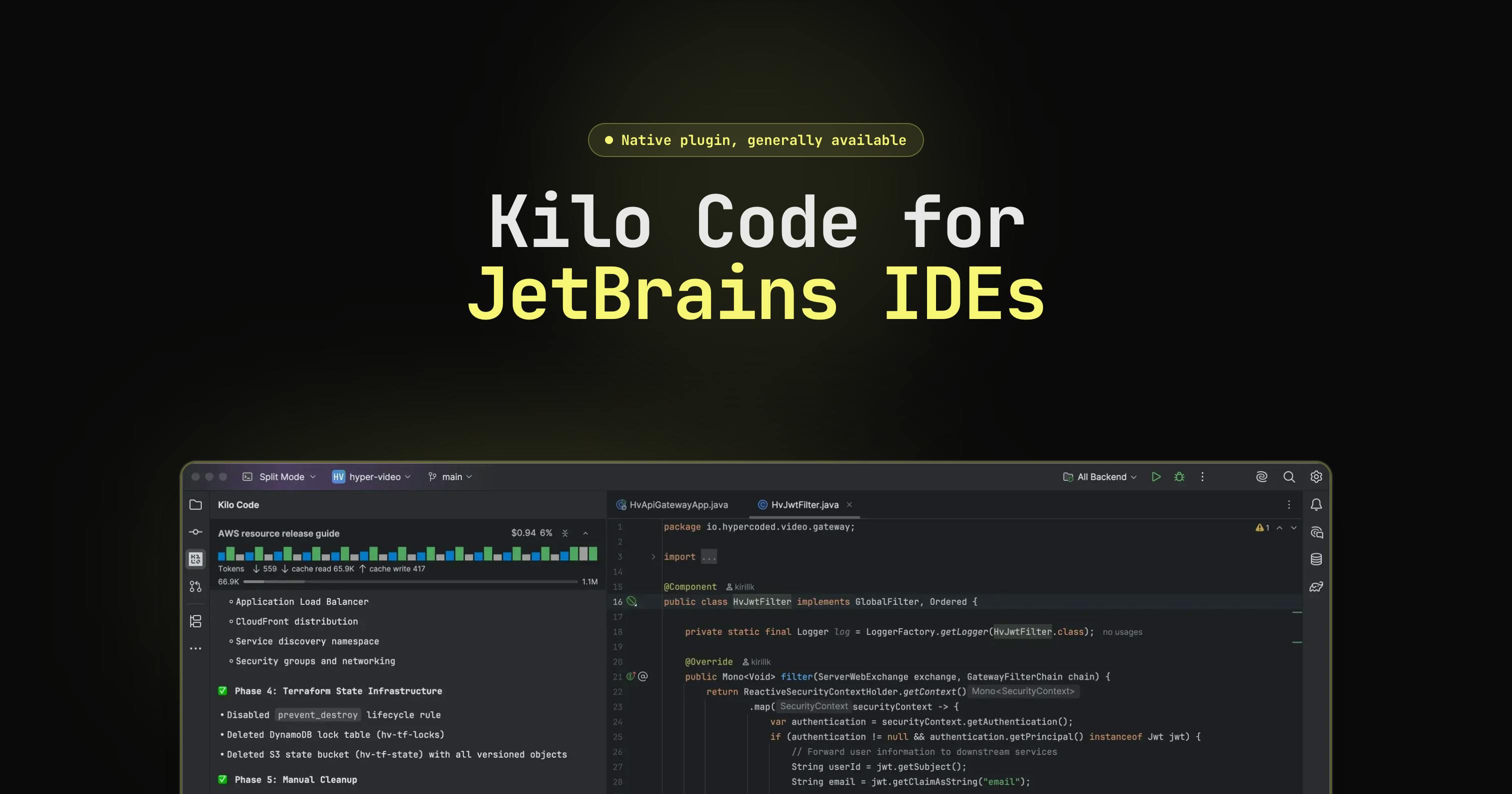
Kilo Code Lands on JetBrains: A Deep Dive into the Open-Source AI Coding Agent
Kilo Code for JetBrains is a fully native, open-source AI coding Agent supporting IntelliJ IDEA, PyCharm and more, featuring parallel Agents, 500+ models, and inline GitHub PRs.