Bill Gates Warns: AI Will Usher in the Most Turbulent Era in Human History

Bill Gates warns AI will bring unprecedented societal turbulence, raising urgent questions about wealth and power.
Bill Gates warns that AI will usher in one of the most turbulent eras in human history. Beyond job displacement, the deeper concern is how AI's benefits will be distributed and whether technological power will concentrate among a tiny elite. As "Pandora's box" is already open, society must urgently address new distribution mechanisms, inclusive AI governance, and regulatory frameworks to prevent extreme inequality.
Gates' Latest Warning
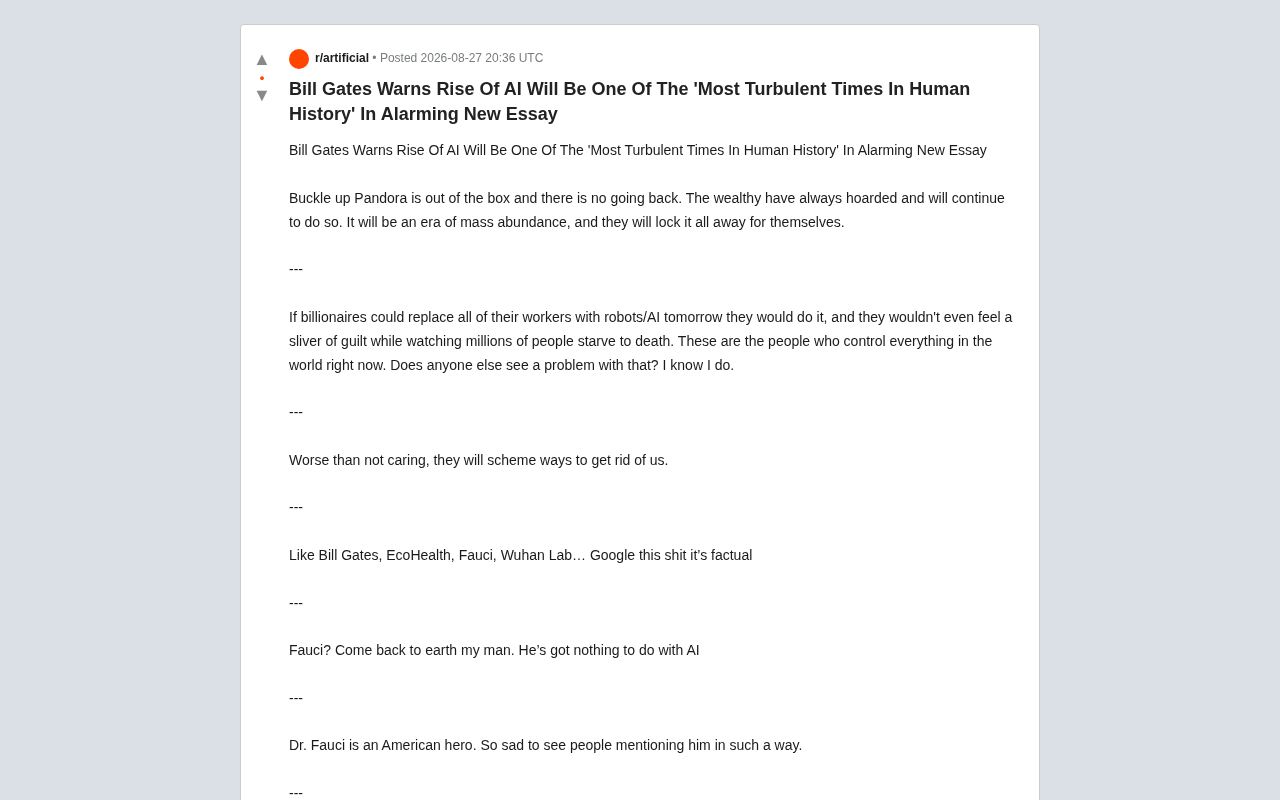
Recently, Microsoft co-founder Bill Gates issued a stark warning in a widely discussed article: the rise of artificial intelligence will mark "one of the most turbulent periods in human history." The statement quickly went viral on social media, sparking fierce debates about AI, wealth distribution, and social power structures—particularly in communities like Reddit.
As a veteran figure in the tech industry, Gates' views on AI have always commanded attention. This time, rather than simply touting AI's technological dividends, he turned the spotlight on the social upheaval the technology could unleash. This shift in tone from "tech optimism" to "cautious vigilance" is itself worth reflecting on. In fact, Gates' stance on AI has undergone a notable evolution. As early as 2015, he expressed concerns about superintelligence during a Reddit AMA, aligning himself with Elon Musk and Stephen Hawking. Yet after ChatGPT captured global attention in 2023, he published a lengthy essay titled The Age of AI Has Begun, calling GPT-4 the "second revolutionary technology" he'd witnessed in his lifetime (the first being the graphical user interface)—a decidedly optimistic pivot. Microsoft's subsequent investment in OpenAI, totaling over $13 billion, further reinforced that impression. His renewed emphasis on "turbulence" now signals a deeper maturity in his understanding of AI—and reflects a broader collective reckoning underway among the tech elite.
"Pandora's Box" Is Open: AI Development Is Irreversible
In the ensuing discussions, one core theme kept surfacing: AI's development is irreversible. As one commenter vividly put it, "Pandora's box has been opened and cannot be closed again." This captures the reality of our current technological trajectory—regardless of how we feel about AI, it has already embedded itself deeply into the fabric of our economy and society.
This irreversibility is precisely one of the root causes of the "turbulence" Gates describes. Unlike previous technological revolutions (the Industrial Revolution, the internet revolution), AI possesses the potential to self-iterate and replace human cognitive labor, potentially delivering shockwaves far broader and faster than any prior technological shift. To understand this self-iterative capability: consider OpenAI's GPT series—the leap from GPT-3 to GPT-4 represented a qualitative jump in reasoning, coding, and multimodal understanding, while training cycles actually shortened. More critically, AI is already participating in its own development. Google DeepMind's AlphaCode can write competition-level code, and AI-assisted chip design (such as Google using AI to optimize TPU chip layouts) is accelerating hardware iteration. This "AI accelerating AI" positive feedback loop—what researchers call "recursive self-improvement"—means the pace of technological progress could grow exponentially, far beyond the linear development trajectories of steam engines or early computers.
The Double-Edged Sword of Technological Progress
Every major technological breakthrough in history has come with a painful adjustment period. Steam engines displaced artisans; computers transformed office work. But these transformations typically unfolded over extended buffer periods, allowing society to gradually adapt. The problem with AI is that it could simultaneously disrupt both white-collar and blue-collar jobs in an extremely short timeframe, drastically shrinking the window for societal adjustment.
Looking back, the First Industrial Revolution spanned from the 1760s to the mid-19th century—nearly a hundred years. During that period, Britain endured the Luddite movement (workers destroying machinery in protest), child labor, expanding urban slums, and other severe social crises. It wasn't until the passage of the Factory Acts and the rise of the labor movement that society gradually established a new equilibrium. The Second Industrial Revolution (the age of electrification) similarly required decades of adjustment. The internet revolution compressed that adaptation period to roughly 20 years, but its primary disruptions were concentrated in specific domains like information distribution and retail. AI is fundamentally different because it simultaneously affects cognitive labor (legal analysis, medical diagnosis, software development, financial auditing) and physical labor (autonomous driving, warehouse logistics, agricultural harvesting). Its impact spans virtually every industry, and the window for society to establish a new equilibrium may be measured in years rather than decades.
Wealth Distribution Anxiety in the AI Era
Judging from Reddit community reactions, the public's deepest concern isn't the technology itself—it's how the technological gains will be distributed. Multiple commenters pointedly observed: if billionaires could replace all their employees with robots and AI, they would "do it tomorrow" without a shred of guilt.
This anxiety reflects a real structural contradiction: Will the era of "mass abundance" created by AI see its benefits monopolized by the few who control the technology and capital?
"Mass abundance" is a concept that has gained frequent currency in Silicon Valley and economics circles in recent years. Its core assumption is that when AI and automation drive marginal production costs to near zero, human society will face the possibility of "post-scarcity" for the first time. This echoes economist Jeremy Rifkin's predictions in The Zero Marginal Cost Society. However, basic economic principles tell us that scarcity exists not only on the production side but also on the distribution side. Critical resources like land, energy, and data remain finite, and the tech giants that control AI infrastructure—GPU clusters, training data, algorithm patents—including Microsoft, Google, Meta, and NVIDIA—are constructing a new "digital landlord" landscape. Whether abundance translates into universal welfare depends entirely on institutional design.
Some argue that we may be entering an era of extreme material abundance, but this wealth will be "locked away," serving only a tiny elite. This isn't mere pessimism—it's a reasonable extrapolation of current wealth concentration trends.
A Repeatedly Cited Economic Paradox
A fascinating paradox emerged in the discussions: If everyone is unemployed, who will companies sell their products to? Some commenters questioned whether mass unemployment would ultimately destroy consumer markets, causing businesses themselves to collapse.
This paradox has deep connections to the economic theory of "insufficient effective demand." As early as the 1930s, Keynes pointed out that when workers' incomes decline, shrinking aggregate demand leads to a downward economic spiral. Marx even earlier identified the "inherent contradiction of capitalism"—the fundamental conflict between capital's drive to suppress labor costs and the need to maintain consumer markets. In the AI context, this contradiction is pushed to its extreme: if automation eliminates most employment, workers' role as consumers disappears along with their jobs.
But the counterargument is equally sharp: when a small group owns robotic labor and all the world's resources, they "don't need to sell anything to anyone anymore." The traditional "production—consumption—reproduction" cycle could be entirely broken, with economic logic rewritten from scratch. While this scenario is extreme, it has historical parallels—feudal aristocrats didn't depend on serfs' "purchasing power" to maintain their rule; they directly controlled the means of production. The extreme scenario of the AI era might look like this: a tech elite forms a self-sufficient economic loop, completely detached from the mass economy, rendering the traditional market economy framework obsolete. This prospect reveals the structural power shift AI could bring—ordinary people's value within the production system could be marginalized.
The Line Between Rumor and Reason
As a side note, the discussions around Gates were also peppered with conspiracy theories. Some tried to force connections between Gates, the pandemic, and laboratories, attempting to construct an "elite conspiracy" narrative.
Rational voices pushed back forcefully. One commenter recalled that those who claimed "vaccines will kill recipients within three years" have now been proven wrong six years later—their prophecies never materialized, while some who rejected science paid the price. This exchange reminds us: When discussing serious issues like AI, distinguishing fact-based concerns from baseless conspiracy theories is essential.
Conflating Gates' warnings about AI with unrelated health conspiracy theories only dilutes the truly important questions—namely, the concentration of technological power and social equity.
The Real Challenge: Power Structures, Not Technology Itself
Cutting through the noise of these discussions, a more profound insight emerges: the real battleground of the AI era isn't employment—it's power.
One commenter hit the nail on the head: as AI and robotics mature, those who control these technologies "no longer need to sell anything," while ordinary people could be reduced from "labor force" to subjects requiring "management." When the masses lose their bargaining power within the economic system, the balance of social power will fundamentally shift.
This is perhaps the deeper meaning of the "turbulence" Gates describes—AI triggers not just economic restructuring, but a fundamental challenge to existing social contracts and power distribution mechanisms.
How Should We Respond to AI's Impact?
Faced with such prospects, passive waiting is clearly not an option. Society needs to think ahead: How do we design new distribution mechanisms (such as the ongoing discussion around universal basic income)? How do we ensure AI technology is inclusive rather than monopolistic? How do we prevent excessive concentration of technological power at the regulatory level?
Regarding distribution mechanisms, the discussion around Universal Basic Income (UBI) has moved from academic ivory towers to policy experimentation. Between 2017 and 2022, Finland conducted the world's most closely watched UBI experiment, providing 2,000 unemployed individuals with €560 per month. Results showed significant improvements in participants' well-being and social trust. A research project funded by OpenAI CEO Sam Altman provided $1,000 per month to low-income Americans for three years; results published in 2024 indicated that UBI helped recipients pursue career transitions and educational investment. However, critics point out that in a scenario of mass AI-driven unemployment, funding UBI becomes a core challenge—if the tax base shrinks dramatically due to unemployment, UBI's sustainability is questionable. This is why proposals for an "automation tax" or "robot tax" on AI companies have surfaced in policy discussions across various countries.
On the regulatory front, major global economies have begun pursuing differentiated approaches. The EU's AI Act, officially passed in 2024, is the world's first comprehensive AI legislation, employing a risk-based tiered regulatory framework. The United States tends to favor executive orders and industry self-regulation. China introduced generative AI management measures and deepfake regulations in 2023, emphasizing content safety and algorithmic transparency. However, the fundamental regulatory dilemma remains: AI technology iterates far faster than legislative cycles, and the technical capabilities of multinational tech giants often exceed the regulatory reach of any single nation. Striking a balance between encouraging innovation and mitigating risk remains the core challenge facing policymakers worldwide.
Gates' warning is less a prophecy than a wake-up call. It reminds us that the trajectory of technology is not predetermined—it depends on the institutional choices we make today. Whether AI becomes the liberator of "mass abundance" or an amplifier of inequality, the answer lies in our own hands.
Conclusion
The reason Bill Gates' article has generated such intense reactions is precisely because it touches the rawest nerve of our era. Technological progress has never been the whole story—how we harness technology, distribute its dividends, and safeguard fairness are what will determine the direction of the AI era. Now that Pandora's box is open, the only thing we can do is face this inevitable transformation with clarity and wisdom.
Related articles

Meta vs. Publishers: The AI Data Battle Over Terms of Service Changes and the Future of the Internet
Meta changed its business account terms to allow AI training on linked website data, sparking backlash from publishers and creators. Industry groups demanded negotiations, forcing Meta to remove 'training' wording and delay the effective date. The dispute reveals the deeper battle over data authorization and the future of the internet in the AI era.

When Outside Xbox Meets Blood on the Clocktower: A Legion Match in Minecraft
Outside Xbox guests Ellen and Mike play Minecraft Blood on the Clocktower in a Legion game. How can three good players fight an evil majority amid information noise? This article breaks down Legion mechanics, information-role mind games, and the endgame reversal.

Kimi K3.1 Hands-On Test: Open-Source Model Nears Opus, Video Generation Steals the Show
Kimi K3.1 completed motion graphics, 3D rendering, mini-games, and video generation in a live test. Analysis of its 2.8T MoE architecture, gap vs Opus/GPT, and hidden video generation.