AI Agent Architecture Explained: Four Core Modules and the Complete Path to Production

A systematic breakdown of AI Agent architecture's four core modules and practical deployment guidance.
This article provides a comprehensive analysis of AI Agent architecture, covering its four core modules—Memory, Planning, Tools, and Action. It explains the fundamental differences between Agents and plain LLM API calls, details mechanisms like ReAct decision loops, Chain-of-Thought, and Function Calling, and offers practical guidance on when businesses truly need an Agent versus a simple workflow.
Why Agents Have Become the Central Direction in AI
If you've worked with large language models, you've probably noticed an obvious limitation: when you call an LLM API directly, it's essentially a simple "input → process → output" pipeline—you send the model some content, it processes it, and returns a result. That's fine for simple Q&A, but when we want AI to actually complete complex tasks, the ability to answer questions alone is far from enough.
Today's mainstream LLM APIs (such as OpenAI's GPT series, Anthropic's Claude, Google's Gemini, etc.) all follow a "stateless request-response" pattern—each call is independent, the model doesn't automatically remember what happened in the previous conversation, and it can't initiate actions on its own. This architecture stems from the Transformer's autoregressive generation mechanism: the model predicts the next most likely token one at a time until it generates a complete response. This means the model's capability boundary is confined to "text generation within a given context window"—it can't autonomously perceive changes in the external environment, trigger follow-up actions, or maintain goal-oriented coherence across multi-turn interactions.
As enterprise demand surges and the market continues to expand, Agents are widely recognized as the key form factor for LLM deployment. According to Grand View Research and other firms, the global AI Agent market is projected to grow from approximately $5 billion in 2024 to over $47 billion by 2030, with a compound annual growth rate exceeding 40%. Tech giants like Microsoft, Google, and Salesforce have all made Agent capabilities a core part of their product strategy—Microsoft launched Copilot Studio to support enterprise Agent building, Google integrated Agent Builder into its Vertex AI platform, and Salesforce released Einstein Copilot Agent. In the open-source ecosystem, frameworks like LangChain, CrewAI, and AutoGen are also iterating rapidly, lowering the barrier to Agent development.
However, despite everyone emphasizing that Agent development is the next big opportunity, very few resources clearly explain "how to actually build an Agent": which framework to choose, how to call tools, how to prepare data, how to deploy to production—there are gray areas everywhere. This article will systematically break down the complete architecture and development logic of AI Agents, helping you build a clear technical understanding.
The Fundamental Difference Between AI Agents and Plain LLMs
To understand Agents, you first need to understand how they fundamentally differ from simply calling an LLM API. Here's an intuitive example: suppose you need to hammer a nail into a wall. You can't drive the nail in by just "thinking" about it. You need to hold the nail in place, pick up the hammer and strike, then observe how deep the nail has gone—this is a complete loop of "understand the problem → make a plan → use a tool → execute → observe the result," with plan adjustments as needed.

When solving real-world problems, we typically don't go straight from thinking to having the answer. Instead, we go through multiple stages: understanding, planning, executing, observing, and adjusting. The essential design philosophy of an Agent is to give AI this kind of human-like task-handling capability.
If we say that the LLM is responsible for core understanding and reasoning, then the Agent is responsible for enabling the model to continuously complete tasks around a specific goal. This is the most important distinction between an Agent and simply calling an API: the former is an autonomous intelligent entity that can handle tasks, while the latter is just a passive Q&A tool.
The Four Core Modules of an Agent System
Think of an Agent as a complete system. Beyond the LLM that serves as its core engine, it contains four key components: Memory, Planning, Tools, and Action. Only when these modules are assembled together do you get an Agent that can continuously handle tasks.
Memory Module: Short-Term and Long-Term Memory
Imagine you're having a lengthy conversation with AI: in the first step you tell it the goal, in the second step you add constraints, and in the third step you raise new requirements based on previous results. If the AI has zero memory of what happened before, subsequent tasks can't continue. Therefore, for tasks that require multiple sequential steps, an Agent must retain the necessary context.
Memory is divided into two types:
- Short-term memory addresses "what happened during this task." It stores the current conversation history, task steps, and intermediate results in the runtime environment, but the information may disappear once the task ends.
- Long-term memory addresses "what has happened with this user in the past." For example, a user-facing AI application can read historical information based on user ID, letting the Agent know what the user has done before, what they've discussed, and how the current task relates to past interactions.
At the engineering level, short-term memory typically relies on Context Window management—passing the current conversation history and task state as a message list into each model request. But since context windows have token limits (e.g., 128K tokens for GPT-4 Turbo, 200K tokens for Claude 3), strategies like summary compression and sliding windows are needed to trim information when conversations or tasks grow too long. Long-term memory is usually implemented using vector databases (such as Pinecone, Weaviate, Chroma, etc.): historical conversations, user preferences, and past task results are encoded as high-dimensional vectors for storage, and relevant memory fragments are recalled via Semantic Search when needed and injected into the current context. This RAG-based (Retrieval-Augmented Generation) approach allows Agents to break through the physical limitations of the context window, achieving memory persistence across sessions and over time.
Planning Module: Task Decomposition and Adaptive Adjustment
Planning is where Agents differ most significantly from ordinary Q&A systems. For example, if your boss asks you to write an industry analysis report, you won't start writing the moment you receive the task. Instead, you'll decompose it: define the industry scope → gather materials → analyze data → distill key conclusions → organize into a report.
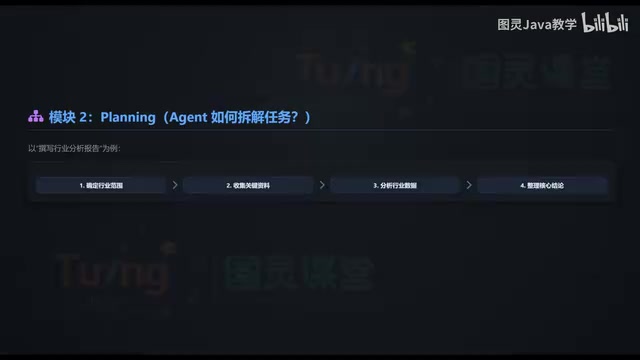
Agents work the same way. When a task is complex, the Agent first determines how to break it into steps, then executes them one by one. In Agent research and practice, multiple planning approaches have emerged, such as Chain-of-Thought (CoT), Tree-of-Thought (ToT), and the ReAct framework. They don't all solve exactly the same problem, but they share a core objective: making the model go beyond just considering the final answer and instead engage in systematic reasoning and decision-making around the task.
Specifically, Chain-of-Thought (CoT) was proposed by the Google Brain team in 2022. Its core idea is to guide the model to "think step by step" by including intermediate reasoning steps in the prompt, which significantly improves accuracy on complex tasks like mathematical reasoning and logical judgment. Tree-of-Thought (ToT) is an advanced version of CoT, proposed by Yao et al. in 2023. It allows the model to explore multiple reasoning paths and select the optimal branch through a backtracking mechanism, similar to how humans "try, backtrack, and retry" when solving difficult problems. The ReAct (Reasoning + Acting) framework, also proposed by Yao et al., innovates by alternating between reasoning (Reason) and acting (Act): the model first thinks about what it should do, then performs a concrete action (such as calling a search engine), and after receiving the observation result, enters the next round of reasoning. This alternating loop enables the model to continuously correct its judgment based on real feedback, rather than generating an answer solely from pre-trained knowledge in one shot.
It's worth emphasizing that planning is not a one-time, immutable process. Suppose you've planned five steps, and at step three you discover the actual result doesn't match expectations. If you stubbornly follow the original plan, cascading errors will follow. Therefore, adaptively re-planning based on execution results is a critically important Agent capability.
Tools Module: The Bridge to the Real World
LLMs don't inherently have the ability to connect with the outside world. For instance, if you ask "What's the weather like in Beijing today?" and the model has no internet access, it can only answer based on pre-training data. But if you connect it to real-time APIs—whether for weather, stocks, or flights—it can retrieve live information.
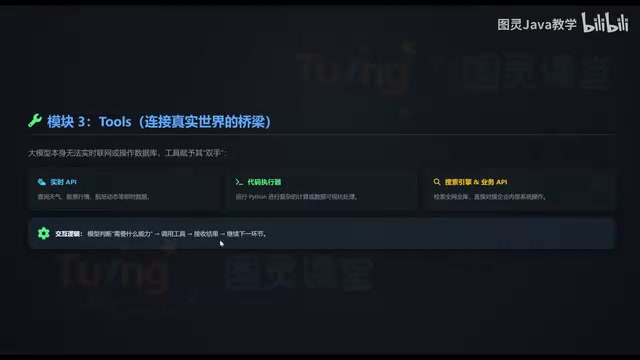
This is exactly what tools do: they connect the LLM to external capabilities. The model determines what capability is needed at any given moment and then calls the corresponding tool; the tool returns the result, and the model uses it to complete subsequent tasks. Beyond APIs, tools also include calculators, code execution environments, search tools, and various business system interfaces. This way, an LLM that could originally only generate text gains the ability to process external information and perform concrete operations.
From a technical implementation perspective, the core mechanism for LLMs calling tools is Function Calling. Taking OpenAI's implementation as an example, developers declare available tools in the API request using JSON Schema format—specifying the tool's name, description, and parameter structure. During generation, if the model determines it needs to use a tool, it outputs a structured function call request (containing the function name and parameter values) instead of plain text. The application layer receives this request, executes the corresponding function logic (e.g., making an HTTP request to a weather API), and passes the result back to the model, which then continues generating the subsequent response. The MCP (Model Context Protocol) proposed by Anthropic in 2024 further standardizes this process, aiming to establish a universal connection protocol between models and external tools/data sources—similar to a "USB port" for AI—making integration between different models and tools more standardized and interoperable.
Action Module: The Perception-Planning-Action-Observation Decision Loop
With memory, planning, and tools in place, there's still the most critical piece—Action. The goal of action is not to make plans, but to actually get the task done. It can be understood as a loop system composed of four stages, which is also the core flow of the ReAct execution framework:
- Perception: Receive input from the external environment, pass it to the LLM for understanding, and clarify what problem is being faced.
- Planning: Based on the current task, the model determines how to solve it—how many steps are needed, and what the next step should be.
- Action: Execute specific operations based on the plan—this could be generating content, or calling a tool or API, producing an execution result.
- Observation: Evaluate whether the execution result meets expectations.

Among these, the observation stage is especially important—it's the most critical distinction between an Agent and a simple workflow. Suppose an Agent originally planned to execute five steps, but the result from step one isn't necessarily correct. If the result meets expectations, proceed to the next step; if not, the Agent needs to identify where the problem lies and whether to adjust subsequent plans or modify steps—thus forming a new loop of perception, planning, action, and observation, repeating until the task is finally completed.
So an Agent is not simply chaining multiple APIs together. Its core value lies in the ability to continuously adjust the execution process based on environmental feedback. This is also why, when designing an Agent, you can't focus solely on LLM performance—you must also pay attention to memory, planning, and the decision loop.
The Key to Deploying Agents: Determining Whether Your Business Actually Needs One
Putting it all together: the LLM is the core engine, memory preserves context and historical information, planning considers how to decompose and execute tasks, tools connect to external capabilities, and action completes tasks through continuous "perception → planning → action → observation" loops.
But in actual development, different tasks call for different planning approaches. For simple tasks with fixed processes, a standard workflow may be more stable and doesn't need a complex Agent at all. Only tasks involving dynamic decision-making that require continuous step adjustments based on feedback truly need an Agent.
In real projects, distinguishing between "needs an Agent" and "only needs a workflow" is a critical architectural decision. A Workflow is a pre-defined, fixed execution path—like "receive order → check inventory → generate shipping label → notify logistics"—where the inputs, outputs, and branching conditions at each step are deterministic. It's suitable for scenarios with standardized processes and limited exceptions. Agents, on the other hand, are suited for tasks where the execution path cannot be fully determined at design time—for example, "research competitors and generate a comparative analysis," where which information to search, how many rounds of searching to do, and what angles to analyze from all depend on what's actually discovered along the way. In its 2024 Agent design guide, Anthropic explicitly recommends: start with simple Prompt Chaining and deterministic workflows first, and only introduce a full Agent loop when the requirements genuinely involve dynamic decision-making and adaptive adjustment. Overusing Agents actually introduces unnecessary complexity and unpredictability.
Therefore, the first question when building an Agent isn't "which technology to choose," but "does the current business and task actually need an Agent?" If the answer is yes, then proceed to select the appropriate planning and decision-making approach. This is also a key concept to internalize when later studying task decomposition, reflection, and re-planning.
Summary
The core of an AI Agent is not about having an LLM just answer questions, but about enabling it to understand tasks, formulate plans, call tools, execute actions, and continuously adjust based on results—all oriented around a specific goal. Once you understand this logic, studying various Agent frameworks, toolkits, and planning methods becomes much easier—you'll be able to see through their execution mechanisms and understand what problem each one solves. This is the foundational understanding needed for the journey from beginner to practitioner.
Related articles
Anthropic Sued: Claude Max 20x Plan Allegedly Delivers Only 6x Usage?
A lawsuit against Anthropic alleges Claude Max's 20x plan delivers only ~6x usage, and the 5x plan just 3.5x. We break down the legal details, community reactions, and the AI subscription transparency crisis.

Cursor Beginner's Guide: A Six-Step Workflow for Managing Changes, Rollbacks, and Validation
New to Cursor and keep breaking things? Learn a six-step dev workflow covering Cursor Rules, Plan mode, Diff review, and Checkpoint rollback to go from guesswork to engineering.
Is Cheap Cursor Reselling Reliable? The Real Risks of Shared Account Pools Exposed
An in-depth analysis of Cursor Pro budget reselling services, exposing the shared account pool model behind so-called legitimate accounts and deep discounts from technical, compliance, and data security perspectives.