Billions Spent on Border Surveillance: Why AI Towers Can't Save the Lost

Billions in U.S. border AI surveillance detects crossers but isn't designed to rescue them — a fatal gap.
The U.S. has deployed a massive AI surveillance tower network along the border, costing billions, yet in April 2024, José Morales Bernal died despite being within range of three towers. The tragedy reveals a structural disconnect: the system was designed from the start for enforcement and apprehension, not rescue. Alerts feed into interception workflows, not emergency response. The case raises deeper AI ethics questions about goal misalignment and who gets encoded into algorithmic priorities.
Billions Spent on Border Surveillance: Why AI Towers Can't Save the Lost
On April 8, 2024, José Morales Bernal crossed the U.S.-Mexico border, one day before his 32nd birthday. As he walked through the desert of southern New Mexico in the early morning hours, he was theoretically within range of three surveillance towers. By design, that moment should have triggered a cascade of technical alerts and human responses.
Instead, a border surveillance system built at a cost of billions of dollars failed to find him before he died. This tragic case puts a sharp question before the public: why can such expensive, sophisticated surveillance technology fail to reach people in time to save their lives?
A "Smart Wall" Built on Billions
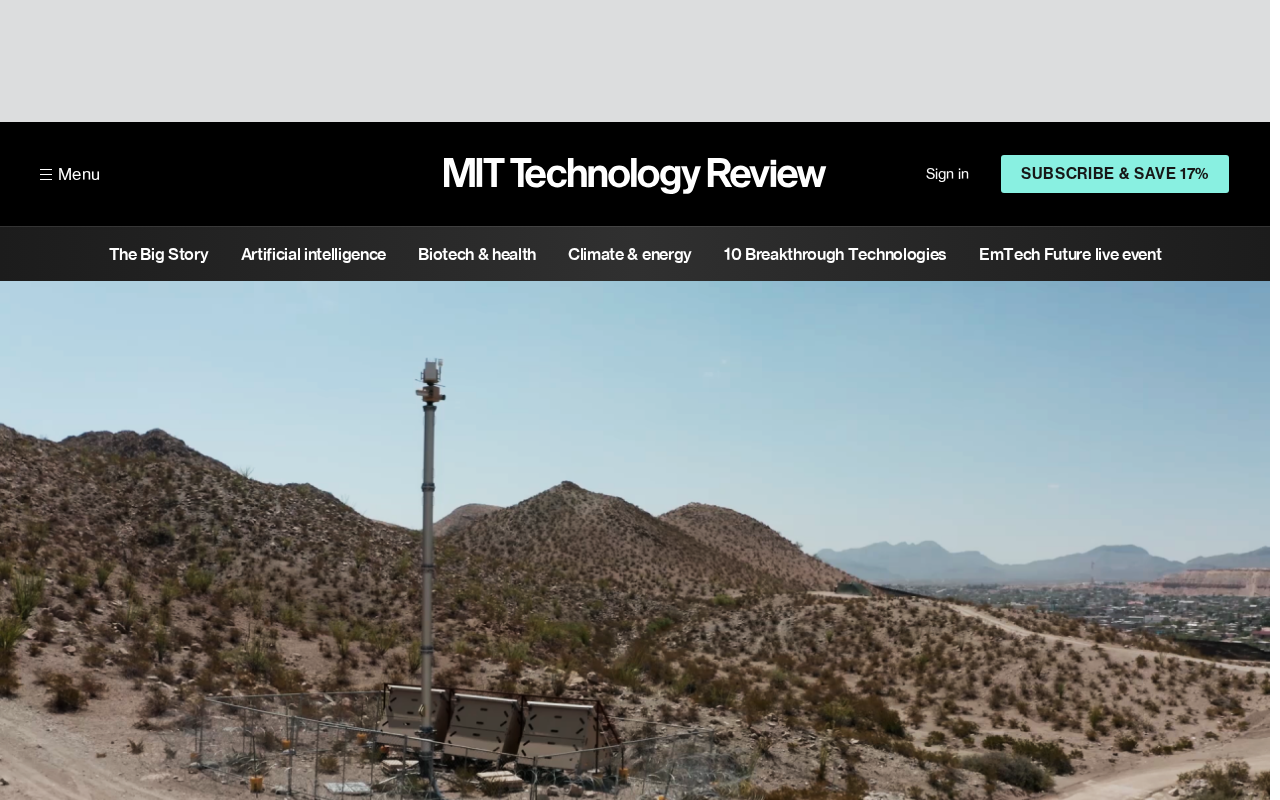
Over the past several years, the U.S. government has poured enormous funding into border surveillance technology. Surveillance towers, sensors, radar, thermal imaging cameras, and AI-powered image recognition algorithms form an electronic monitoring network blanketing vast stretches of desert. These newly installed towers are said to detect moving targets at long range — in theory, anyone entering their detection radius is captured by the system.
The core logic of this system is to convert "people" into signals recognizable by algorithms: heat signatures, movement trajectories, visual features. When border enforcement agencies discuss these investments, they typically emphasize the sophistication of the technology and the breadth of its detection coverage. Yet Morales Bernal's case exposes a brutal gap — between detecting a target and saving a life, there is a vast chasm.
The Purpose of Surveillance: Apprehension or Rescue?
The crux of the problem is that these surveillance technologies were designed, at their core, to serve enforcement and apprehension — not search and rescue. The system is optimized to identify people attempting to cross the border, intercept them, and arrest them. It is not optimized to recognize individuals facing life-threatening risks such as dehydration, heat stroke, or being lost in the desert and to dispatch rescue accordingly.
When a person appears in a surveillance feed, the system and its operators focus on "this is a border crosser to be intercepted" — not "this is someone who may be walking toward death." This design orientation determines how technical resources are allocated: more computing power and manpower go toward the apprehension pipeline, while life-saving rescue is never built into the core response mechanism.
This explains why someone can be technically "seen" yet still not be saved. A surveillance tower can capture an image, but without a corresponding rescue trigger mechanism, timely personnel dispatch, or a life-first response protocol, that data is nothing more than a silent record.
The institutional responsibility for search and rescue along the U.S. border falls primarily on the Border Patrol's BORSTAR (Border Patrol Search, Trauma, and Rescue) unit, but its personnel numbers are severely mismatched with the vast desert terrain it must cover. At the same time, alerts generated by the surveillance system are categorized by default as "border crossing events" rather than "medical emergencies" — routing a case to rescue response requires additional assessment steps. Research by humanitarian organizations suggests that during extreme heat, a disoriented adult in the desert can die from dehydration and hyperthermia within hours. The time gap between "being detected" and "being found and given assistance" frequently exceeds that survival window. This demonstrates that even when the detection system is functioning normally, the absence of a rapid-response mechanism triggered by signs of life-threatening distress means that technical capability cannot translate into actual rescue action.
The Collapse of Technological Determinism
Morales Bernal's death is a devastating rebuttal to technological determinism. Policymakers often tout high-tech surveillance as the answer to the complex problems of the border, as if deploying enough cameras and algorithms will make every problem tractable. But technology carries no value judgments of its own — it faithfully pursues whatever objectives it has been given.
When a surveillance system's objective is narrowly defined as "control and interception," it cannot automatically become a humanitarian rescue tool. Billions of dollars purchased detection capability, but they did not purchase a response system oriented around saving lives. What is missing in between is not better algorithms — it is policy priorities, institutional design, and human coordination.
This case also reminds us that in any discussion of AI surveillance systems, we must ask: whose objectives is this system actually serving? Which outcomes is it optimizing for? When technical capability and humanitarian responsibility are decoupled, even the most advanced system can become a silent witness to tragedy rather than an intervening force that prevents it.
A Technological Ethics Problem Worth Serious Reflection
Viewed from a broader perspective, the border surveillance case is a textbook example of AI application ethics. The effectiveness of any system composed of sensors, algorithms, and automated decision-making does not depend on its technical specifications alone — it depends on the objective framework and response mechanisms into which it is embedded.
Detection is not the same as response, and response is not the same as rescue. A complete, human-centered system requires automated, timely, and clearly prioritized linkages among all three. The current border surveillance architecture clearly has a break in that chain.
The name of José Morales Bernal thus becomes a challenge to the entire logic of technological investment: when we direct billions of dollars toward surveillance technology, what exactly do we expect it to do? If the answer does not include "finding people before they die," then no amount of spending can meet the most basic humanitarian standard.
AI ethics research has an important concept called goal misalignment: when the objective a system is optimized for diverges from the outcome society actually expects, the system can produce systemic harm even while performing well on its technical metrics. The border surveillance case is a real-world illustration of this problem. The system may be quite efficient at "detecting border crossers," but that objective was never expanded to include "identifying people in mortal danger." This is not merely an algorithmic design problem — it is a value choice made at the institutional level. Policymakers determined during procurement and deployment what the system should optimize for and what it should ignore. Without mandatory requirements to incorporate humanitarian rescue metrics into system performance evaluations, contractors and operators have no incentive to allocate resources for this in the technical architecture. The same logic applies to AI surveillance systems in other contexts, and it warns us that at the very beginning of system design, we must ask explicitly: whose interests have been encoded into this algorithm?
Background
One of the core technologies in this border surveillance system is the Integrated Fixed Towers (IFT) program, an ongoing initiative by U.S. Customs and Border Protection (CBP), with Israeli defense company Elbit Systems as the primary contractor. Each tower is equipped with long-range thermal imaging cameras, radar, and AI-assisted target classification algorithms capable of detecting moving objects and automatically distinguishing humans from animals across a range of several kilometers. However, the live feeds from these towers are transmitted to remote operations centers, where human operators conduct manual assessments before deciding whether to dispatch Border Patrol agents. This "detect–assess–respond" chain is theoretically complete, but each link introduces time delays and priority filtering. During high-traffic periods, large numbers of targets are detected simultaneously, forcing operators to triage — and signals that "appear to require rescue" are routinely buried under a queue of "interception" tasks.
Related articles

"Black October": Did AI Uncover 3% of All Critical Vulnerabilities Ever?
A Reddit post claims 3% of all critical software vulnerabilities ever were found in the past month, dubbed 'Black October.' We break down the statistical issues, how AI-assisted code auditing accelerates discovery, and how developers should respond.

Microsoft Project Gecko: Using AI to Bridge Language Gaps for African Farmers
Microsoft's Project Gecko launches PharmaChat, letting African farmers ask questions in their native language and get precise video clips and farming book chapters via AI. The project also releases three interactive manuals to advance inclusive AI.

Musk's Space Dominance: How Starlink Throttling Undermines Ukraine's Defense
SpaceX's Starshield throttling disabled Ukraine's high-speed interceptor drones, exposing how Musk's private control over low Earth orbit communications affects battlefield dynamics and national security, and highlighting the risks of commercial space militarization and space governance dilemmas.