BioPhys-Bridge: A New Benchmark for Cross-Disciplinary Scientific Reasoning
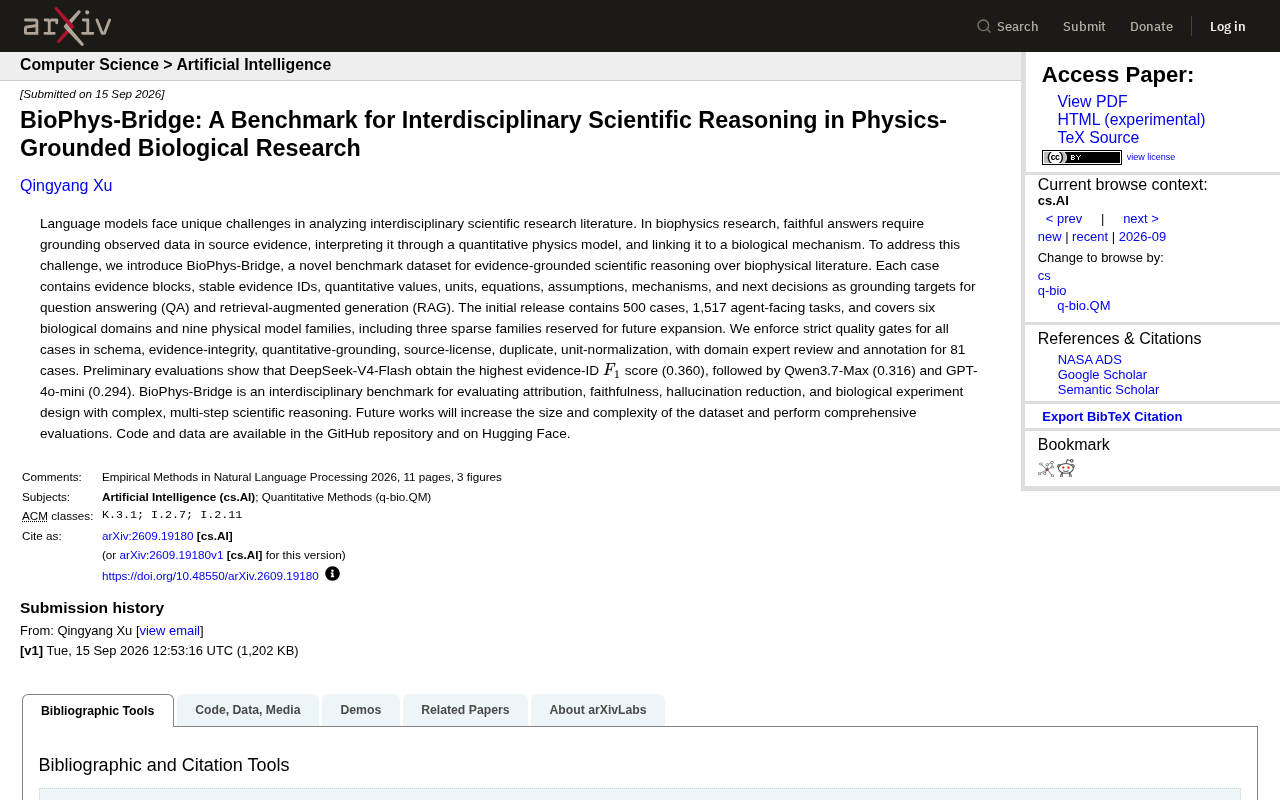
BioPhys-Bridge benchmarks LLMs on evidence-grounded biophysics reasoning, exposing major attribution gaps.
BioPhys-Bridge is an evaluation benchmark designed for cross-disciplinary biophysics reasoning, testing whether LLMs can maintain traceable evidence and faithful conclusions across complex multi-step scientific tasks. Its initial release includes 500 cases and 1,517 agent-oriented tasks spanning six biological domains and nine physical model families, with each case decomposed into structured grounding targets supporting both QA and RAG. Quality is ensured through automated gates and expert review of 81 cases. Early evaluations show the top model, DeepSeek-V4-Flash, achieves only 0.360 F1 on evidence ID attribution, highlighting significant room for improvement in cross-disciplinary grounding. Code and data are open-sourced on GitHub and Hugging Face.
The Challenge of Cross-Disciplinary Research for Large Language Models
Language models are getting increasingly capable at handling scientific literature — but when research spans multiple disciplinary boundaries, the challenge escalates sharply. Biophysics is a prime example: a reliable answer requires grounding observed data in original evidence, interpreting it through quantitative physical models, and linking conclusions to specific biological mechanisms. This reasoning chain is tightly interconnected, and any broken link can lead models to produce answers that sound plausible but lack genuine support.
To tackle this problem, researchers have introduced BioPhys-Bridge — an evidence-grounded scientific reasoning benchmark built around biophysics literature. Its core goal is to test whether models can maintain traceable evidence and faithful conclusions throughout complex, multi-step scientific reasoning, while effectively suppressing hallucinations.
Dataset Design and Structure
Every case in BioPhys-Bridge is not a simple question-answer pair, but rather decomposed into a series of structured grounding targets. These targets include evidence blocks, stable evidence IDs, quantitative values, units, formulas, underlying assumptions, biological mechanisms, and next-step decision directions.
This design allows the benchmark to support two types of tasks simultaneously: question answering (QA) and retrieval-augmented generation (RAG). In other words, models must not only answer "what," but also explain "where is the evidence" and "how do we derive biological mechanisms from physical models."
The initial release contains 500 cases and 1,517 agent-oriented tasks, spanning six biological domains and nine physical model families. Three of those physical model families are sparse categories, reserved for future expansion — leaving room for the benchmark to grow.
Retrieval-Augmented Generation (RAG) is a technical paradigm that combines large language models with external knowledge bases: before generating an answer, the model first retrieves relevant passages from a document corpus and uses them as context for reasoning. Compared to generation that relies purely on parametric memory, RAG grounds outputs in verifiable source documents, reducing hallucination risk. In BioPhys-Bridge's design, RAG tasks require models not only to produce an answer, but to precisely locate the specific passages or numerical values from the evidence block library that support that answer — going further than standard RAG. An incorrect evidence ID counts as a failure even if the surface-level answer appears correct, directly testing the model's attribution capabilities.
Rigorous Quality Control
Quality control is where cross-disciplinary datasets most often go wrong. BioPhys-Bridge applies multiple strict quality gates to all cases, covering the following dimensions:
- Schema validation: ensures uniform and consistent data structure
- Evidence integrity: verifies the reliability of evidence blocks
- Quantitative grounding: numerical values must correspond to their sources
- Source licensing: complies with appropriate usage rights
- Deduplication: prevents redundant cases
- Unit normalization: standardizes dimensional expressions
On top of this, the research team invited domain experts to manually review and annotate 81 cases. This dual mechanism — automated quality gates plus expert review — is key to establishing credibility for a cross-disciplinary benchmark.
Initial Performance of Leading Models
Preliminary evaluations reveal the true state of current models when it comes to evidence attribution. Using evidence ID F1 score as the core metric:
- DeepSeek-V4-Flash achieved the highest score of 0.360
- Qwen3.7-Max followed closely at 0.316
- GPT-4o-mini scored 0.294
Notably, even the best-performing model reached only around 0.36 on evidence ID F1. This number concretely reflects that existing large models still have considerable room for improvement on tasks requiring precise evidence localization and tight linkage between physical quantitation and biological mechanisms. These cross-disciplinary, multi-step reasoning tasks serve as a litmus test for exposing model hallucinations and weaknesses in attribution.
The F1 score is a widely used evaluation metric in information retrieval and classification tasks — it is the harmonic mean of Precision and Recall. Precision measures how many of the evidence IDs the model provides are correct; Recall measures how many of the correct evidence IDs the model successfully retrieves. F1 ranges from 0 to 1, with higher values indicating better performance. In the context of BioPhys-Bridge, evidence ID F1 directly reflects the model's ability to precisely match conclusions with their corresponding original evidence blocks. Even if a model produces a semantically reasonable answer, the F1 score will still be low if it cannot accurately cite the corresponding evidence sources. The current best model reaching only 0.36 indicates that model performance on precise attribution remains far below what scientific practice demands.
Significance and Outlook
BioPhys-Bridge fills a gap in cross-disciplinary scientific reasoning evaluation. It goes beyond measuring whether a model can get the right answer — it emphasizes attribution, faithfulness, hallucination suppression, and biological experimental design, all of which are critical capabilities in real-world research settings.
For researchers looking to integrate large language models into scientific workflows, this benchmark offers a more practically grounded measuring stick — one that compels models to remain rigorous throughout complex evidence chains, rather than settling for fluent but superficial narratives.
The research team has indicated that future work will expand the dataset's scale and complexity, as well as conduct more comprehensive evaluations. Currently, the code and data are publicly available on GitHub and Hugging Face, providing a foundation for community reproduction and extension. As the benchmark continues to evolve, it has the potential to become an important reference point for evaluating scientific reasoning capabilities.
Related articles
Three Stages of AI LLM Testing: A Practical Guide from Core Concepts to API Calls
A learning path for testers covering LLM fundamentals, prompt engineering, OpenAI SDK calls, API Key vs Token differences, streaming output, RAG, and Agent systems.

Vercel's Chief of Software Looks Back: The Evolution of Agent Building — From Multi-Agent Chains to File System Agents
Vercel's Chief of Software Andrew recaps the agent-building journey at AI Engineer: from giant prompts to multi-agent chains, monolithic memory, file system agents, and the open-source EVE framework.
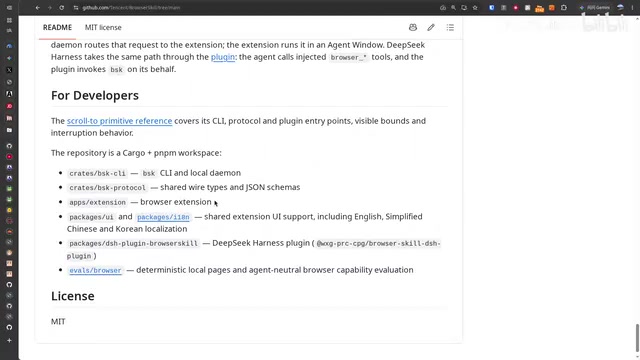
Tencent's Open-Source BSK in Action: Letting AI Take Over Your Already-Logged-In Browser
Tencent's open-source BSK (Browser Skill Kit) lets AI take over your real, logged-in Chrome via WebSocket. We break down the architecture, setup, and three key pitfalls from real-world testing.