bitdrift.ai: Agent-Driven Mobile Observability Platform with 10x MTTR Improvement

bitdrift.ai uses AI Agents for real-time mobile observability, achieving 10x MTTR improvement without app releases.
bitdrift.ai is the world's first agentic mobile observability platform that eliminates the traditional dependency on app releases for debugging. Built on full-fidelity real-time data and AI Agents with autonomous querying capabilities via its Public API and bd skills framework, it enables instant root cause analysis. Early users report 10x MTTR improvement, marking a paradigm shift from passive instrumentation to active, agent-driven investigation.
The Pain Points of Mobile Observability and a New Paradigm
For mobile app developers, troubleshooting production issues is often a race against time — yet one that demands agonizing patience. Traditional mobile observability tools suffer from a fundamental dilemma: when you spot an abnormal performance metric or a sudden shift in user behavior, collecting more granular data or validating hypotheses typically requires code changes, a new release, and waiting for users to update — a cycle that can stretch to ten days or longer. By the time you finally get the data, the original context has long vanished.
Mobile apps differ fundamentally from web apps when it comes to observability. Server-side code for web applications can be updated and deployed at any time, allowing developers to adjust log levels or add monitoring metrics within minutes. But mobile app code runs on user devices, and every change must go through compilation, testing, app store review (typically 24–48 hours for iOS), and waiting for users to actively update. Statistics show that even with forced update strategies, getting 80% or more of active users onto a new version typically takes one to two weeks. This means mobile observability inherently suffers from "time lag" — a problem discovered today might require waiting until next week or even the week after to obtain more detailed diagnostic data through a new version.
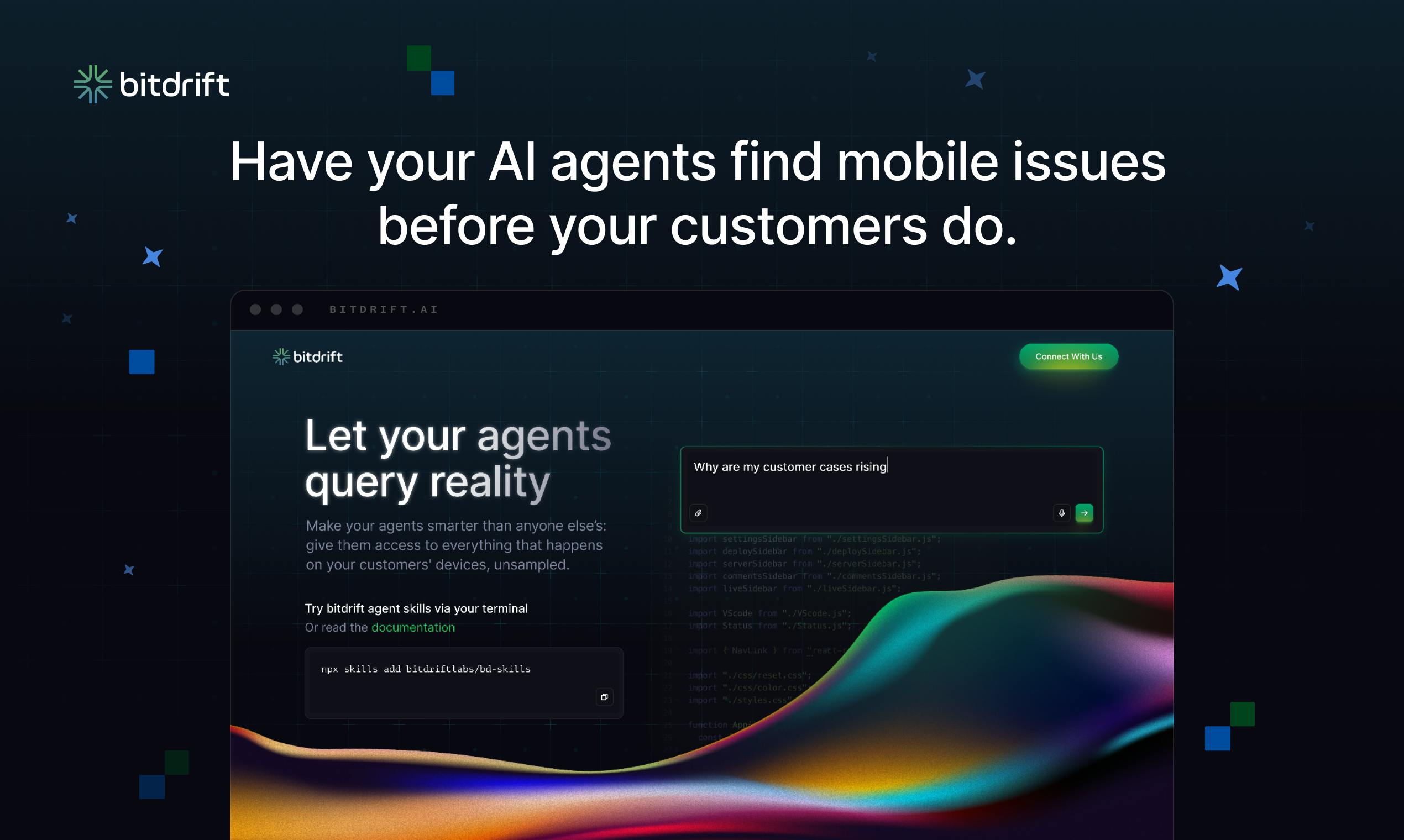
bitdrift.ai was born to address exactly this pain point. It describes itself as "the world's first agentic mobile observability platform," with a core approach of introducing AI Agents into the mobile observability ecosystem. These agents can query mobile user behavior in real time and take autonomous action, fundamentally transforming the passive model of "instrument first, release next, analyze later."
How bitdrift.ai Works at Its Core
Real-Time, Full-Fidelity Data Foundation
According to the product description, bitdrift AI is a "real-time, full-fidelity observability system." These two keywords deserve deeper exploration:
- Real-time: Data is no longer lagging logs but live information available for agent invocation at any moment;
- Full-fidelity: No sampling, no pre-aggregation — complete user behavior traces and performance metrics are preserved.
In traditional observability practice, systems typically employ sampling or pre-aggregation strategies to reduce storage and compute costs when dealing with massive data volumes. For example, the distributed tracing system Jaeger defaults to sampling only 0.1% of requests, while Prometheus compresses raw metrics into statistical summaries through preset aggregation rules. While these approaches save resources, they also mean that when you need to trace back a specific user's complete behavior chain, the original data may already be lost. Full-fidelity collection retains every raw event record without any lossy compression. In recent years, the maturation of columnar storage (such as ClickHouse) and stream processing (such as Apache Flink) technologies has made full-fidelity collection increasingly feasible at manageable costs.
This means user journeys, performance metrics, and behavioral changes are all immediately accessible when the agent needs them — rather than "waiting ten days for the next app release to get the data." This "data on demand" capability is the prerequisite for autonomous troubleshooting.
Built on Public API and bd skills
From an architectural perspective, bitdrift AI is built on the bitdrift Public API and bd skills. The former provides standardized data access interfaces, while the latter is a set of "skill" encapsulations that enable AI Agents to understand and operate on mobile observability data. Through these two layers of abstraction, the AI agent can query user behavior, retrieve metrics, identify anomalies, and autonomously execute analysis and response actions — just like a human engineer would.
The application of AI Agents in operations has gone through distinct evolutionary stages. The earliest AIOps (Gartner first coined the term in 2016) primarily focused on anomaly detection and alert noise reduction, remaining essentially tools that "assist human decision-making." Since 2023, as large language models (LLMs) gained capabilities in natural language understanding, tool use/function calling, and multi-step reasoning, truly "autonomous action-oriented Agents" have begun to emerge. These Agents can not only identify problems but also autonomously plan investigation steps, call APIs to retrieve data, form hypotheses, and validate them. bitdrift's "bd skills" is essentially a toolset provided for Agents, enabling LLMs to interact with mobile observability data systems through structured interfaces.
This "Agent + Observability" combination represents an implementation of AIOps on mobile: instead of engineers manually writing queries and staring at dashboards, the agent proactively intervenes when problems are in their early stages.
Early Data: What 10x MTTR Improvement Means
The early feedback provided by the product team is quite impressive: early users of bitdrift AI report significantly faster problem resolution, with Mean Time To Recovery (MTTR) improving by 10x.
MTTR (Mean Time To Recovery) is one of the four key DORA (DevOps Research and Assessment) metrics and a core measure of service reliability in Google's SRE framework. According to the DORA 2023 annual report, "elite" teams typically achieve MTTR within 1 hour, while "low-performing" teams may need days to weeks. For mobile applications, MTTR calculation is more complex — even after identifying the root cause, fixes still require going through the release process, making mobile MTTR inherently higher than server-side. The 10x improvement claimed by bitdrift is more credible if focused on the "discovery to root cause identification" phase (rather than the full cycle including release fixes), as this is precisely where agents can deliver the most value.
A single crash or a critical flow bottleneck can directly impact retention and revenue. If this 10x improvement can be validated at larger scale across more diverse scenarios, it would represent a qualitative leap in efficiency for mobile development teams.
It's worth noting that this data comes from self-reported early user feedback, with sample size and measurement criteria still unclear. The actual degree of improvement will vary depending on team size, application complexity, and existing toolchains. But the direction is clear: using agents to compress the time from discovering a problem to identifying the root cause.
Product Hunt Performance and Market Positioning
On Product Hunt, bitdrift.ai received 74 upvotes, ranking #17, and was categorized under "Software Engineering," "Developer Tools," and "Artificial Intelligence." This positioning accurately summarizes its target audience — it's not aimed at end consumers but serves development and SRE teams who need to ensure mobile application quality.
Interestingly, "agentic" is becoming one of the hottest keywords in the developer tools space. Between 2024 and 2025, "Agentic" has evolved from an academic concept to a product selling point for developer tools. At the code level, tools like Cursor, Devin, and GitHub Copilot Workspace let Agents participate in code writing and debugging; at the CI/CD level, Harness AI and Buildkite have begun introducing Agents to automatically fix build failures; in security, tools like Snyk use Agents to automatically generate vulnerability fix PRs. Prior AI-ification in the observability space has mainly manifested in Datadog's Watchdog (anomaly detection) and New Relic's AI assistant (natural language queries), but these remain primarily "human-in-the-loop." bitdrift's differentiation lies in deploying Agents directly on the mobile data pipeline with autonomous action capabilities — a first in the mobile observability sub-segment.
From code generation to CI/CD to observability, AI Agents are progressively permeating every stage of the software engineering lifecycle. The emergence of bitdrift.ai can be seen as an extension of this wave into the niche of mobile observability.
The Paradigm Shift from "Passive Instrumentation" to "Active Querying"
The most imaginative aspect of bitdrift.ai is its attempt to break the long-standing "release dependency" in mobile observability. In the traditional model, what you can observe depends on what instrumentation you added in the previous version. The combination of full-fidelity data + agent querying theoretically allows engineers (or agents) to flexibly "ask questions" after the fact, without needing to anticipate all potentially needed data in advance.
This paradigm shift is analogous to the evolution in databases from "predefined reports" to "ad-hoc queries" — you no longer need to design all report templates in advance but can construct queries on the fly whenever needed. When this flexibility is combined with AI Agent autonomous reasoning capabilities, troubleshooting can become a "conversational investigation": after discovering an anomaly, the Agent first examines the overall distribution, then narrows the scope to specific device models or network environments, and finally drills down to a single user's complete behavior trace — all without human intervention.
Implementation Challenges and Open Questions
Of course, platforms like this face real-world challenges:
-
Data costs and privacy compliance: Full-fidelity, real-time collection means enormous data volumes and transmission overhead, while also involving compliance issues around user behavior data. The EU's GDPR requires a lawful basis for data processing (such as user consent or legitimate interest) and mandates data minimization principles — which inherently tensions with the "collect everything" philosophy. The US CCPA/CPRA grants users "right to delete" and "right to opt-out." Additionally, Apple's App Tracking Transparency (ATT) framework and Google's Privacy Sandbox impose technical limitations on cross-app data correlation. If bitdrift is to serve enterprise customers globally, it needs privacy protection mechanisms built into its architecture — such as on-device data anonymization, differential privacy, and data retention policies — ensuring full-fidelity collection doesn't equate to unrestricted user surveillance.
-
Reliability boundaries of agents: Allowing AI to autonomously "take action" raises the critical question of ensuring accurate judgment without erroneous operations — key to building trust. The current industry consensus on autonomous Agents is the need for "guardrails" — clearly defining which operations Agents can execute (such as read-only queries), which require human confirmation (such as triggering alerts or modifying configurations), and gradually building trust through tiered authorization.
-
Reproducibility across general scenarios: Whether the 10x MTTR improvement from early users can be replicated across applications of different scales and complexities still requires more case studies to validate.
Summary
Overall, bitdrift.ai represents a frontier exploration in the convergence of mobile observability and AI Agents. For mobile development teams suffering from troubleshooting challenges, it offers a compelling new approach — letting agents intervene with complete data at the first moment a problem occurs, rather than having engineers painstakingly trace through incomplete logs ten days later. If your team is looking for a more efficient mobile application performance monitoring solution, bitdrift.ai is worth adding to your evaluation list.
Key Takeaways
Related articles

Python 3.15 New Feature: Is the sentinel Type Better Than None?
Python 3.15 adds the sentinel type, using named unique sentinel objects to replace None and bare object(), resolving confusion among missing values, explicit emptiness, and invalid input while avoiding type hint failures.

Deep Learning's Three Architectures and the Universal Approximation Theorem: A Complete Guide to MLPs, CNNs, and Transformers
Explaining the inductive bias differences among MLP, CNN, and Transformer, the existence meaning of the Universal Approximation Theorem (UAT), and the role of Taylor expansion in approximation analysis, while clearing up common misconceptions.

GitLab Emergency Patch Release: Analysis of Critical Security Fixes
GitLab releases critical patch 19.5.1, sparking 355 points of discussion on Hacker News. This article analyzes the background, upgrade steps for self-hosted instances, and verification points to help DevOps teams respond quickly to security updates.