"Black October" Goes Viral: Over 30 Security Incidents in Quick Succession — Is an Internet Lockdown Coming?

A Reddit list compiles over 30 security incidents, revealing that the attack focus is shifting upstream in the supply chain.
A Reddit post compiled recent security incidents into a "Black October" list, resonating strongly in the security community. The list covers three main threads: web infrastructure (PHP, NGINX, HTTP/3, GitLab), the certificate trust system (eMudhra), AI toolchains (LiteLLM poisoning, Cairn incident, Meta Muse leak), and nation-scale data breaches (California student data, Medi-Cal, State Bank of India, SafePay ransomware). The article notes that aggregation amplifies panic and some details need official confirmation; "internet lockdown" is more sentiment than prediction, with the realistic path being tighter regulation and stricter vetting. The real signal is the shift from single-point servers to upstream trust chain, and practitioners should prioritize dependency inventory, update channel verification, and strict AI agent permissions.
Why the Security Community Is Collectively "Losing It"
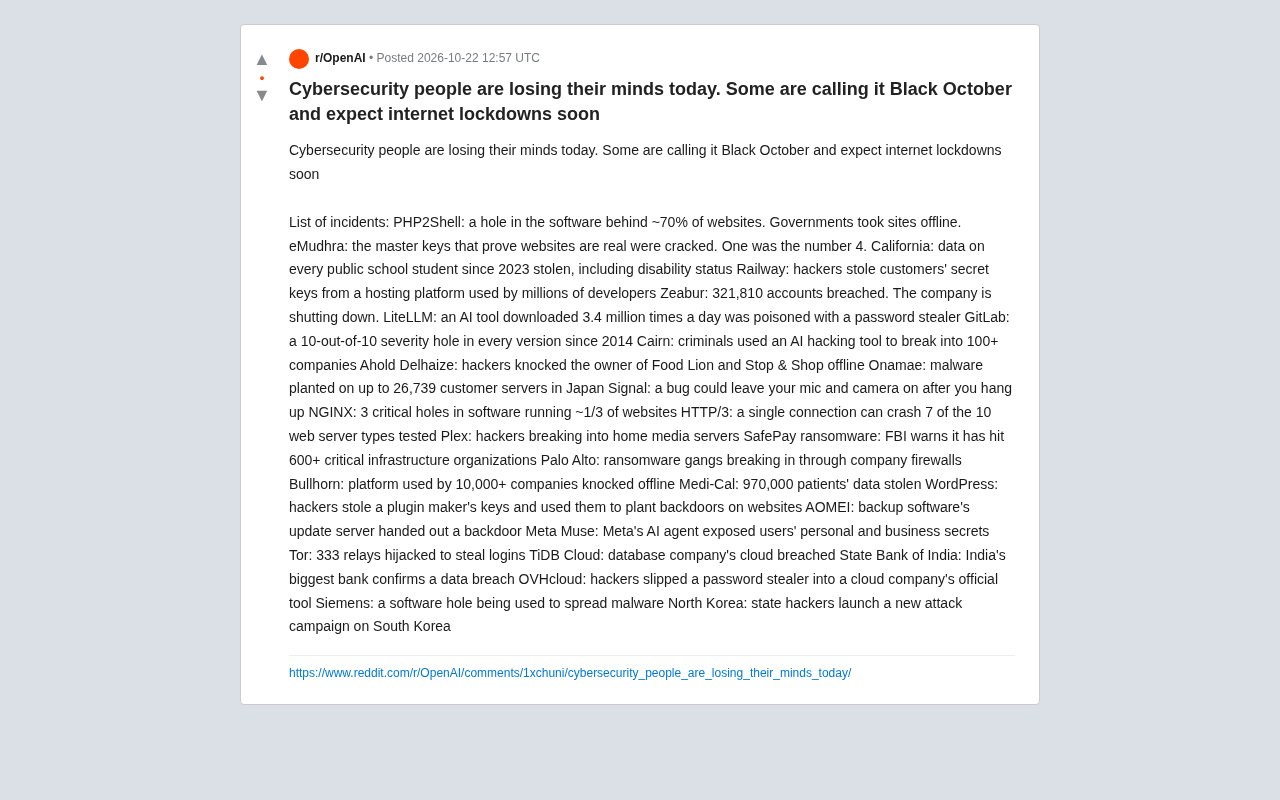
A post on Reddit has rapidly gained traction in the security community: someone labeled the recent barrage of security incidents as "Black October" and predicted that an "internet lockdown" is imminent. The post itself contains no lengthy analysis — it simply lists a catalog of events. But the length and weight of that list is enough to make any practitioner frown.
The list spans virtually every layer — from web infrastructure to AI tools, from government data to home routers. Not every detail has necessarily been independently verified, but as an "emotional sample" it precisely captures the anxiety of today's security practitioners: vulnerabilities are no longer isolated, one-off accidents — they are emerging in systemic, cascading fashion.
Three Threads Hidden in the List
Breaking the list apart reveals three clear attack paths behind the chaos.
The "Foundation" of Infrastructure Is Loosening
PHP2Shell is described as a hole affecting the software behind roughly 70% of websites; NGINX is said to have three critical vulnerabilities while powering about a third of all websites; HTTP/3 is characterized as being able to "take down seven of ten tested web servers with a single connection." Add to that a "10-out-of-10" vulnerability present in every version of GitLab since 2014, and the foundational components of the web world appear to be exposing structural weaknesses simultaneously.
Even more concerning is the eMudhra incident — the post claims that "the master keys proving website identity were compromised, one of them being the number 4." If the root trust of the certificate system is shaken, what's affected isn't any single company but the entire HTTPS trust model.
The Root Trust Model of the Certificate System: HTTPS security doesn't come from the encryption algorithms themselves but from a chain of trust issued level by level from "root certificates." Browsers and operating systems ship with a built-in set of trusted root certificate authorities (CAs), and any website certificate that can be traced back to these roots is automatically considered trustworthy. The private keys of root CAs are therefore the most fragile and most critical assets in the entire model — if leaked, an attacker could theoretically forge valid certificates for any domain and carry out undetectable man-in-the-middle hijacking. This is precisely why the eMudhra incident is alarming: what's being shaken isn't some site's certificate but the very premise of "who has the authority to prove a website's identity." In practice, certificate transparency logs and root certificate revocation mechanisms can provide some remediation, but there remains a window of exposure during the response period.
AI Has Become an Amplifier on Both Sides of Attack and Defense
LiteLLM is an AI tool with 3.4 million daily downloads, and the post claims it was implanted with a password stealer; in the Cairn incident, criminals used AI hacking tools to break into over 100 companies; Meta's AI agent "Muse" was alleged to have leaked users' personal and business secrets. AI here is both an attack surface and an attack weapon.
This aligns with the security community's recent consensus: the supply chain security of AI toolchains is far from mature, and attackers have already begun using AI for automated reconnaissance and intrusion.
Supply Chain Risks in the AI Toolchain: Tools like LiteLLM derive their value from providing a unified wrapper around multiple LLM APIs, and developers often introduce them directly into production environments as a "middle layer," granting them access to keys, logs, and even internal data. This means a single poisoning incident can simultaneously affect a large number of downstream projects. Unlike traditional dependencies, AI toolchains iterate quickly, have sparse audit coverage, weak community review, and often execute arbitrary code at install time. The Cairn incident illustrates the other side: attackers use AI for automated reconnaissance and vulnerability discovery, compressing probing that would take humans weeks into hours. With both attack and defense amplified simultaneously, the inertia of "ship first, secure later" becomes far more costly in AI scenarios.
Data Breaches Have Reached "Nation-Scale"
Data on all public school students in California since 2023 was stolen, including disability status; 970,000 Medi-Cal patient records were stolen; State Bank of India confirmed a data breach; Ahold Delhaize (parent company of Food Lion and Stop & Shop) was crippled by hackers; the FBI warned that SafePay ransomware has struck over 600 critical infrastructure organizations. What these incidents share: the victims aren't small companies but public and critical infrastructure institutions holding vast amounts of sensitive data.
Beyond the Panic: Three Calm Assessments
First, the aggregation itself amplifies panic. Compressing events from different times, with different severity levels and different credibility into a single list creates the illusion of "simultaneous collapse." Some entries (such as the Zeabur shutdown and the number of affected servers at Onamae) should be verified against official disclosures and should not be spread as established fact.
Second, the real signal is "supply chain," not "single points." From the theft of a WordPress plugin author's keys, to the AOMEI backup software update server distributing backdoors, to OVHcloud's official tooling being stuffed with a stealer — attackers have clearly shifted their focus upstream in the trust chain. Securing your own server is no longer enough; every update channel you rely on is a potential entry point.
Third, "internet lockdown" is more an expression of sentiment than a technical prediction. There have been localized internet shutdowns and platform takedowns throughout history, but a global lockdown has neither technical precedent nor an identifiable entity capable of executing it. The more realistic trajectory is tighter regulation, increased compliance auditing, and stricter enterprise vetting of third-party components.
Why "Supply Chain Attacks" Are Trickier Than Single-Point Vulnerabilities: The remediation path for traditional vulnerabilities is "patching," whereas supply chain attacks tamper with components you actively trust and automatically pull — plugin updates, software upgrade packages, package manager sources. Their common feature: the distribution channel itself is compromised, signature or verification steps are missing, and users out of habit don't verify each time. The defense focus therefore shifts from "guarding the perimeter" to "verifying the source": signature verification of update packages, anomaly monitoring of outbound traffic, and version/source vetting of third-party component admission. This is essentially a restructuring of trust management, not merely technical hardening.
What Practitioners Can Do Now
In the short term, the top priority is inventorying dependencies: map out the versions and sources of the web servers, certificate issuance chains, AI tools, and backup/update channels you use, and verify versions of GitLab, NGINX, and PHP-related components. In the medium term, incorporate "is the update server itself trustworthy" into your threat model, and implement signature verification and outbound monitoring for auto-update mechanisms. In the long term, the permission boundaries of AI agents need to be set as strictly as database accounts — the Meta Muse lesson shows that what an agent can read determines the blast radius of a breach.
One security practitioner's summary under the post has been repeatedly cited: this isn't the victory of any single attack but a manifestation of the attack surface expanding faster than defenders can absorb. The list will keep growing; the question is whether we treat it as a one-off panic or as an opportunity to restructure priorities.
One-line Summary
A Reddit list compiles over 30 security incidents, revealing that the attack focus is shifting upstream in the supply chain.
Paragraph Summary
A Reddit post compiled the recent barrage of security incidents into a "Black October" list, striking a strong chord in the security community. The list covers three main threads: web infrastructure (PHP, NGINX, HTTP/3, GitLab), the certificate trust system (eMudhra), AI toolchains (LiteLLM poisoning, the Cairn incident, Meta Muse leak), and nation-scale data breaches (California student data, Medi-Cal, State Bank of India, SafePay ransomware). The article notes that the aggregation amplifies panic and that some details should be verified against official disclosures; "internet lockdown" is more an expression of sentiment, with the realistic trajectory being tighter regulation and stricter admission reviews. The real signal is that the attack focus is shifting from single-point servers to upstream in the trust chain, and practitioners should prioritize inventorying dependencies, verifying update channels, and strictly setting AI agent permissions.
Related articles

"Black October": Did AI Uncover 3% of All Critical Vulnerabilities Ever?
A Reddit post claims 3% of all critical software vulnerabilities ever were found in the past month, dubbed 'Black October.' We break down the statistical issues, how AI-assisted code auditing accelerates discovery, and how developers should respond.

Microsoft Project Gecko: Using AI to Bridge Language Gaps for African Farmers
Microsoft's Project Gecko launches PharmaChat, letting African farmers ask questions in their native language and get precise video clips and farming book chapters via AI. The project also releases three interactive manuals to advance inclusive AI.

Musk's Space Dominance: How Starlink Throttling Undermines Ukraine's Defense
SpaceX's Starshield throttling disabled Ukraine's high-speed interceptor drones, exposing how Musk's private control over low Earth orbit communications affects battlefield dynamics and national security, and highlighting the risks of commercial space militarization and space governance dilemmas.