Blender Agent Bridge: Letting AI Control 3D Modeling via the MCP Protocol

Open-source Blender extension connects AI clients via MCP protocol for AI-assisted 3D modeling with human-in-the-loop safety.
Blender Agent Bridge is a free, open-source Blender extension that uses the MCP (Model Context Protocol) to connect AI clients like Codex, Claude, and Cursor to Blender's 3D workspace. It enables AI Agents to inspect scenes, gather visual evidence, and execute modeling operations while keeping edits, script trust, paid generation, and approvals under the creator's control. With integrations for Meshy.ai, Tripo3D, and Polyhaven, it streamlines the full creative workflow from asset generation to scene assembly.
As AI Agents rapidly penetrate various creative tools, the 3D modeling space is seeing new explorations. Recently launched on Product Hunt, Blender Agent Bridge is a free, open-source Blender extension that connects Blender to mainstream AI clients like Codex, Claude, and Cursor through the MCP (Model Context Protocol), enabling AI Agents to truly participate in 3D creative workflows.
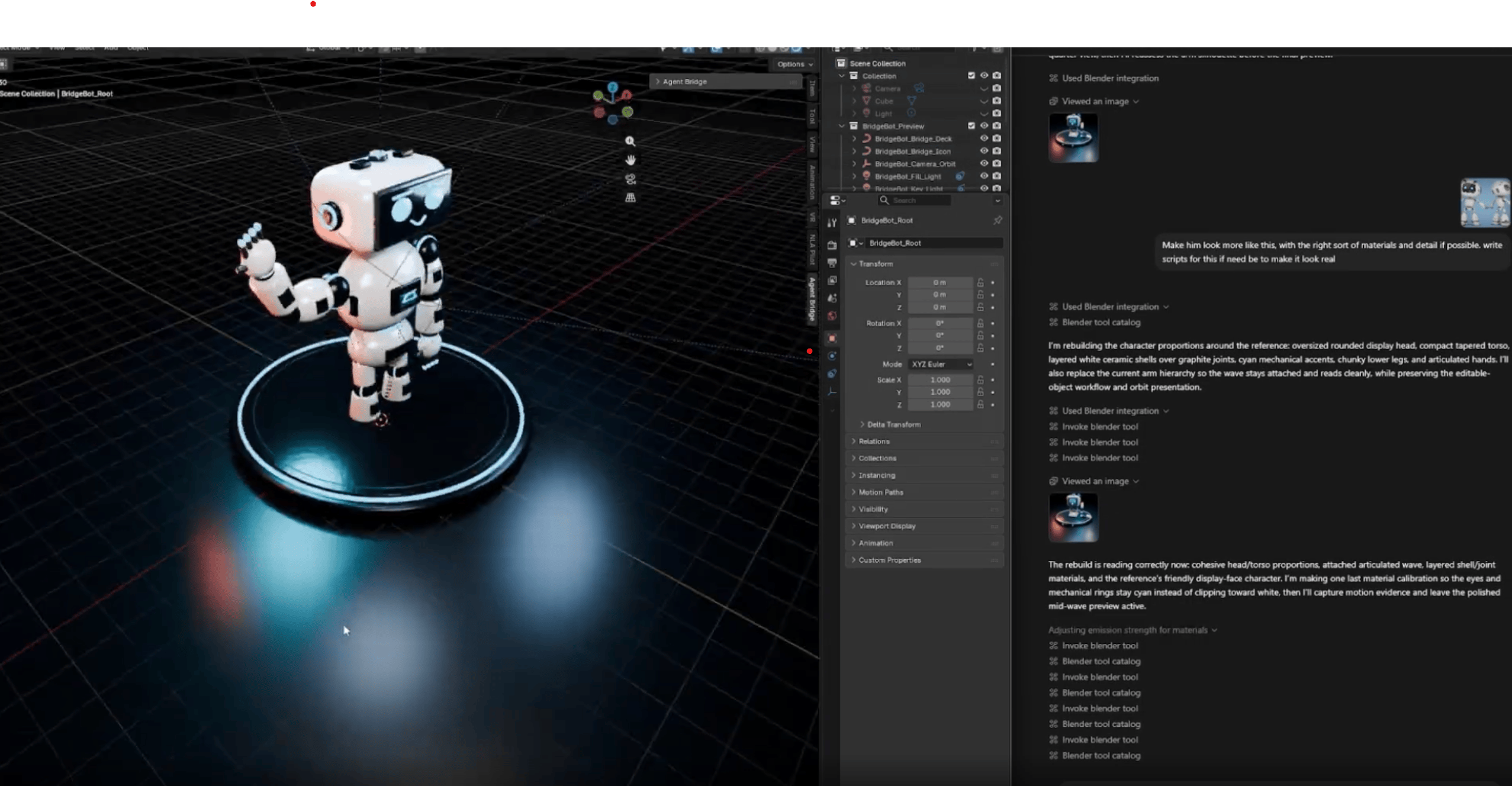
Built by developer CallMeJones, the project received 65 upvotes after launch, ranking 14th on the daily leaderboard and categorized under open source, artificial intelligence, GitHub, and 3D modeling.
MCP Protocol: A Universal Interface for AI Agents to Access Professional Tools
To understand the value of Blender Agent Bridge, you first need to understand what MCP means. MCP (Model Context Protocol) is a standardized communication protocol that enables large language models to interact with external tools and data sources. It was originally proposed and open-sourced by Anthropic in late 2024, aiming to solve a longstanding industry pain point: every AI application needing to integrate with external tools requires custom adapter code, resulting in massive duplication of effort and fragmented integration solutions.
MCP defines a standard client-server architecture: AI clients (like Claude, Cursor) act as MCP Clients to initiate requests, while external tools (like Blender) expose their capabilities through MCP Servers. The protocol supports three core primitives — Tools (callable functions), Resources (readable data sources), and Prompts (predefined interaction templates) — enabling AI to discover, understand, and invoke external tool capabilities in a structured manner. Through MCP, AI clients are no longer limited to pure text conversations but can invoke external application capabilities, read context, and execute operations.
For professional software like Blender, which has complex functionality and a steep learning curve, MCP integration means users can direct AI to understand scenes and execute operations using natural language. Blender is an open-source 3D creation suite born in 1994 that has evolved over thirty years into a full-pipeline creative platform encompassing modeling, sculpting, animation, rendering, compositing, video editing, and even 2D animation. As of 2024, it has millions of monthly active users, with commercial giants like Netflix and Epic Games using Blender in production. However, its comprehensive functionality also creates an extremely high learning barrier — there are hundreds of keyboard shortcuts alone, and the Python API contains thousands of interfaces. This is precisely the core pain point where AI-assisted tools can make an impact.
Compared to traditional plugin-based automation, MCP-based AI bridging is far more flexible — existing AI clients like Codex, Claude, and Cursor can all become Blender's "operation assistants" without needing separate adapters developed for each tool. It's worth noting that these three clients represent different use cases: OpenAI Codex focuses on code generation and command-line automation tasks; Claude is Anthropic's conversational AI assistant known for long-context understanding and safety, with its desktop client natively supporting MCP; and Cursor is an AI-native code editor with built-in multi-model support and Agent mode capable of autonomously executing multi-step tasks. Users can choose any client to control Blender based on their preferences and work habits.
A Complete Loop from Conversation to Action
The core capability of Blender Agent Bridge lies in enabling AI Agents to inspect scenes and gather visual evidence. This means the AI isn't blindly generating scripts but can first "understand" the current 3D scene state — including model structure, materials, lighting, and other information — then provide suggestions or execute tasks accordingly. This "perceive—decide—execute" closed loop is precisely what distinguishes AI Agents from simple scripting tools.
From a technical implementation perspective, this requires the MCP Server to serialize Blender's scene information into structured data that AI can understand (such as scene tree hierarchies, object transformation matrices, material node graph connections, etc.), while also potentially rendering viewport screenshots as visual references to pass to multimodal AI models. This dual-channel (structured data + visual information) scene perception approach gives AI a far more accurate understanding of the current work state than pure text descriptions alone.
Safety First: Keeping Control in the Creator's Hands
In AI automation tools, the greatest concern is often loss of control — AI modifying files without permission, executing untrusted scripts, or triggering paid operations causing unexpected costs. Blender Agent Bridge addresses these risks with clear solutions in its architectural design.
According to the project description, it places edits, script trust, paid generation, and approvals entirely under the artist's control. AI can make suggestions and prepare action plans, but actual execution requires creator confirmation.
This design follows the Human-in-the-Loop philosophy — a system design principle originating from cybernetics and machine learning. Its core idea is to retain human decision nodes within automated workflows. In machine learning, it was originally used in active learning scenarios: when a model is uncertain about a prediction for a sample, it submits it to human judgment. As AI Agent capabilities strengthen, this concept becomes even more critical in production environments. GitHub Copilot's "suggest-confirm" mode and the human takeover mechanism in autonomous driving are both concrete implementations of this philosophy. In professional creative tool scenarios, it ensures AI operations remain auditable and reversible, unleashing AI's assistive capabilities while avoiding uncontrollable damage from automation.
Script Trust and Paid Generation Protection Mechanisms
The "script trust" and "paid generation" control mechanisms deserve attention. The script trust feature prevents AI from executing potentially harmful automation code — in Blender, Python scripts have nearly unlimited permissions, with access to the file system, network, and even OS-level functionality. A malicious or erroneous script could cause data loss or system security issues. Therefore, implementing tiered trust management for AI-generated scripts (such as only allowing execution of safe APIs that manipulate Blender's internal data while prohibiting file system and network access) is a necessary measure for ensuring production environment security.
Paid generation controls target integrated third-party paid AI generation services (such as Meshy.ai and Tripo3D's premium generation features), ensuring no charges are incurred without the user's knowledge. These details reflect the developer's deep understanding of real production environment needs — in scenarios where creators may be away from their workstations for extended periods while AI Agents continue running, the absence of explicit spending authorization mechanisms could lead to unexpectedly large bills.
Third-Party Ecosystem Integration: Full Coverage from Generation to Assets
Blender Agent Bridge doesn't operate in isolation — it integrates several mainstream 3D asset and generation services, further expanding workflow capabilities:
- Meshy.ai: An AI-driven 3D model generation platform supporting both Text-to-3D and Image-to-3D generation modes. Its technical approach is based on Multi-view Diffusion — first generating 2D views of an object from multiple angles, then fusing these views into a textured 3D mesh model through 3D reconstruction algorithms.
- Tripo3D: Another mainstream AI 3D generation tool, characterized by fast generation speeds and support for multiple output formats (GLB, FBX, OBJ, etc.), suitable for rapid prototyping and concept design phases.
- Polyhaven: One of the most popular CC0 (public domain) asset libraries in the 3D community, with all assets freely available for commercial use. It currently offers over 600 HDRI environment maps, hundreds of PBR (Physically Based Rendering) materials, and over a hundred photogrammetry scan models. Polyhaven's predecessors were the separate HDRI Haven, Texture Haven, and 3D Model Haven sites, which later merged into a unified platform.
Through these integrations, AI Agents can not only operate Blender itself but also invoke external generation capabilities and asset resources. For example, creators can use natural language to have AI pull an appropriate HDRI environment light from Polyhaven (e.g., "add a warm sunset environment light to the scene"), or invoke Meshy.ai to generate a base model and import it into the scene for refinement (e.g., "generate a medieval-style chair and place it next to the table"). This one-stop resource orchestration capability significantly shortens the path from creative conception to finished output, compressing what would normally be a multi-step process of manually searching asset libraries, downloading, importing, and adjusting into a single natural language command.
What This Means for 3D Creative Workflows
As the most popular open-source 3D software, Blender has a massive user base, but its complexity also intimidates many newcomers. Blender Agent Bridge represents a new approach to lowering the barrier for professional tools — not by simplifying the software's functionality itself, but by letting AI serve as an intermediary layer that understands user intent and executes specific operations.
This approach echoes a larger trend in the software industry: natural language is becoming the new user interface. Just as graphical interfaces replaced command lines to lower the barrier to computer use, AI Agents as an intermediary layer have the potential to further lower the barrier to complex professional software. Users no longer need to memorize operation sequences like "Shift+A to open the Add menu, select Mesh > UV Sphere, then Tab to enter Edit mode" — they can simply say "add a sphere at the scene center and enter edit mode."
For professional creators, the value of such tools lies in automating tedious repetitive operations (like batch-renaming objects, uniformly adjusting material parameters, arranging objects according to rules) and quickly experimenting with different approaches (like "change this scene's lighting from daytime to nighttime"). For beginners, it could become a powerful aid for learning Blender and getting started with 3D modeling — by observing how AI executes operations, users can reverse-engineer Blender's workflow. Its open-source, free nature also makes community adoption and secondary development much easier.
Of course, as a newly launched project, its actual stability, AI operation accuracy, and performance in complex scenarios still await validation from more users. Particularly when dealing with complex topology operations, precise numerical control, and multi-step dependent tasks, AI Agent reliability will face serious tests. But from a design philosophy perspective, Blender Agent Bridge accurately captures the core proposition of AI Agents entering professional creative domains: amplifying AI capabilities while returning final decision-making authority to humans.
Final Thoughts
Blender Agent Bridge is a noteworthy case of AI Agent and professional creative tool integration. It establishes a connection channel between AI clients and Blender through the MCP protocol, balances automation efficiency with operational safety through fine-grained permission control mechanisms, and expands the overall creative ecosystem through third-party service integration.
From a broader perspective, the emergence of such projects signals that AI tools are evolving from "generating content" to "controlling tools." Early AI 3D applications (like text-to-3D model generation) had AI directly producing results; the direction represented by Blender Agent Bridge is teaching AI to use human professional tools — meaning AI's capability ceiling is no longer limited to 3D knowledge contained in training data, but can leverage professionally refined software like Blender to accomplish more complex and precise creative tasks.
If you're following the practical applications of AI in 3D modeling, design, or content creation, this open-source project is worth adding to your watch list.
Related articles

Gaussian Process Bandit Optimization: Exploration Strategies and Inference Regret Guarantees
Cumulative regret guarantees in Bayesian optimization fail to reflect final recommendation quality. This article examines a new study that provides inference regret guarantees for Gaussian process bandit optimization through exploration query strategies and fill distance analysis, validated on hyperparameter optimization and control tasks.
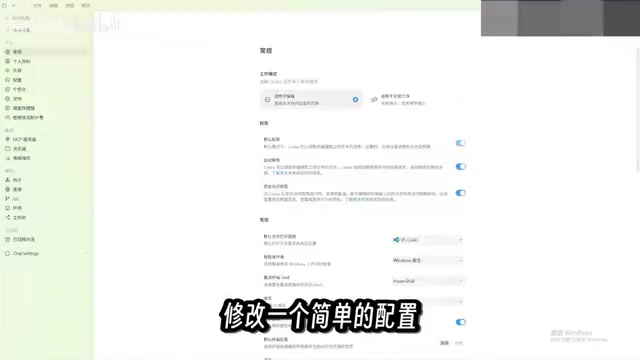
The Most Detailed Codex Guide on Bilibili: From Installation to Real-World Practice
The most detailed Codex guide on Bilibili: from app store installation to daily work mode configuration, with a real coffee shop project demonstrating file organization, data extraction, dashboard creation, and other practical tasks. Learn to use Plan Mode and desktop pets to leverage Codex efficiently.

Appearance Compensation in Volume Rendering: Why RGB Accuracy Cannot Guarantee Density Correctness
Volume rendering research reveals that volumetric data perfectly reproducing external RGB views may still contain density errors: appearance compensation can double central density and keep external rays unchanged even when L2 error exceeds 14.52%. Density recovery depends on appearance capacity, spatial resolution, and measurement design.