Blind Locomotion for Wheeled Quadruped Robots: Paper Recommendations and Research Directions
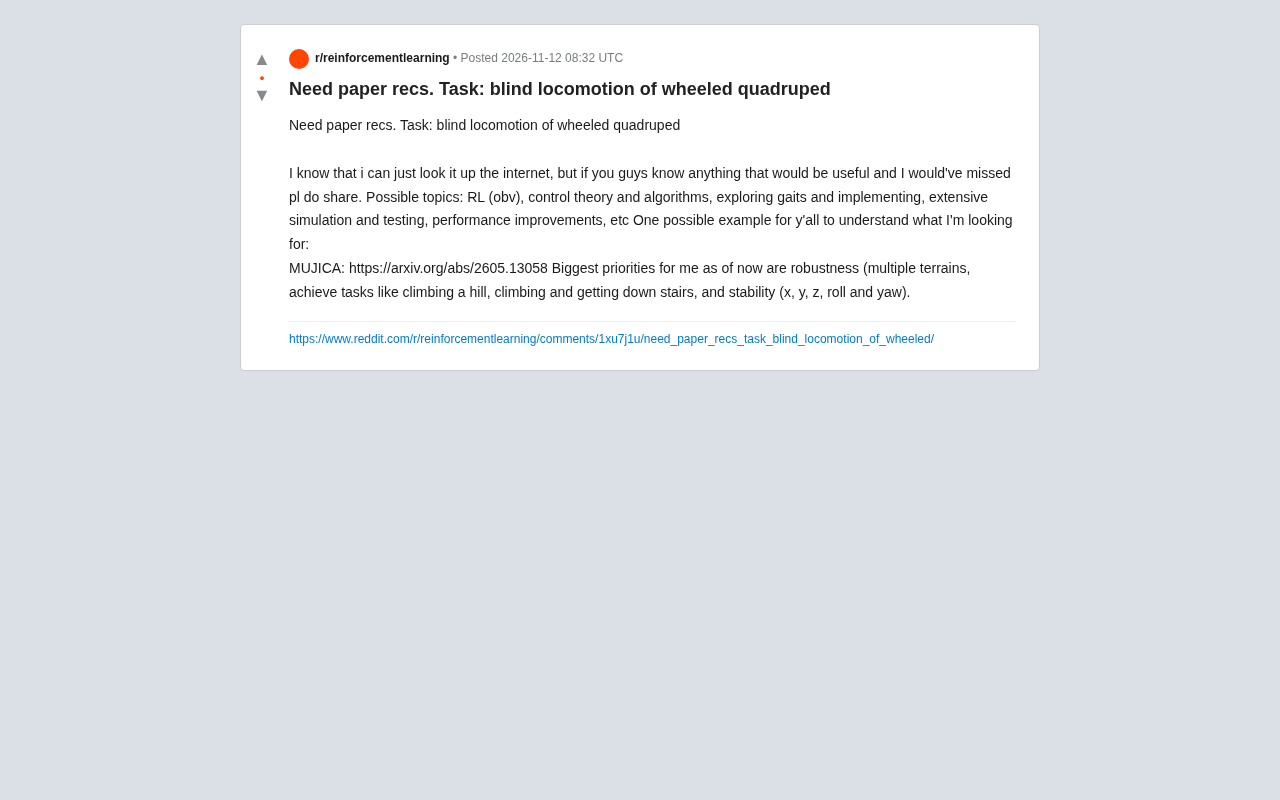
A paper recommendation overview for blind locomotion of wheeled quadruped robots, covering RL, control algorithms, gaits, and simulation.
The article takes a Reddit researcher's request for paper recommendations on blind locomotion of wheeled quadruped robots as its starting point, noting that blind locomotion refers to achieving stable movement using only proprioception (joint encoders, IMUs) without external perception such as vision, which is essential for perception-limited environments like smoke and darkness. The poster cited the MUJICA paper as an example and clearly identified two major priorities: robustness (multiple terrains, slope climbing, stair ascent/descent) and stability (x, y, z position and roll, yaw posture). Based on this, the article recommends reinforcement learning (PPO, SAC learning implicit terrain representations), classical methods such as model predictive control and virtual model control, and emphasizes the importance of gait exploration, large-scale simulation and domain randomization, and performance metrics such as energy efficiency and speed. Finally, it suggests starting research from the MUJICA references, top conferences and journals, and open-source communities.
Why Is Blind Locomotion for Wheeled Quadruped Robots Worth Studying?
Wheeled quadruped robots combine the efficiency of wheeled mobility with the terrain adaptability of quadruped robots, giving them unique advantages on rough terrain, stairs, slopes, and similar scenarios. Blind locomotion refers to achieving stable movement without relying on vision or external perception, using only proprioception (such as joint encoders and IMUs). This capability is essential for operating in perception-limited environments (e.g., smoke, darkness, textureless ground). Recently, a researcher on Reddit posted seeking paper recommendations for this task and outlined specific directions: reinforcement learning (RL), control theory and algorithms, gait exploration, simulation testing, and performance improvement.
Proprioception in robotics refers to a robot's ability to perceive its own state through internal sensors, typically including joint encoders (measuring joint angles and velocities), inertial measurement units (IMUs, measuring acceleration and angular velocity), and motor current sensors (indirectly estimating joint torques). Unlike external perception such as vision or LiDAR, proprioception does not depend on ambient lighting, texture, or visibility, and therefore remains reliable in perception-degraded scenarios such as smoke, darkness, and dust. Blind locomotion policies typically take a history sequence of proprioceptive signals as input, allowing the neural network to implicitly infer quantities that are difficult to measure directly, such as terrain height and contact state—this is also the key mechanism enabling them to handle unknown terrain.
Core Paper Recommendations: Starting from MUJICA
The poster cited MUJICA (arXiv:2605.13058) as an example to illustrate the type of paper they were looking for. MUJICA is likely a locomotion control framework for wheeled quadruped robots, but the original material did not provide further details. Based on this example and the task requirements, the following paper directions are worth attention:
Applications of Reinforcement Learning in Blind Locomotion
RL is a natural choice for achieving blind locomotion, because policies can learn implicit terrain representations from proprioceptive history. Recommended papers include those using algorithms such as PPO and SAC to train wheeled quadruped robots to climb slopes and ascend/descend stairs. For example, some work decouples the motion of wheeled quadrupeds into wheel speed control and leg posture adjustment, jointly optimizing them through RL.
PPO (Proximal Policy Optimization) is a policy-gradient-based deep reinforcement learning algorithm that limits the magnitude of each policy update by clipping the importance sampling ratio, thereby balancing training stability and sample efficiency. It is currently one of the most commonly used algorithms in legged robot locomotion control. SAC (Soft Actor-Critic), on the other hand, is an off-policy algorithm based on the maximum entropy framework that encourages the policy to maintain action diversity while preserving task performance; it has higher sample reuse but is relatively more complex to implement and tune. In blind locomotion tasks, researchers typically design the policy network as a multi-layer perceptron or recurrent network, with inputs consisting of joint positions, velocities, IMU readings, and the previous action, and outputs being target joint angles or torques, while using parallel environments in simulation for large-scale sampling to accelerate convergence.
Control Theory and Classical Algorithms
Model Predictive Control (MPC) and Virtual Model Control (VMC) are widely used in quadruped robots. For wheeled quadrupeds, wheel-ground contact models and lateral stability need to be considered. The poster emphasized robustness (multiple terrains) and stability (x, y, z, roll, yaw), so control methods based on Lyapunov stability may provide theoretical guarantees.
Model Predictive Control (MPC) solves a finite-horizon optimal control problem in each control cycle, using the current state as the initial value and the system dynamics model as constraints, rolling-optimizing the control inputs for several future steps and executing only the first step. For wheeled quadruped robots, MPC can incorporate wheel-ground contact forces, friction cone constraints, and body posture stability into a unified optimization framework, making it naturally suited to handling lateral stability and multi-terrain robustness. Virtual Model Control (VMC), in contrast, simplifies the robot into a virtual spring-damper system at the center of mass and solves for the joint torques of each leg through the desired virtual forces; it has low computational cost and fast response, and is often combined with MPC or RL policies to provide a low-level force control interface.
Key Research Topics and Priorities
The poster clearly identified two major priorities: robustness (multiple terrains, slope climbing, stair ascent/descent) and stability (x, y, z position and roll, yaw posture). This means the papers should cover:
- Gait exploration: The gaits of wheeled quadrupeds include wheeled locomotion, walking, and hybrid wheel-leg locomotion. How to automatically switch gaits according to terrain is a core problem.
- Simulation and testing: Large-scale simulation (e.g., Isaac Gym, PyBullet) is essential for training and validation. Domain randomization can improve sim-to-real transfer capability.
- Performance improvement: Including metrics such as energy efficiency, speed, and payload capacity.
Domain randomization is a core technique for improving sim-to-real transfer: during simulation training, parameters that are difficult to model accurately in the real world are randomized, such as ground friction coefficients, body mass and center-of-mass position, motor delay and noise, and terrain height distribution. By training in a large number of randomized environments, the policy is forced to learn more robust representations that are insensitive to environmental parameters, thereby maintaining performance when deployed on real robots. A complementary technique is curriculum learning, which gradually transitions from flat ground to complex terrains such as slopes and steps, preventing the policy from failing to converge in the early stages of training due to excessive task difficulty.
Cross-Validation of Multiple Sources
The original material is only a single Reddit post and provides no other sources. Therefore, the analysis in this article is based on the requirements of that post, but the recommended directions enjoy broad consensus in the robotics field. For example, combining RL with MPC in blind locomotion control has been a trend in recent years.
How to Start Your Research
It is recommended to start with the references and related work of the MUJICA paper, and to follow top conferences and journals such as ICRA, IROS, and Science Robotics. At the same time, searching for "wheeled quadruped blind locomotion" on GitHub can lead to open-source implementations. The poster hoped to obtain "useful resources that may have been missed," so participating in community discussions (such as r/robotics on Reddit) is also a way to get recommendations.
Conclusion
Blind locomotion is a key capability for wheeled quadruped robots on the path to practical deployment. Learning robust policies through RL, combining classical control to ensure stability, and thoroughly testing in simulation are the mainstream approaches in current research. We hope the above directions provide valuable reference for the poster.
One-line Summary
A paper recommendation overview for blind locomotion of wheeled quadruped robots, covering research directions such as RL, control algorithms, gaits, and simulation.
Paragraph Summary
The article takes a Reddit researcher's request for paper recommendations on blind locomotion of wheeled quadruped robots as its starting point, noting that blind locomotion refers to achieving stable movement using only proprioception (joint encoders, IMUs) without external perception such as vision, which is essential for perception-limited environments like smoke and darkness. The poster cited the MUJICA paper as an example and clearly identified two major priorities: robustness (multiple terrains, slope climbing, stair ascent/descent) and stability (x, y, z position and roll, yaw posture). Based on this, the article recommends reinforcement learning (PPO, SAC learning implicit terrain representations), classical methods such as model predictive control and virtual model control, and emphasizes the importance of gait exploration, large-scale simulation and domain randomization, and performance metrics such as energy efficiency and speed. Finally, it suggests starting research from the MUJICA references, top conferences and journals, and open-source communities.
Related articles

AI Teams Up with Mathematicians to Attack the Riemann Hypothesis: 17 Million Lines of Code Tear Open a 167-Year Gap
In November 2026, Anthropic mathematicians and Claude claimed to have discovered a proof of the Riemann Hypothesis, publishing 17 million lines of Lean formalized code that passed machine verification. This article analyzes the event's impact on mathematics and cryptography, and the deeper questions raised by the separation of discovery and understanding.

AI Claims Formal Proof of the Riemann Hypothesis — But Machine Verification Isn't a Mathematical Proof
In Nov 2026, Anthropic's Levent Alpöğe released a Riemann Hypothesis proof of 175,000 code files that passed machine formal verification. But machine verification isn't a mathematical proof: the kernel can't confirm the proposition is the Riemann Hypothesis humans understand, and there's no human-readable paper. This article breaks down how ζ function zeros determine prime-count deviation, and the core of the controversy.

Anthropic Raises Over $80 Billion in IPO, DeepSeek Secures $100 Billion in Funding: AI Weekly Roundup
This week in AI: Anthropic's Nasdaq IPO raises $93.5B in the largest ever, DeepSeek closes ~100B yuan round, AI claims formal Riemann proof, MiniMax breaks crypto candidates in seconds.