Blink Launches 4K Security Cameras: New Pan-Tilt and Spotlight Models Join Budget Lineup

Blink debuts 4K security cameras, adding pan-tilt and battery spotlight models to cover more scenarios at low cost.
Amazon-owned Blink expands its budget security camera lineup, introducing 4K resolution for the first time along with its first pan-tilt model and a battery-powered spotlight camera, complementing rather than replacing the Mini 2K, Mini 2K Plus, and Outdoor 2K Plus. 4K offers higher pixel density for identifying distant details; the pan-tilt model covers larger areas with one unit, and the battery spotlight solves outdoor power issues while improving color night vision and deterrence. The article notes consumer security competition is shifting from "having or not" to "good or bad," with 4K trickling down as costs fall, and reminds users to weigh storage, bandwidth, battery life, subscription fees, and privacy.
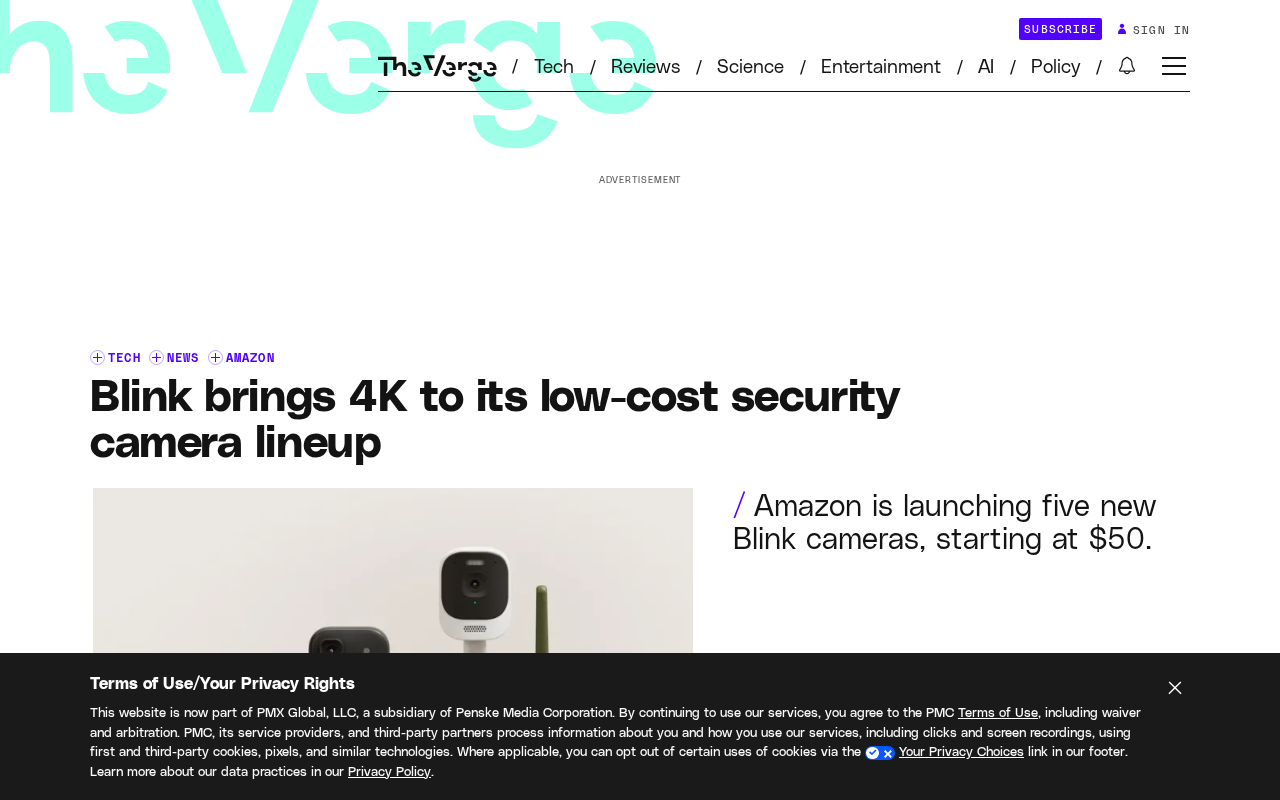
Amazon-owned Blink is expanding its budget security camera lineup, introducing 4K resolution for the first time and adding a pan-tilt model as well as a battery-powered spotlight camera. These new products improve on the existing Mini 2K, Mini 2K Plus, and Outdoor 2K Plus in resolution and coverage, with features segmented for different scenarios.
Product Line Expansion: From 2K to 4K
The core change in this Blink release is raising the top resolution from 2K to 4K. For security cameras, higher resolution means more detail in the same field of view—for example, clearer identification of faces, license plates, or distant objects. Previously, Blink's Mini 2K series and Outdoor 2K Plus focused on value for money; adding 4K brings image quality closer to mid-to-high-end products while maintaining the brand's customary low-price positioning.
According to the original report, the new lineup includes Blink's first 4K pan-tilt model and a battery-powered spotlight model. Pan-tilt functionality lets users remotely control the camera's viewing angle through the app, covering a larger area and reducing blind spots; the battery-powered spotlight camera suits scenarios where wiring is impossible or flexible placement is needed, and the spotlight provides extra illumination at night to improve color night vision.
Pan-Tilt (PTZ) vs. Fixed Cameras
Pan-tilt is the basic capability of a PTZ camera: pan refers to horizontal rotation, tilt to vertical pitch, both driven by stepper motors, letting users remotely change the lens orientation in the app. Compared with a fixed camera, a single PTZ unit can cover a larger sector, but it can only point in one direction at a time, so there is a trade-off between "seeing wide" and "seeing everything at once." Most PTZ products support preset patrol positions to automatically tour along a set path.
Notably, Blink's 4K PTZ model is pan-tilt rather than full PTZ, typically without optical zoom; digital zoom cropped from 4K still retains usable clarity, which is one of the practical values of combining 4K with a pan-tilt head.
What 4K Actually Means for Security
4K is 3840×2160, about 8.3 megapixels—roughly 2.2 times that of 2K (typically 2560×1440, about 3.7 megapixels). Its value is not that the overall image looks "better," but that pixel density in the same field of view is higher, so distant targets remain identifiable after digital magnification. The cost is that bitrate and storage requirements multiply, and in low light the smaller pixels capture less light, so night vision performance may not improve in tandem.
Feature Segmentation Meets Different Security Needs
Blink's strategy here clearly leans toward scenario-based coverage. In the existing lineup, the Mini series suits indoor placement, the Outdoor series targets outdoor environments, and the new pan-tilt and spotlight models further fill gaps for specific needs.
The pan-tilt model suits users who need wide-area monitoring, such as yards, garages, or open commercial spaces; instead of installing multiple fixed cameras, users can cover a broader area by rotating the view. The battery-powered spotlight model solves the pain point of outdoor locations without power outlets, while the spotlight's active deterrent effect can also discourage intrusions to some extent.
These new products complement rather than fully replace the existing 2K products. For budget-conscious users who don't demand the utmost image quality, 2K models remain an economical choice; for those who want higher-definition footage or more flexible monitoring angles, 4K and pan-tilt models offer an upgrade path.
Design Trade-offs of Battery-Powered Cameras and Spotlights
Battery-powered cameras rely on PIR (passive infrared) sensors to trigger wake-up and otherwise stay in deep sleep to save power, so they cannot record continuously 24/7 or provide live preview like wired models. Wake-up incurs a delay of hundreds of milliseconds, which may miss the start of an event—an inherent trade-off of battery-powered designs.
The spotlight is a double-edged sword on battery models: on one hand it supplements light for color night vision and acts as an active deterrent; on the other, LED power consumption far exceeds that of the camera itself, and frequent triggering significantly shortens battery life. Such products therefore typically offer "on only when triggered" and "always on" modes, with adjustable brightness and duration.
Color Night Vision vs. Infrared Night Vision
Traditional infrared night vision outputs black-and-white footage in dark environments because infrared light carries no color information. Color night vision requires a white-light spotlight or a large-aperture sensor; the former restores color in the dark but exposes the camera's location and may disturb neighbors. When buying, distinguish whether "full-color night vision" relies on a fill light or the sensor itself—the two differ markedly in power consumption and stealth.
The Competitive Logic of the Budget Security Market
Blink has secured a place in the security camera market with a low-price strategy; introducing 4K while maintaining its budget positioning reflects how competition in the consumer security market is shifting from "having or not" to "good or bad." Users are no longer satisfied with merely being able to see—they want to see clearly, see everything, and install conveniently.
Amazon uses the Blink brand to reach price-sensitive users, forming a high-low pairing with brands like Ring. The addition of 4K and pan-tilt gives Blink stronger spec appeal in the same price band, but the actual experience also depends on image-processing algorithms, night vision performance, cloud storage fees, and battery life.
From an industry perspective, 4K is becoming the next adoption milestone for security cameras. As sensor and chip costs fall, 4K resolution once reserved for high-end models is gradually trickling down to entry-level products—good for consumers, but it also means manufacturers need to differentiate on software experience, privacy protection, and subscription services.
Amazon's Dual-Brand Strategy
Blink and Ring both belong to Amazon but occupy different tiers: Ring focuses on doorbells and whole-home security ecosystems, with higher prices, fuller features, and deep ties to subscription services; Blink, founded by the Immedia Semiconductor team and acquired by Amazon in 2017, is known for low-power in-house chips and long battery life, targeting price-sensitive users. This combination lets Amazon cover both entry-level and mid-to-high-end markets while sharing infrastructure across channels and cloud services.
The Subscription Business Model
Hardware margins on consumer security cameras are limited, so manufacturers generally profit through cloud storage subscriptions. Blink's subscription plans are billed per device and offer cloud recording, person detection, and more; without a subscription, users typically get only live view and notifications, with event recordings relying on local USB storage or the Sync Module. The true total cost of ownership of "low-cost hardware" therefore must include years of subscription fees—a key variable when evaluating Blink's value against competitors.
Buying Advice and Considerations
Existing Blink users considering an upgrade should note that 4K recording places higher demands on storage and network bandwidth, and battery models may see shorter runtime when 4K and the spotlight are enabled. The pan-tilt model's motorized structure also means the installation location needs to leave room for rotation.
Moreover, a security camera's actual value depends not only on hardware specs but also on cloud storage subscriptions, local storage options, notification accuracy, and privacy encryption. Before buying, confirm each model's storage options and subscription fees to avoid unexpected long-term costs.
Blink's new lineup shows the direction of evolution for budget security cameras: higher resolution, more flexible viewing angles, and more convenient power. For users building a home or small-business security system, this offers more choices across price bands, but the final decision should still account for the specific installation environment and long-term cost of ownership.
Bandwidth and Storage Estimates for 4K Recording
4K security video commonly uses H.265 encoding, with a single stream bitrate of roughly 4–8 Mbps. At an estimated 6 Mbps, one hour of recording is about 2.7 GB, and 24/7 continuous recording is about 65 GB per day; event-triggered recording greatly reduces daily data volume, depending on trigger frequency. If home upload bandwidth is insufficient, cloud backup may be limited or downscaled, while local storage requires a microSD card or Sync Module with matching capacity.
Privacy and Data Security
Cameras involve the most sensitive home video data, so before buying it's worth confirming: whether local storage is supported to bypass the cloud, whether data is encrypted in transit and at rest, whether privacy masking (blocking specific areas) is available, and the vendor's policy on law enforcement data requests. These software-level differences often affect long-term experience more than resolution specs.
One-line Summary
Blink debuts 4K security cameras, adding pan-tilt and battery spotlight models to cover more scenarios at low cost.
Paragraph Summary
Amazon-owned Blink is expanding its budget security camera lineup, introducing 4K resolution for the first time along with its first pan-tilt model and a battery-powered spotlight camera, complementing rather than replacing the existing Mini 2K, Mini 2K Plus, and Outdoor 2K Plus. 4K brings higher pixel density for identifying distant details like faces and license plates; the pan-tilt model covers larger areas with a single unit, while the battery spotlight model addresses the pain point of outdoor locations without power and improves color night vision and deterrence. The article notes this reflects consumer security competition shifting from "having or not" to "good or bad," with 4K trickling down to entry-level products as costs fall; it also reminds users to consider storage and bandwidth, battery life, cloud subscription fees, and privacy protection as part of the total cost.
Related articles

"Black October": Did AI Uncover 3% of All Critical Vulnerabilities Ever?
A Reddit post claims 3% of all critical software vulnerabilities ever were found in the past month, dubbed 'Black October.' We break down the statistical issues, how AI-assisted code auditing accelerates discovery, and how developers should respond.

Microsoft Project Gecko: Using AI to Bridge Language Gaps for African Farmers
Microsoft's Project Gecko launches PharmaChat, letting African farmers ask questions in their native language and get precise video clips and farming book chapters via AI. The project also releases three interactive manuals to advance inclusive AI.

Musk's Space Dominance: How Starlink Throttling Undermines Ukraine's Defense
SpaceX's Starshield throttling disabled Ukraine's high-speed interceptor drones, exposing how Musk's private control over low Earth orbit communications affects battlefield dynamics and national security, and highlighting the risks of commercial space militarization and space governance dilemmas.