Block Engine: An In-Depth Look at the Open-Source Engine for Multi-Language Programming in a Single File

Block Engine lets you mix Python, JS, Lua, and PHP in one file with automatic cross-language variable sharing.
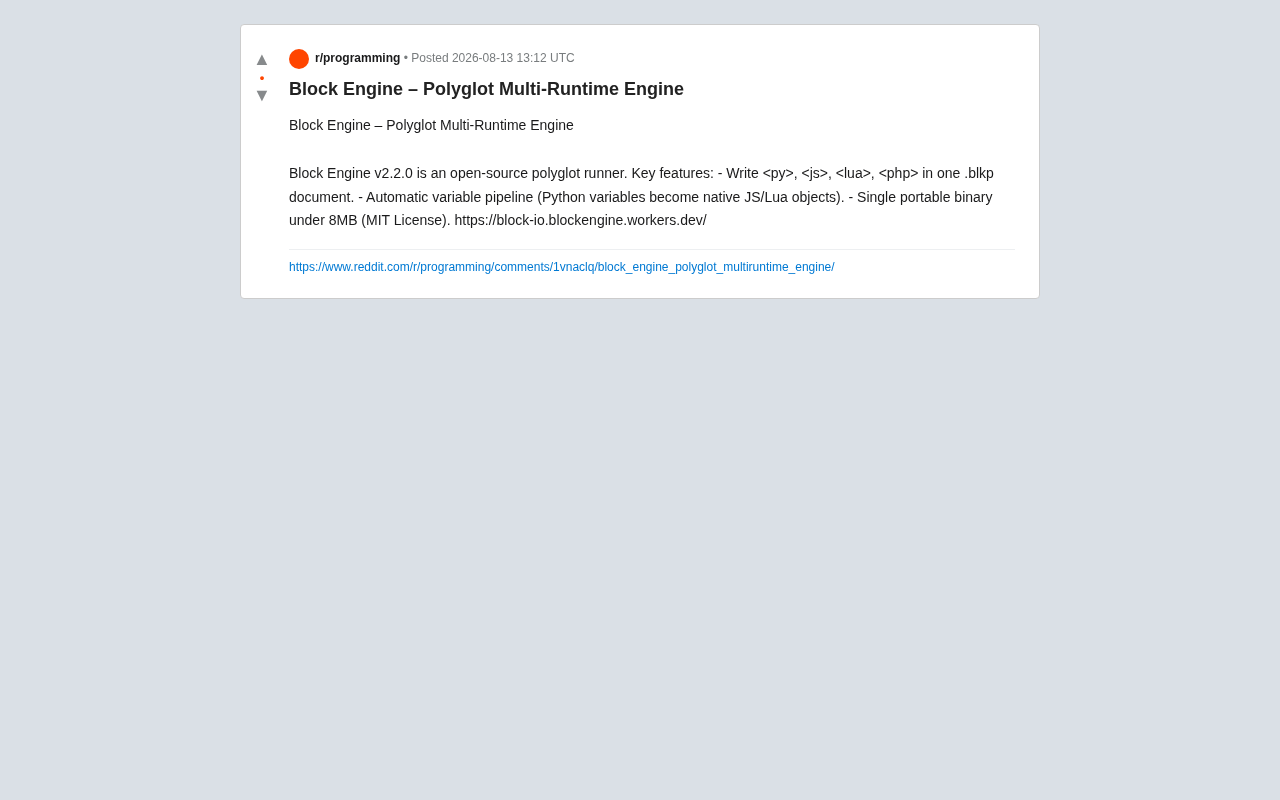
Block Engine v2.2.0 is an open-source polyglot runtime that lets developers write Python, JavaScript, Lua, and PHP in a single .blkp file. Its automatic variable pipeline enables seamless cross-language data sharing without manual serialization. Packaged as a portable binary under 8MB, it targets rapid prototyping, teaching, and glue-layer scripting, though questions remain about performance overhead and type system coverage.
When Multiple Languages Can Live in One File
In traditional software development, collaboration between different programming languages typically means complex inter-process communication, serialized data exchange, or building microservice architectures. Conventional multi-language collaboration relies on IPC mechanisms like pipes, sockets, and shared memory, or network protocols such as gRPC and REST APIs for data exchange between microservices. While these solutions are mature, they introduce serialization/deserialization overhead, network latency, deployment complexity, and the inherent failure modes of distributed systems. For example, when a Python service passes data to a Node.js service via JSON, you have to deal with encoding, network timeouts, version compatibility, and more.
Recently, Block Engine v2.2.0 surfaced on the Reddit open-source community with a rather radical idea: let Python, JavaScript, Lua, PHP, and other languages be written directly in a single .blkp file with seamless variable sharing. Block Engine aims to solve cross-language collaboration within a single process, reducing complexity from "distributed system level" down to "function call level."
This open-source project is released under the MIT license and centers on the concept of a "Polyglot Multi-Runtime." Its core selling point is freeing developers from language boundaries, allowing them to call the most suitable language for each task within a single file. It's worth noting that polyglot runtimes aren't an entirely new concept — Oracle's GraalVM is the most well-known pioneer in this space. Through its Truffle framework, GraalVM lets Java, JavaScript, Python, Ruby, R, and other languages share a single virtual machine for zero-overhead cross-language interoperability. GraalVM's core approach compiles each language into an intermediate representation (IR), which is then optimized and executed by a unified JIT compiler. The key difference between Block Engine and GraalVM is that GraalVM targets the enterprise JVM ecosystem — it's large and depends on Java infrastructure. Block Engine takes a lightweight, embedded approach, covering scripting language scenarios in a single file under 8MB, positioning itself more as a "Swiss Army knife" tool.
Core Features of Block Engine
Writing Multiple Languages in a Single Document
Block Engine's most intuitive feature is support for mixing code from multiple languages in a single .blkp file using tag syntax. Developers can write Python logic with <py> tags, JavaScript with <js>, Lua scripts with <lua>, and PHP code blocks with <php>.
This design is similar to early web development where HTML, CSS, and JavaScript were mixed in the same page, but Block Engine extends it to backend scripting languages. The concept of multi-language files has several historical precedents: Jupyter Notebooks support running different language kernels in different cells via magic commands; Emacs' Org-mode Babel system allows embedding and executing multiple language code blocks in the same document with variable passing for data flow; Microsoft's .NET platform enables seamless interop between C#, F#, VB.NET, and others through the CLR (Common Language Runtime). What makes Block Engine unique is its focus on dynamic scripting languages, file-level mixing rather than project-level interop, and its minimalist single-file distribution — positioning it closer to a developer's everyday scripting tool rather than an enterprise platform.
For scenarios requiring rapid prototype validation, or where different languages each have their strengths (e.g., Python for data processing, Lua for game logic scripting), this approach can significantly reduce context-switching costs.
Automatic Variable Pipeline for Cross-Language Data Sharing
If multi-language mixing is just "concatenation," the real engineering value lies in Block Engine's Automatic Variable Pipeline mechanism.
According to official documentation, variables defined in a Python code block can be automatically converted into native objects in JavaScript or Lua for direct use. This means developers don't need to manually handle JSON serialization, type mapping, or data passing logic — the engine handles data bridging between different language runtimes under the hood.
This is the most technically sophisticated part of the project. Cross-language data type mapping has always been challenging — how do Python dictionaries and lists map to JavaScript objects and arrays? How do you handle differences in numeric precision and string encoding between languages? The engine needs to do significant coordination work at runtime.
Specifically, these challenges include: Python's int is an arbitrary-precision integer, JavaScript's Number is an IEEE 754 double-precision float (with a safe integer range only up to 2^53-1), and Lua before version 5.3 didn't even have a native integer type. For strings, Python 3 uses Unicode strings, Lua strings are essentially byte sequences, and PHP strings are also byte arrays. More complex scenarios involve differences in null value semantics: Python's None, JavaScript's null/undefined, and Lua's nil don't have a simple one-to-one correspondence. Additionally, Python dictionaries allow any hashable object as a key, while JavaScript object keys can only be strings or Symbols. These semantic differences mean "fully transparent" variable sharing is theoretically impossible to achieve with 100% fidelity — the engine must establish conventions or throw warnings in certain edge cases.
If Block Engine can truly achieve transparent variable sharing for most common scenarios, it would dramatically reduce the cognitive burden of multi-language collaboration.
A Lightweight Portable Binary Under 8MB
Another noteworthy highlight is size control. Block Engine packages the entire multi-runtime engine into a single portable binary of less than 8MB.
Considering it needs to embed or orchestrate execution capabilities for four languages — Python, JavaScript, Lua, and PHP — 8MB is remarkably restrained. From a technical implementation perspective, this likely employs an embedded language interpreter strategy: the Lua interpreter itself is extremely lightweight (around 200KB), QuickJS (a JavaScript engine developed by FFmpeg creator Fabrice Bellard) compiles to only about 600KB-1MB with ES2020 support, MicroPython or a stripped-down CPython can be kept within a few MB, and for PHP, an embedded implementation like PH7 may be used. By statically linking these lightweight interpreters and using binary compression tools like UPX, the 8MB size is achievable.
However, this also means standard library support for each language may be incomplete — for example, Python might not support third-party libraries that depend on C extensions like numpy or pandas, and JavaScript might lack Node.js native modules and filesystem APIs. Developers need to understand the actual capability boundaries of each language environment.
This "single-file, download-and-run" distribution approach is friendly for CLI tools, embedded script execution, and ad-hoc scripting tasks in CI/CD pipelines, avoiding the hassle of configuring multiple language environments.
Use Cases and Potential Value of Block Engine
Based on the project's positioning, Block Engine could be valuable in the following scenarios:
- Rapid script prototyping: Leveraging the ecosystem strengths of each language in one file — for example, combining Python's data science libraries with JavaScript's string processing.
- Teaching and demos: Intuitively demonstrating the same logic implemented in different languages, or cross-language data flow concepts.
- Glue layer tasks: Serving as a lightweight binding tool connecting components in different languages, replacing some microservice or IPC communication scenarios.
- Game and embedded scripting: Lua is widely used in gaming, and combining it with Python/JS could enable new script orchestration approaches.
Issues to Consider Realistically Before Use
As an open-source project that just released v2.2.0, Block Engine raises some questions worth asking beyond its impressive concept.
Performance overhead is the primary concern. Coordinating multiple language runtimes within a single process means cross-language serialization and deserialization of variables will inevitably incur performance costs. Whether the pipeline mechanism becomes a bottleneck for high-frequency, high-volume variable passing requires actual benchmark testing to verify. For reference, GraalVM achieves near-zero overhead interop in cross-language calls through a shared object model, but this relies on a unified intermediate representation layer. Solutions based on independent interpreters typically require data copying at language boundaries, with overhead potentially reaching microsecond or even millisecond levels depending on data structure complexity.
Type system boundaries also deserve attention. The type systems of different languages vary dramatically — how many complex types can automatic mapping cover? How are custom classes, closures, and circular references handled? The official documentation has yet to elaborate on these points.
Regarding ecosystem maturity, as an emerging project, whether its debugging toolchain, error localization, and IDE support can keep pace with developer experience needs will directly determine whether it remains an "interesting toy" or can enter production environments. Specifically, when a variable from a Python code block in a .blkp file is passed to a JavaScript code block and triggers a runtime error, can developers quickly locate the source of the problem? Can stack traces cross language boundaries? These are critical details that determine real-world usability.
Conclusion
Block Engine represents an exploratory direction toward breaking down programming language barriers. With its combination of "multi-language in one file + automatic variable pipeline + lightweight binary," it aims to lower the barrier to multi-language collaboration. While performance, type mapping, and ecosystem maturity still need to be proven, its MIT open-source license and minimalist distribution under 8MB provide a low-cost entry point for curious developers. For engineers who frequently switch between multiple languages, this is at least a new tool worth watching and experimenting with.
Related articles

Amphibious Transforming Drone: Beyond 100x Power Savings, What Are the Real Needs?
Is the amphibious transforming drone just a gimmick? Starting from the 100x power difference of the M4 Morphobot, explore real application scenarios and thesis topic ideas, analyzing boundary conditions where pure drones and pure ground robots both fail.

Warhound Raises $200 Million: Genetically Engineered "War Dogs" Paired with Anduril Gear
Warhound raises $200M, backed by Ben Lamm and Palmer Luckey, to genetically engineer dogs for military and law enforcement use and equip them with Anduril gear. This article analyzes its technology direction, funding logic, and ethical controversy.

Claude API Comes to Google Cloud: IAM Integration and SDK Access Guide
Anthropic hosts the full Claude API on Google Cloud with IAM-controlled permissions and unified billing. This guide covers the Vertex AI and Anthropic-hosted entry points, IAM role configuration, and SDK access.