BMW's New i3 Delivers 468-Mile Range in Neue Klasse Platform Debut
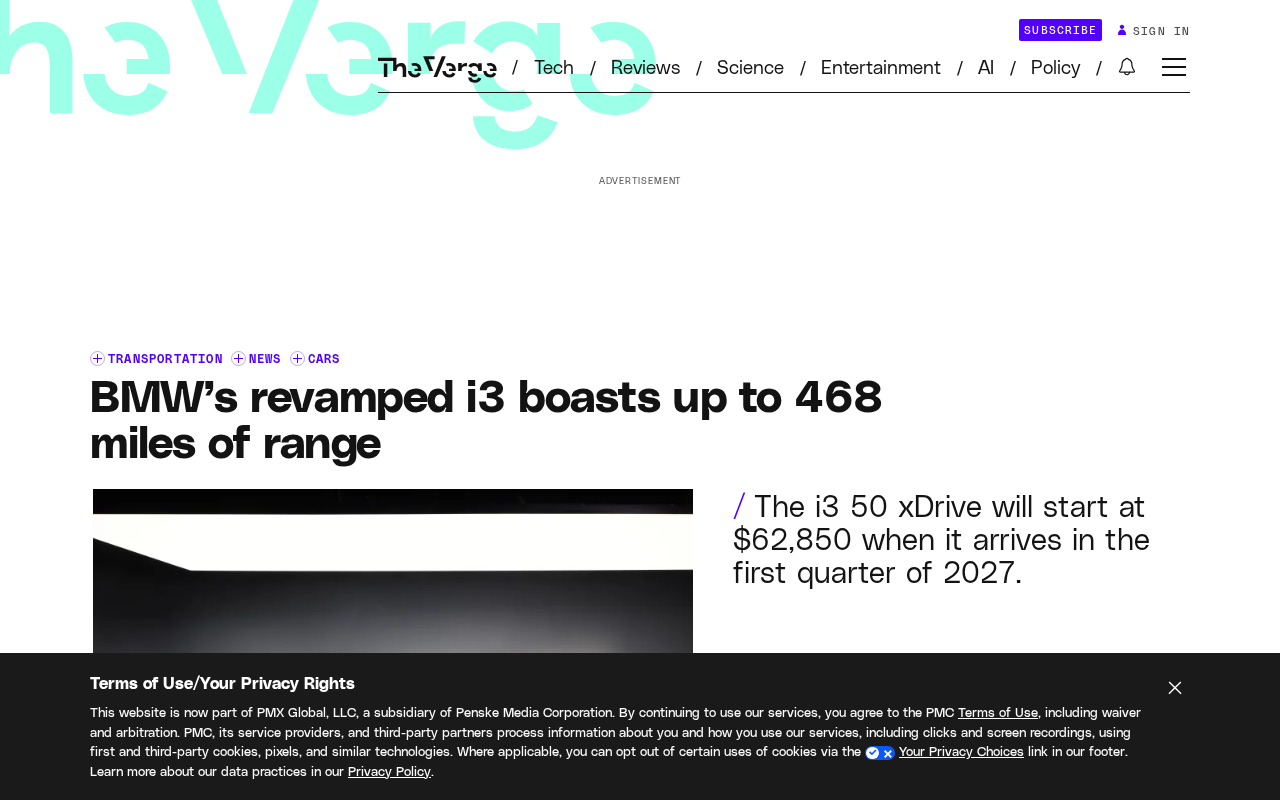
BMW's new i3 targets 468 miles of range on its all-new Neue Klasse EV platform.
BMW has officially revealed key specs for the all-new i3, headlined by a range of up to 468 miles (approx. 753 km). The model makes a complete transition from the original compact electric hatchback to a full four-door sedan, underpinned by BMW's Neue Klasse platform featuring next-gen battery cells, 800V charging architecture, and a new electrical/electronic system. After strategically withholding battery, range, and pricing details at launch, BMW is now disclosing them — a sign the model's market rollout is entering a concrete phase. If the range holds up in real-world conditions, the new i3 will directly challenge Tesla and Mercedes-Benz EQ on key metrics, while also marking a pivotal milestone in BMW's systemic shift toward the software-defined vehicle era.
BMW has finally pulled back the curtain on the all-new i3. When the German automaker first announced it would reinvent the i3 as a pure-electric four-door sedan built on the Neue Klasse platform, it left a striking number of key details unanswered — battery capacity, range, and pricing were all conspicuously absent. Now, BMW has begun filling in those blanks, with the most headline-grabbing figure being a range of up to 468 miles (approximately 753 km).
From Compact Hatchback to Full Electric Sedan
Anyone familiar with BMW's lineup knows the original i3 was an experimental compact electric hatchback — an early EV icon defined by its bold urban positioning and carbon fiber body construction. This time around, BMW has chosen to breathe new life into the i3 nameplate, transforming it from a small city runabout into a proper four-door electric sedan.
The shift itself sends a clear message: BMW is elevating the i3 from a niche experiment into a mainstream flagship for the brand's electric future. Carrying over the name preserves brand equity, though it may also spark debate among loyal owners about just how much has changed.
The original i3 launched in 2013 with a carbon fiber-reinforced plastic (CFRP) body structure, keeping curb weight to around 1,200 kg — a benchmark in EV lightweight design at the time. But constrained by the energy density of batteries available then, the first-gen i3 managed only around 130 to 160 km of range (NEDC cycle), forever limiting it to urban commuting and keeping it out of the mainstream EV market. BMW discontinued the original i3 in 2022 after nearly a decade in production.
There was a multi-year naming gap between the two generations, during which BMW shifted its EV strategy toward the iX, i4, and i5 — models adapted from conventional platforms. The return of the i3 marks the first time BMW has applied this emotionally resonant historical name to a production sedan on the Neue Klasse platform, a market signal that goes well beyond the car itself.
What the Neue Klasse Platform Means
The most important foundation underpinning the new i3 is BMW's highly anticipated Neue Klasse ("New Class") platform — the architecture BMW sees as the technological cornerstone of its next generation of EVs, encompassing a new electrical/electronic architecture, battery technology, and software systems.
That 468-mile range figure is a direct demonstration of what this platform can deliver. Compared to most mainstream electric sedans currently on the market, that range places the new i3 firmly in the front row, promising a significant reduction in range anxiety for long-distance travel. That said, official figures typically represent peak performance under ideal conditions; real-world results will vary based on driving style, temperature, load, and other factors — and will need to be verified through independent testing.
The Neue Klasse name itself carries deep historical weight. Translated literally from German as "New Class," it originally referred to a line of sedans BMW produced in the 1960s and '70s — the very models that helped rescue the brand from near-bankruptcy and sparked its revival. Reviving the name today is clearly BMW's way of invoking that symbolic turning-point moment from its own history.
On the technical side, the Neue Klasse platform uses sixth-generation cylindrical cells (46 mm diameter), offering roughly 20% greater energy density than the previous generation. It also introduces an 800V high-voltage charging architecture for faster DC fast charging, and deeply integrates BMW's new "Heart of Joy" software system, enabling continuous over-the-air (OTA) updates. This full-stack, in-house approach — from cell chemistry to vehicle electronics — is central to BMW's strategy of reducing supplier dependency and building a sustainable competitive advantage.
Pricing and Specs Coming Into Focus
At the time of the initial reveal, BMW deliberately withheld core specs including battery capacity, range, and pricing. Those details are now being officially disclosed. Pricing, a critical factor in any buying decision, has finally entered the official conversation.
For a mainstream electric sedan, the balance between range, price, and platform technology will directly determine its competitiveness. BMW's phased approach to releasing information also fits the broader industry playbook of sustaining buzz around a new model over time.
What This Means for the EV Market
If the 468-mile range holds up in the real world, the new i3 will have a clear edge on one of EVs' most critical hard metrics, putting it in direct competition with Tesla and Mercedes-Benz's EQ lineup, among others. For potential EV buyers still on the fence, class-leading range remains one of the most effective ways to ease hesitation.
At a deeper level, the arrival of the Neue Klasse platform marks a new chapter in BMW's EV strategy — one that goes beyond any single model and represents a systematic push by a legacy luxury automaker to catch up in software-defined vehicles, battery efficiency, and overall vehicle architecture. Whether the new i3 can deliver on its spec-sheet promises, and whether its pricing proves competitive, will be a defining test of BMW's EV credibility.
BMW continues to roll out the full details, and more information on battery specs and launch timing is worth watching closely.
Related articles

Perplexity Hybrid Compute Tested: Privacy Data Never Leaves the Mac
Perplexity Hybrid Compute tested: how PrivacyGate intercepts sensitive data, how local and cloud models divide work, model differences on 16GB vs 32GB Macs, and privacy protection in real scenarios like bank statements and medical records.

Big Fat Fish Roasts Mainstream LLMs at Home and Abroad: Doubao Takes the Crown, DeepSeek Tied for First
Bilibili creator Big Fat Fish roasts mainstream LLMs: Doubao tops for emotional value, DeepSeek ties first for open-source value, with ERNIE, Hailuo, Yuanbao, Kimi, Qwen, Kling, Claude, Gemini, and Grok each branded with a distinct persona.

How to Truly Test AI Agents Before Production? A Practical Testing and Monitoring Framework
BotGage founder Pramin Pradeep shares a three-step framework for testing AI Agents before production: Agent registration visibility, red teaming, and production observability — plus a real case cutting QA costs from $180K to $80K and an analysis of IT roles shifting to Agent supervisors.