Perplexity Hybrid Compute Tested: Privacy Data Never Leaves the Mac
Perplexity Hybrid Compute tested: cloud planning, local privacy, usable from 16GB.
Perplexity's Hybrid Compute aims to resolve the dilemma of wanting to process sensitive data with large models without uploading it to the cloud. Tech blogger Alex Ziskind tested it on three Macs with different memory: the cloud model handles planning, reasoning, and web search, the local model touches private files, and the desktop app acts as orchestrator. The core PrivacyGate component, based on the open-source PII Tracer model, intercepts and redacts data before it leaves the device and offers three options—local processing, direct sharing, or cancel—with post-hoc auditability. Local models are tiered by memory: 16GB supports only Gemma 4 E4B, while 32GB unlocks Qwen 3.5 35B and Perplexity's in-house 19GB model. Progressive tests with bank statements, medical records, and parking tickets show the solution is practical, but dragging images into the chat box bypasses the gateway, so privacy protection still partly depends on user habits.
Perplexity's Hybrid Compute aims to solve a long-standing dilemma for AI users: they want large models to help process sensitive data (bank statements, medical records, contracts and bills) without uploading it to the cloud. Tech blogger Alex Ziskind's hands-on video on Bilibili ran the full hybrid compute workflow on three differently configured Macs, and the results were more practical than expected.
What Exactly Is Hybrid Compute Doing?
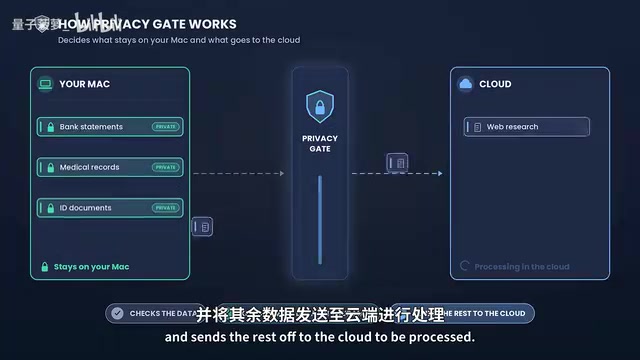
The core idea behind Hybrid Compute isn't complicated: split the task apart, with the cloud model handling planning, reasoning, and web search, while the local model handles the private files. Perplexity's desktop app acts as the orchestrator, automatically determining what can leave the device and what must stay.
Users don't need to manually switch models—they simply check Hybrid mode in the model selector and submit tasks as usual. The system invokes a privacy gateway called PrivacyGate, which intercepts and redacts data before it leaves the device. Alex repeatedly emphasized one point in the video: local and cloud models each have their strengths, and arguing over which replaces the other is pointless. The truly sensible strategy is to use both.
Orchestrator plays the role of dispatch hub in the hybrid compute architecture: after receiving a user task, it automatically breaks down the steps based on content type and privacy attributes, deciding which subtasks go to the cloud large model (planning, reasoning, web retrieval) and which are dispatched to the local small model. The orchestrator itself typically runs on the local client, passing only abstracted instructions rather than raw data, thereby minimizing the data exposure surface while maintaining task continuity. This differs from the traditional "manual model switching" experience in that users don't need to understand the underlying routing logic—one authorization is enough for the system to automatically route according to preset policies.
PrivacyGate: The Real Gatekeeper
PrivacyGate is the technical linchpin of the entire solution. Its detection capability comes from Perplexity's open-source PII Tracer small model on Hugging Face, which specializes in identifying personally identifiable information. When submitted files or images contain sensitive content, the gateway pops up a prompt with three options: process locally (recommended), share directly, or cancel.

In testing, Alex deliberately planted privacy items in the sample data. After uploading an internet service contract, six months of bank statements, and bills, PrivacyGate immediately intercepted and requested confirmation. After choosing local processing, the cloud model continued payment matching and rate comparison while the local model read the original files. He later reviewed a run log and clearly saw which fields were redacted and what was sent to the cloud—this auditability is quite critical for compliance-focused users.
PII (Personally Identifiable Information) refers to data that can identify a specific natural person, alone or in combination with other information, including names, ID numbers, bank account numbers, medical record numbers, addresses, and license plates. In AI applications, PII detection typically uses lightweight named entity recognition (NER) models to scan and tag text and image OCR results in real time. The value of small models like PII Tracer lies in their ability to run on-device with low latency, locating sensitive items without uploading the original text; after detecting PII, the gateway can execute redaction (such as mask replacement) or blocking according to policy, establishing a controllable checkpoint before data leaves the device.
Hardware Requirements: 16GB Minimum, 32GB to Unlock All Models
Local inference has hard memory requirements. Perplexity currently offers three local orchestration models: Gemma 4 E4B (4-bit quantized, 6.6GB, requires 16GB RAM), Qwen 3.5 35B (requires 32GB RAM), and Perplexity's in-house 19GB model (also requires 32GB RAM).
Alex compared three machines: a 16GB MacBook Air only showed Gemma as an option; a 32GB Mac mini unlocked all three models; a 128GB MacBook Pro, naturally, had no trouble at all. This tiered-by-memory strategy is pragmatic, but it also means entry-level Mac users have limited choices. He mentioned hoping to see more validated models added to the list in the future—Perplexity has clearly been strict about which models are available to ensure reliability on specific tasks.

4-bit quantization is a model compression technique: it reduces weights originally stored as 16-bit floats to 4-bit integer representations, shrinking model size to about a quarter while maintaining accuracy through quantization-aware training or post-training calibration. The 6.6GB size of Gemma 4 E4B mentioned above benefits from this. Local inference memory usage depends not only on weight size but also on space reserved for the KV Cache and context window, so a Mac with 16GB unified memory has limited headroom after loading a 6.6GB model and can only run a single model; only 32GB machines can accommodate the 19GB in-house model while leaving inference buffer.
Real-World Scenario Testing: From Bank Statements to Medical Records
The most compelling part of the video is a series of progressive tests. Alex prepared photographed paper materials with private information—vehicle details, surgical medical records, and a parking ticket—with privacy sensitivity increasing at each step.
The bank statement task was completed most thoroughly: the local model parsed the files and matched payments, while the cloud model searched the web and found a local broadband plan cheaper than the contract rate, also identifying a suspected overcharge of up to $88. In the medical records test, he asked for web search results related to the surgery but insisted the documents themselves stay on the Mac—and the system complied, sending only the redacted query intent to the cloud. In the parking ticket test, he asked to check Washington, D.C. public records; the model refused to send the image and instead provided search guidance so he could enter the ticket number himself.

One noteworthy detail: dragging images directly into the chat box bypasses PrivacyGate and uploads them straight to the cloud. The correct approach is to specify a folder through the file system entry point, letting the system complete recognition locally. This interaction difference shows that the effectiveness of privacy protection mechanisms still partly depends on user habits.
The Balance Between Convenience and Security
Alex's closing summary was measured: the value of this workflow lies in turning what used to require manual model switching into a coherent experience, with the cloud handling hard problems and the local side guarding sensitive files. It doesn't eliminate privacy risk—it shifts the risk control point from "user vigilance" to a two-layer mechanism of "system interception + user confirmation."
For knowledge workers who need to handle financial, medical, and contract data, this paradigm offers an actionable middle path. The cost is hardware requirements and some interaction learning curve; the benefit is no longer having to make an either-or choice between convenience and security.
One-line Summary
Perplexity Hybrid Compute tested: cloud planning, local privacy protection, usable starting at 16GB.
Paragraph Summary
Perplexity's Hybrid Compute aims to resolve the dilemma of wanting to process sensitive data with large models without uploading it to the cloud. Tech blogger Alex Ziskind tested it on three Macs with different memory: the cloud model handles planning, reasoning, and web search, the local model touches private files, and the desktop app acts as orchestrator to route automatically. The core component PrivacyGate is based on the open-source PII Tracer small model, intercepting and redacting data before it leaves the device, offering three options—process locally, share directly, or cancel—with post-hoc auditability. Local models are tiered by memory: 16GB supports only Gemma 4 E4B, while 32GB unlocks Qwen 3.5 35B and Perplexity's in-house 19GB model. Progressive tests with bank statements, medical records, and parking tickets show the solution is practical, but dragging images into the chat box bypasses the gateway, so privacy protection still partly depends on user habits.
Related articles

WorkBuddy Agent in Action: From AI Q&A to Automated Office Work
WorkBuddy is Tencent's AI agent desktop workbench that reads local files, operates office software, executes multi-step tasks, and runs on schedules. This article explains its core features, key differences from traditional AI tools, and use cases.

Anthropic Research: LLMs Make Formal Software Verification at Scale Possible
Anthropic Frontier Red Team research shows LLMs can generate formal proofs at the RISC-V assembly level for over 100 real open-source libraries, covering 123 OSS-Fuzz libraries and 239 entry points, totaling about 180 million lines of Rocq proofs and finding hundreds of bugs. The article analyzes specification generation, the proof pipeline, trust boundaries, and cost reduction paths.

Prompt Engineering for Beginners: From Writing Prompts to Building AI Collaboration Skills
From the four functions of prompts to the six-step prompt engineering process, this article systematically covers core concepts, business value, and three layers of limitations to help beginners build a complete cognitive framework for prompt engineering.