Book Review: 'The Principles of Diffusion Models' — A Rigorous Yet Intuitive Introduction

'The Principles of Diffusion Models' balances math rigor with intuition and is free to access online.
'The Principles of Diffusion Models' by Lai et al. is a systematic textbook covering the mathematical foundations of diffusion models, aimed at researchers, graduate students, and practitioners with basic deep learning knowledge. Its key strength is balancing mathematical rigor with intuitive understanding, supported by appendices for deeper exploration. A Reddit community reviewer noted that backgrounds in information theory, probability, and DDPM significantly boost the reading experience. The full text is freely available online, and community feedback has praised it as an exceptional resource for building a coherent, structured understanding of diffusion model theory.
Diffusion models have become one of the cornerstones of generative AI, powering everything from image generation to video synthesis. Yet for researchers and practitioners who want a deep understanding of the underlying theory, comprehensive learning resources have remained relatively scarce. A recently discussed textbook in the Reddit machine learning community — The Principles of Diffusion Models by Lai et al. — fills exactly that gap.
A Textbook for Multiple Levels of Readers
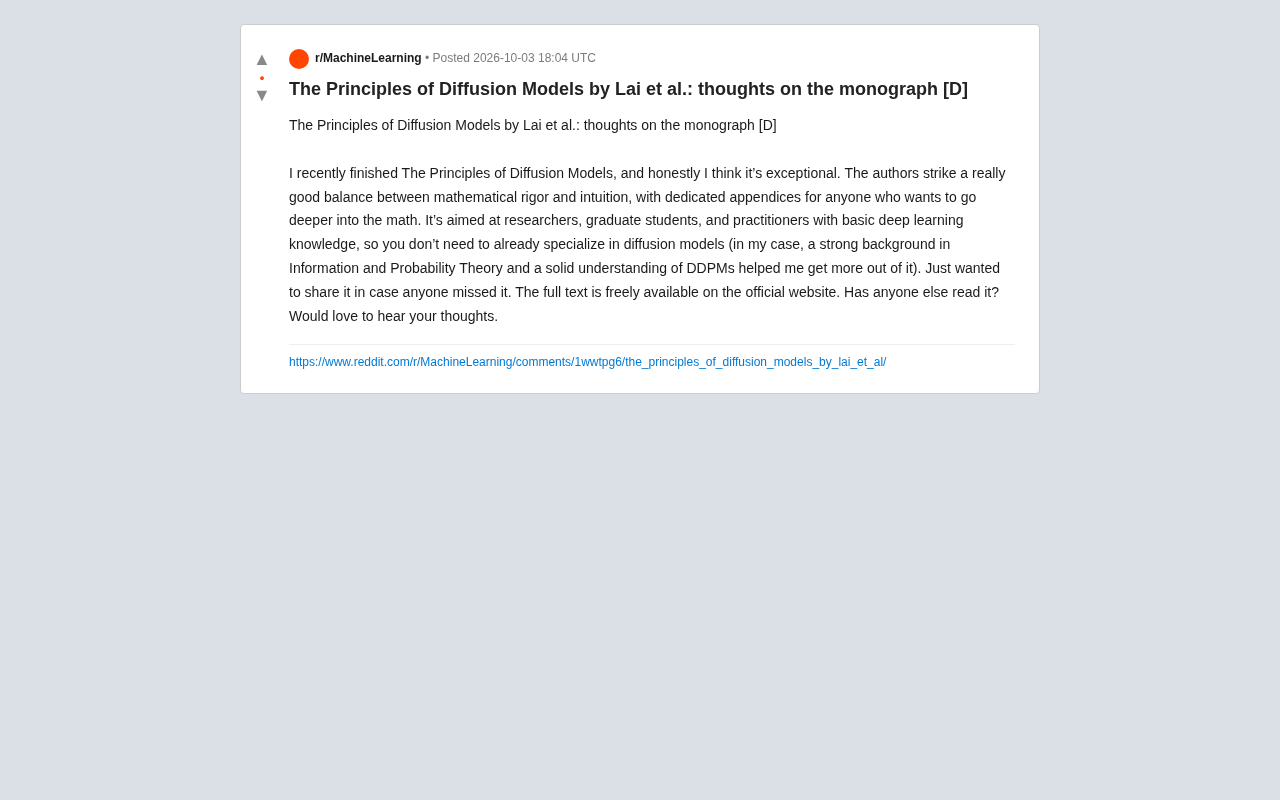
According to a Reddit user who shared the book, it strikes a remarkably good balance between mathematical rigor and intuitive understanding. Rather than sacrificing depth for accessibility, the authors include dedicated appendices that provide a more advanced mathematical path for readers who want to dig deeper. This layered design means readers with different backgrounds can each find an approach that suits them.
The book's intended audience is clearly defined: researchers, graduate students, and practitioners with a foundational background in deep learning. In other words, readers don't need to be diffusion model experts coming in — a solid grounding in basic deep learning is sufficient to benefit from this text.
Prerequisites and Background Knowledge
While the book is positioned for readers with basic deep learning knowledge, the person who shared it was candid about their actual experience: a solid background in information theory and probability, along with familiarity with DDPM (Denoising Diffusion Probabilistic Models), helps you get significantly more out of it.
This is worth noting for prospective readers. Diffusion models are fundamentally built on mathematical tools like stochastic processes and probability distribution transforms — the derivations for the forward noising process and reverse denoising process both depend heavily on probability theory. Readers who are already familiar with how classic models like DDPM work will find the learning curve much smoother when working through this systematic treatment of the principles. Conversely, those starting from scratch may need to spend more time working through the appendix material.
Background: What is DDPM? DDPM (Denoising Diffusion Probabilistic Models) is a landmark paper published by Ho et al. in 2020 that established the foundational paradigm for modern diffusion models. Its core idea involves two processes: the forward process gradually adds Gaussian noise to the original data over T steps until the data becomes pure random noise; the reverse process trains a neural network to progressively predict and remove that noise, reconstructing real samples from pure noise. DDPM's derivation relies on the variational lower bound (ELBO) and Markov chain assumptions, and involves probabilistic tools such as KL divergence and conditional Gaussian distributions. Understanding DDPM not only builds intuition for diffusion models, but is also a necessary prerequisite for understanding subsequent advances (such as DDIM and the latent diffusion models used in Stable Diffusion). Readers not yet familiar with DDPM may want to read the original paper or a companion blog post before diving into this textbook.
A Freely Available Learning Resource
One particularly reader-friendly aspect is that the full text of the book is freely available on the official website. At a time when high-quality technical books often carry steep price tags, this open-access approach significantly lowers the barrier to entry — and reflects the machine learning community's longstanding culture of knowledge sharing.
For graduate students, independent researchers, or learners on a tight budget, a free and systematic textbook is an invaluable resource. It can serve both as an in-depth follow-up after an initial introduction to the topic and as a reference manual during research work.
Background: Open Access in Machine Learning Open access has deep roots in the machine learning field. The arXiv preprint server has allowed researchers to freely access papers since the 1990s, and this ethos has extended to textbooks and monographs. High-quality texts such as Goodfellow et al.'s Deep Learning and Bishop's Pattern Recognition and Machine Learning both offer free online versions, dramatically reducing the cost of knowledge access for learners worldwide. For a fast-moving field like diffusion models, freely available books have an added advantage: authors can continuously update the content to reflect the latest developments, and readers always have access to the most current version without waiting for a new edition.
Why This Kind of Textbook Matters
Diffusion model theory is evolving rapidly, with relevant papers scattered across countless conferences and preprint platforms. Beginners often struggle to build a coherent understanding of the landscape. A structured textbook that balances rigor with intuition can integrate disparate concepts into a clear system, helping readers understand the underlying connections between different approaches — rather than accumulating fragmented knowledge from individual papers.
Community feedback has described the book as "exceptional," reflecting recognition of its success in balancing depth and readability. Of course, any single reader's evaluation carries a personal perspective, and whether the book is truly the right fit still depends on your own mathematical and deep learning background.
Summary
If you're looking for a systematic resource for learning the principles of diffusion models, The Principles of Diffusion Models is well worth adding to your reading list. It's well-suited for readers with a solid deep learning foundation who want both mathematical rigor and intuitive understanding, and the freely available full text makes the cost of trying it essentially zero. For those who already have a background in probability theory and DDPM, this book will very likely exceed expectations.
Related articles

Gaussian Process Bandit Optimization: Exploration Strategies and Inference Regret Guarantees
Cumulative regret guarantees in Bayesian optimization fail to reflect final recommendation quality. This article examines a new study that provides inference regret guarantees for Gaussian process bandit optimization through exploration query strategies and fill distance analysis, validated on hyperparameter optimization and control tasks.

The Most Detailed Codex Guide on Bilibili: From Installation to Real-World Practice
The most detailed Codex guide on Bilibili: from app store installation to daily work mode configuration, with a real coffee shop project demonstrating file organization, data extraction, dashboard creation, and other practical tasks. Learn to use Plan Mode and desktop pets to leverage Codex efficiently.

Appearance Compensation in Volume Rendering: Why RGB Accuracy Cannot Guarantee Density Correctness
Volume rendering research reveals that volumetric data perfectly reproducing external RGB views may still contain density errors: appearance compensation can double central density and keep external rays unchanged even when L2 error exceeds 14.52%. Density recovery depends on appearance capacity, spatial resolution, and measurement design.