Bose Returns to Wired Earbuds for the First Time in 11 Years, Betting on Noise Cancellation and No-Charge Convenience

Bose launches its first wired noise-cancelling earbuds in 11 years, targeting users tired of charging.
Bose has officially unveiled the Bose Noise Cancelling Wired Earbuds, its first wired earbuds in 11 years, breaking from its TWS-focused strategy since 2015. The product zeros in on two core selling points: active noise cancellation and zero charging hassle. Smart features like wear detection and touch gestures were deliberately cut to keep the focus on what matters most — great sound, stable connection, and reliable ANC — making it a clean, no-frills option for pragmatic users. In a market racing toward wireless, Bose is carving out a niche around simplicity and dependability.
Bose Steps Back into Wired Territory
Bose has officially announced its first wired earbuds in 11 years, with a name that says exactly what it is: the Bose Noise Cancelling Wired Earbuds. After discontinuing wired models in 2015 and going all-in on true wireless (TWS) products, the audio brand is now swimming against the current — returning to a wired design at a time when virtually the entire industry has pivoted to wireless.
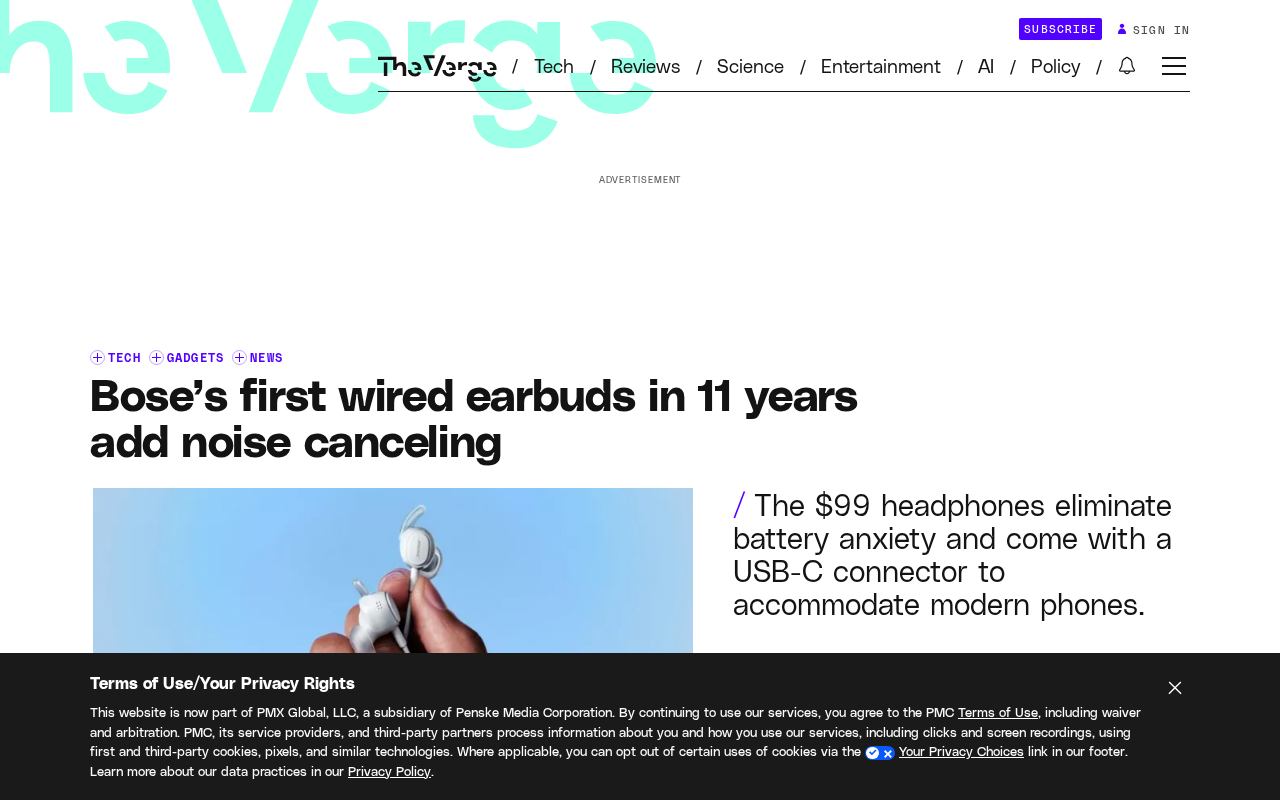
The name alone tells you everything about Bose's pitch: noise cancellation and a wired connection. That straightforward positioning is actually a direct response to two persistent pain points that wireless earbuds have never fully solved.
The Real Problem Wired Design Solves
Despite years of TWS dominance, battery anxiety has never gone away. Users have to remember to charge their earbuds every few days, check whether the case has enough juice before heading out, and hope nothing dies at the worst possible moment. Bose's wired earbuds sidestep all of that entirely — plug in and go, no charging schedule to manage, no risk of running out of power mid-commute.
For pragmatic users, that kind of always-on reliability can be more appealing than the convenience of going wireless. Especially during long work sessions, daily commutes, or any scenario demanding a stable connection, a wired solution eliminates the triple hassle of pairing, dropouts, and charging.
Features: ANC Stays, Smart Extras Are Cut
It's worth noting that going wired doesn't mean going feature-complete. According to official information, the functionality is limited. The earbuds retain Bose's signature active noise cancellation, but shed the smarter, more interactive features — things like sensor-based controls and advanced gesture support — that have become standard on premium TWS products.
This is actually a coherent product philosophy. Wired earbuds, by their nature and cost positioning, can't easily support complex features that depend on dedicated chips and battery power. Bose has chosen to concentrate its resources on what the brand does best — noise cancellation — rather than piling on flashy extras. The "less is more" approach makes the product's target audience crystal clear: users who simply want great sound, a stable connection, and excellent noise cancellation.
Active Noise Cancellation (ANC) works by using built-in microphones to continuously sample ambient noise, then generating an "anti-noise" signal with the inverse phase in real time. When these two signals combine, they cancel each other out at the physical level. Because this process fundamentally relies on microphone sampling and signal-processing chips — not Bluetooth or any wireless protocol — wired earbuds can draw power directly from a device via a 3.5mm jack to run the ANC module, with no need for a large onboard battery. That's the technical foundation that allows Bose to deliver flagship-level noise cancellation in a wired form factor. By contrast, the "smart features" that were cut — wear detection, touch gestures, head-tracking, and similar capabilities — typically require dedicated sensor chips and continuous power, making them costly to integrate into a wired design. Dropping them was the practical call.
The Market Logic Behind a Countercyclical Move
In an industry pushing hard toward wireless and port-free devices, launching wired earbuds might look like nostalgia. But it's better understood as a precise answer to an underserved niche. As mainstream brands keep doubling down on TWS features, a gap has quietly opened up for products that are simple, reliable, and low-maintenance.
The case for wired earbuds remains solid: zero latency, no charging, stable connectivity, and generally friendlier pricing. For gamers, audio creators, and everyday users who are simply tired of managing battery life, those qualities matter. Bose, as a veteran noise-cancellation brand, is repackaging its core technology in a wired format — both as a nod to a classic product line and as a bid for differentiation in an increasingly homogenized wireless market.
TWS earbuds exploded into the mainstream around 2016, largely driven by the popularity of Apple AirPods. Their defining characteristic — fully independent left and right earbuds connected via low-power Bluetooth (BLE) — triggered a sweeping shift toward wireless across the consumer audio market and redirected most R&D investment in the same direction. But TWS is inherently constrained by battery size. Even flagship models typically offer just 6–8 hours of single-charge playback, with the charging case extending total life to around 20–30 hours. For users who need more than 8 continuous hours a day — combining commuting and a full workday — or for office workers who prefer to keep earbuds on a desk and plug in on demand, the plug-and-play reliability of a wired solution still offers something wireless simply can't match.
Final Thoughts
Bose's "retro" comeback is, at its core, a fresh look at how people actually use their earbuds. When wireless became the default, wired became a deliberate choice. Whether the Bose Noise Cancelling Wired Earbuds can win over the market will ultimately come down to sound quality, noise cancellation performance, and price. But the product philosophy itself already makes a compelling statement: not everyone needs wireless, and stability and simplicity are a form of competitive advantage.
Related articles

uGAP: An AI Platform Unifying 100+ African Geospatial Datasets
uGAP is an African geospatial AI platform by a University of Cape Town team, unifying 120+ African datasets with a Python SDK for discovery, processing, and model training, already used in cyclone flood mapping.

Cursor Can Now Control Your Computer: AI Agents Can Drive Desktop Apps for Testing
Cursor adds desktop control: AI agents can drive desktop apps like the iOS Simulator to test their own features. We analyze the impact on dev workflows, possible technical approaches, and reliability concerns.

Vibecoding a Custom Inference Engine: High Hopes, Harsh Reality
A Reddit developer shares the real experience of vibecoding a custom inference engine: running GGUF Q4 models in the browser with WebGL2 and GLSL, only to fall into tokenizer debugging hell. This article analyzes the engineering challenges of browser-side LLM inference and why cloning llama.cpp is the more rational choice.